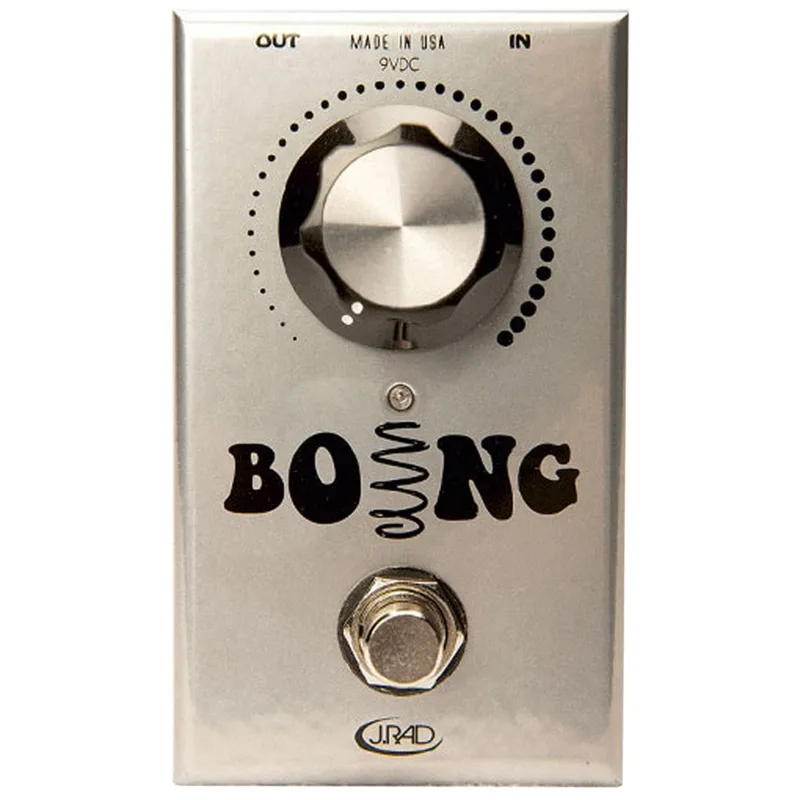


The J. Rockett BOING is a compact spring reverb pedal from J. Rockett Audio Designs, the Nashville-based effects maker. Rockett describes it as "a simple one knob recreation of the classic Deluxe Reverb," meaning it aims to sound like the built-in spring reverb of a Fender Deluxe Reverb amp rather than a studio reverb12. It was the second release in the company's Tour Series line, designed with the advice of touring artists in Nashville and Los Angeles to address the needs players encounter on the road3.
The design goal, as Guitar.com's reviewer Huw Price put it, was "to give a non-reverb amp some atmosphere in a simplistic way that is easily controllable with one's foot"4. That single-minded brief explains the whole pedal: one knob, one footswitch, nothing else.
A one-knob take on the Deluxe Reverb
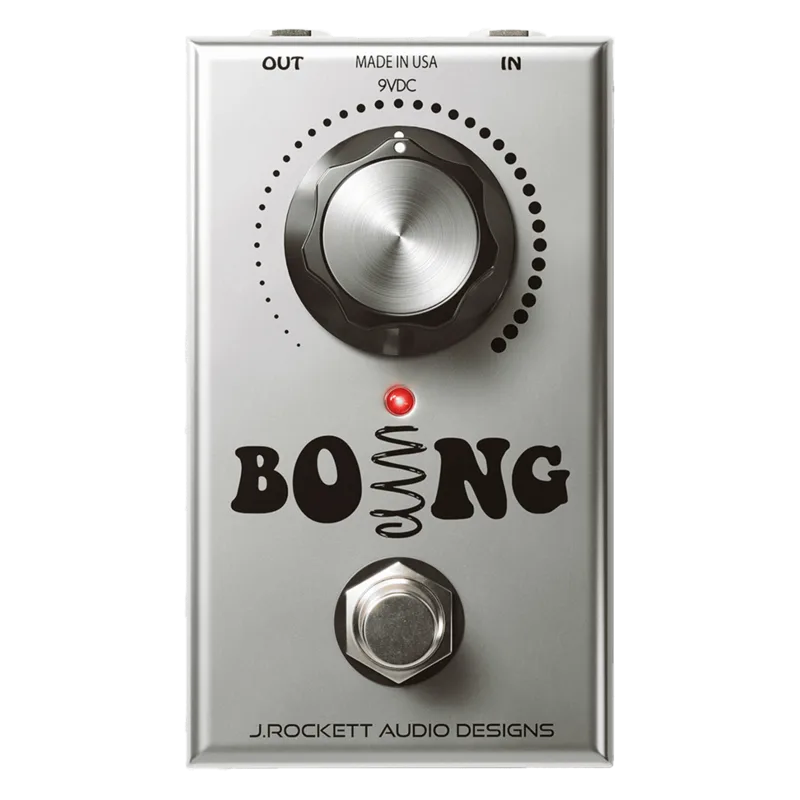
Most reverb pedals offer a panel of controls for dwell, tone, and mix. The Boing takes the opposite approach, copying the classic amp instead. Like many of the classic amps, it is just a single knob reverb for either more or less reverb26. Delicious Audio's launch coverage put it plainly: the pedal "features ONE footswitch (On/Off) and ONE knob (Mix), there's no way you can lose your way home in there"3.
The knob is deliberately oversized so the reverb level can be adjusted with a foot while playing, which is the point of the whole design4. Premier Guitar's launch announcement described the aim as recreating amp reverb and not studio reverb, in contrast to most reverb pedals5.
| Control | What it does |
|---|---|
| Reverb level knob (oversized) | Sets more or less reverb, foot-controllable42 |
| Footswitch | On/Off, true bypass34 |
There is no tone control, no dwell control, and no mode switch. The tone shaping lives in the circuit itself, not on the surface.
How it works: a PT2399 chip with an analog treble circuit
The Boing's circuit is based around the PT2399 digital chip, with an analog treble circuit added for spring-style splash and bounce, along with early reflections4. That makes it a hybrid rather than a pure analog or pure digital design, and Rockett lists it as an analog/digital hybrid with a 60mA current draw2. RockBoard's independent listing instead categorizes the circuit as analog, so the two sources disagree on the label6.
The PT2399 itself has a long history outside guitar effects. EarthQuaker Devices' technical write-up describes it as "quite versatile and a bit of a hybrid chip originally used in karaoke machines, car stereos, and surround sound configurations in the late 90s"7. Premier Guitar has characterized it as "a digital chip often used to more affordably approximate analog-echo tones"8, and it is an echo processor at heart9. In the Boing it is pressed into service as the reverb engine, with the analog treble circuit on top supplying the spring character.
Power, bypass, and reliability
The Boing runs on a 9 volt negative tip adaptor with a 5.5mm x 2.1mm jack, center negative, drawing 60mA264. It is strictly a nine-volt pedal: Guitar.com's review warns that running it at a higher voltage voids the warranty4.
The Boing is a 9V center negative pedal only. Running it above nine volts voids the warranty4.
Bypass is true bypass switching, per Rockett's own product page2, and Guitar.com's review confirms a true bypass footswitch4. The reviewer checked the bypass behavior directly and found "There was barely any difference in tone, whether the guitar signal was passing through the Boing or not"4.
"There was barely any difference in tone, whether the guitar signal was passing through the Boing or not."
Where it came from
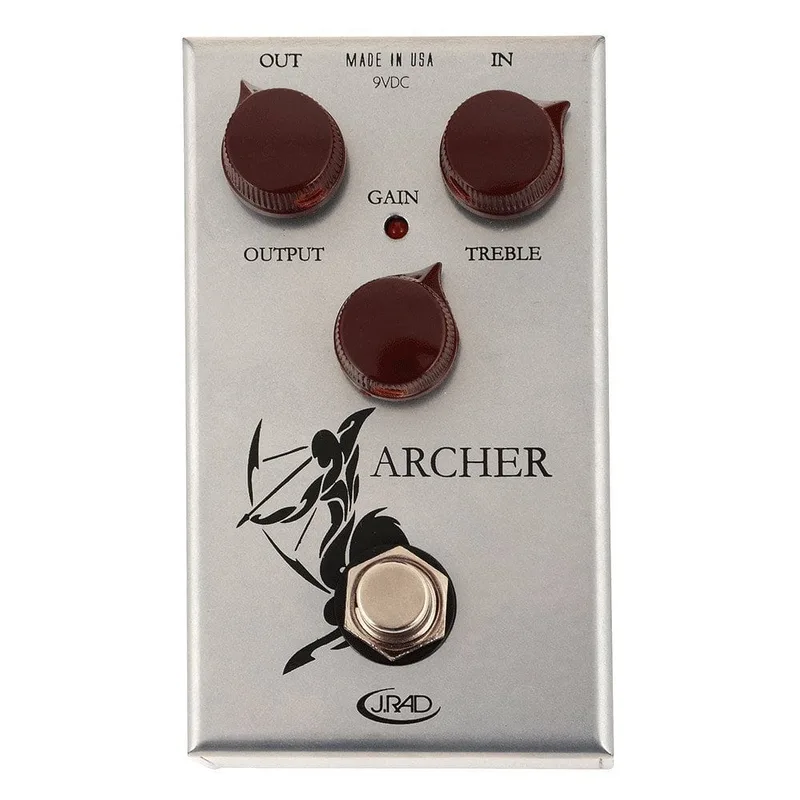
J. Rockett Audio Designs announced the Boing in May 2015 as the second pedal in its Tour Series line, after the Archer OD/Boost53. The Tour Series was designed with input from top touring artists out of Nashville and Los Angeles to address the needs players encounter on the road3. The company is based in Nashville103, and the Boing is made in the USA4.
At launch the Boing carried a $159.00 street price5, and Delicious Audio still listed it at $159 in 201811. In the UK, Guitar.com's 2015 review gave the price as £1494.
What reviewers said
Guitar.com's Huw Price reviewed the Boing in September 2015 and described it as a digital spring reverb emulator styled after the spring reverbs integral to the sounds of the amps the designers grew up with4. His findings on bypass transparency are quoted above4. Delicious Audio's coverage was brief and favorable: "LUVin the BOINGGGGGG......................nice reverb."3
Related pages
- Reverb Pedals
- J. Rockett Audio Designs Boing
- J. Rockett Boing Spring Reverb
- J. Rockett Audio Designs BOING Spring Reverb
- Rockett Pedals Boing Reverb
- Rockett Pedals Boing Reverb B Stock
- J. Rockett Mr. Moto Trem-Verb
Videos
ProGuitarShopDemos
J. Rockett Audio Designs
J. Rockett Audio Designs
Questions
Is the J. Rockett Boing analog or digital?
It is a hybrid. The circuit is built around the PT2399 digital chip, with an analog treble circuit added for spring-style splash and bounce along with early reflections. Rockett lists the pedal as an analog/digital hybrid, and Guitar.com's reviewer described it as a digital spring reverb emulator.
Is the Boing true bypass?
Yes. Rockett Pedals lists true bypass switching for the Boing, and Guitar.com's 2015 review confirms a true bypass footswitch. The reviewer found there was barely any difference in tone whether the guitar signal was passing through the pedal or not.
What power supply does the Rockett Boing need?
It runs on a 9 volt negative tip adaptor with a 5.5mm x 2.1mm jack, center negative, drawing 60mA. It is strictly a nine-volt pedal: Guitar.com's review notes that running it at a higher voltage voids the warranty.
Can the Boing reverb level be set with your foot?
Yes. The design goal was to give a non-reverb amp atmosphere in a way that is easily controllable with the foot, and the pedal uses an oversized reverb level knob that makes this practical. The single knob sets more or less reverb, like the reverb control on a classic amp.
Where is the J. Rockett Boing made?
Guitar.com's 2015 review lists the Boing as made in the USA. J. Rockett Audio Designs is based in Nashville, and the Tour Series line the Boing belongs to was developed with input from touring artists in Nashville and Los Angeles.
Does the J. Rockett Boing have a tone control?
No. The Boing has a single knob for reverb level and one on/off footswitch, with no separate tone control. Its tone shaping is fixed in the circuit, where an analog treble circuit is added for spring-style splash and bounce.
Sources (11)
- Boing - Classic Deluxe Spring Reverb Guitar Pedal, Rockett Pedals, 2026-04-01
- Boing - Classic Deluxe Spring Reverb Guitar Pedal, Rockett Pedals, 2026-03-17
- J. Rockett Boing Spring Reverb, Delicious Audio, 2015-05-29
- J Rockett Audio Designs Boing Reverb review, Guitar.com, 2015-09-04
- J. Rockett Launches New Boing Spring Reverb Pedal, Premier Guitar, 2015-05-28
- Boing by J. Rockett Audio Designs, RockBoard (www.rockboard.de), 2026
- Reverbology, EarthQuaker Devices, 2021-11-09
- Quick Hit: Vick Audio Hypocenter Delay Review, Premier Guitar, 2016-12-25
- Friday Club ED-450b Echo Machine, Pedal of the Day, 2020-01-21
- J. Rockett Uni-Verb, Delicious Audio, 2022-10-31
- J. Rockett Audio Designs Boing, Delicious Audio, 2018-03-04