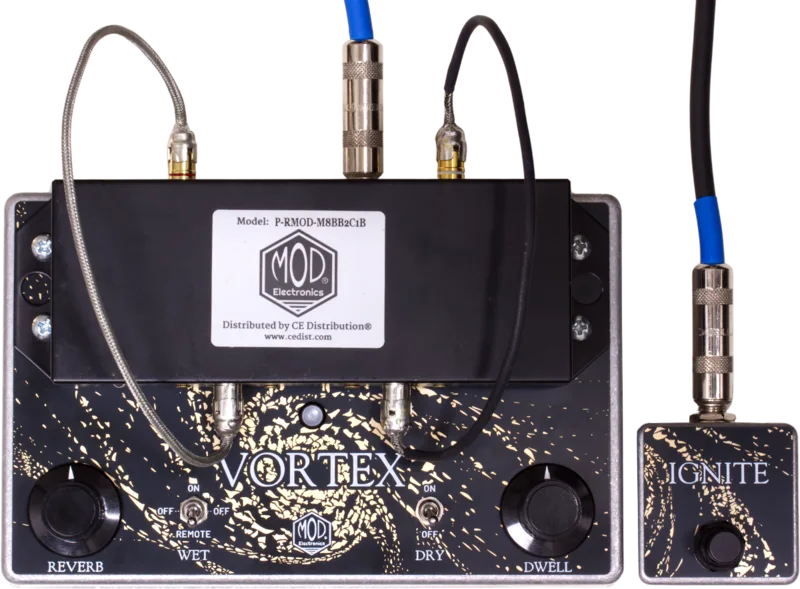
The Mod Electronics Vortex is a compact, pedalboard-friendly spring reverb kit: a real spring reverb, in pedal form, that you build yourself1. It is the fourth entry in the Nexus Series from Mod Electronics, and it comes with one MN-8BB2C1B reverb tank that can be mounted directly on the enclosure, so the springs are part of the unit rather than hidden in an amp1.
For a player used to digital reverb pedals, the Vortex offers the mechanical character of an actual spring tank, with the controls and connections of a stompbox. Mod Electronics provides sound samples on the product page covering Light Reverb, Medium Reverb, Heavy Reverb, Bent Chords and Staccato Lead, so you can hear the range before committing to the build1.
The controls
The control set is deliberately vintage. The Vortex has a REVERB (amount) and DWELL control like many vintage spring reverb units1. REVERB sets how much of the spring effect is mixed into your sound, while DWELL governs how long the springs ring out, the same pairing players know from old amp- and outboard-style spring units.
Two toggle switches shape how the pedal sits in a signal chain1:
| Control | What it does |
|---|---|
| REVERB | Sets the amount of reverb1 |
| DWELL | Sets how long the springs sustain, as on vintage spring reverb units1 |
| WET toggle | Enables or disables the reverb effect on the main unit1 |
| DRY toggle | Disables the dry signal for use as an auxiliary effect or for extreme spacey sounds1 |
The WET switch is the on/off for the effect itself: the reverb can be enabled or disabled via the WET toggle switch on the main unit1.
The DRY switch is the more unusual of the two. It allows the dry signal to be disabled, which the maker describes as useful for running the Vortex as an auxiliary effect, or for extreme spacey sounds1. With the dry signal off, only the output of the springs is heard, which opens up sounds beyond ordinary reverb mixing.
Power and the reverb tank
The Vortex runs on 9VDC and can be powered by a standard 9V pedal supply1. It can also be daisy-chained with other 9VDC effect units1, so it does not need an isolated output on a power supply and can share a daisy-chain cable with the rest of a board.
The Vortex is a kit, not a finished pedal. Mod Electronics rates it at build difficulty 3, and the included MN-8BB2C1B reverb tank mounts directly on the enclosure1.
The included tank is the MN-8BB2C1B, mounted on the enclosure itself1. If you want a different spring character, the maker states the Vortex can also be used with larger reverb tanks such as the 4BB3C1D or 9BB2C1B1. Swapping to a larger tank is a way to change the size and feel of the spring sound, at the cost of a bigger physical unit than the pedalboard-friendly stock arrangement.
Part of the Nexus Series
The Vortex is the fourth entry in the Nexus Series from Mod Electronics1. Within that series it fills the reverb slot: a compact spring reverb kit that pairs the Nexus Series' shared power standard, 9VDC with daisy-chain support, with a genuine spring tank1.
The instruction manual is available from the maker as a PDF, covering the build and setup of the kit1.
Questions
What power supply does the Mod Electronics Vortex need?
The Vortex runs on 9VDC and can be powered by a standard 9V pedal supply, the same kind most pedalboards already use. Because it can be daisy-chained with other 9VDC effect units, it fits on a shared power supply with the rest of a board rather than needing its own dedicated supply.
How hard is the Vortex kit to build?
Mod Electronics rates the Vortex at build difficulty 3 on its product page. It is a kit rather than a finished pedal, so it involves assembling the circuit and mounting the included reverb tank on the enclosure. The instruction manual is available as a PDF from the maker's site.
Can the Vortex use a larger reverb tank?
Yes. The Vortex ships with one MN-8BB2C1B reverb tank mounted directly on the enclosure, but the maker states it can also be used with larger reverb tanks such as the 4BB3C1D or 9BB2C1B. A larger tank changes the spring character and physical footprint of the unit.
What does the DRY switch do on the Vortex?
The DRY toggle switch lets you disable the dry signal entirely. With the dry signal off, the Vortex outputs reverb only, which the maker describes as useful for running it as an auxiliary effect or for extreme, spacey sounds.
Can the Vortex be daisy-chained with other pedals?
Yes. Mod Electronics states the Vortex can be daisy-chained with other 9VDC effect units, so it can share a single 9V power supply with the rest of a pedalboard instead of requiring an isolated or dedicated output.
Where can I find the Vortex instruction manual?
The Vortex instruction manual is published as a PDF on the Mod Electronics site at modelectronics.com, under the file k-993_vortex_instructions_v1.0.pdf. It is linked from the Vortex product page at modkitsdiy.com.
Sources (1)
- Vortex | Mod Electronics, Mod Electronics (modkitsdiy.com), 2026