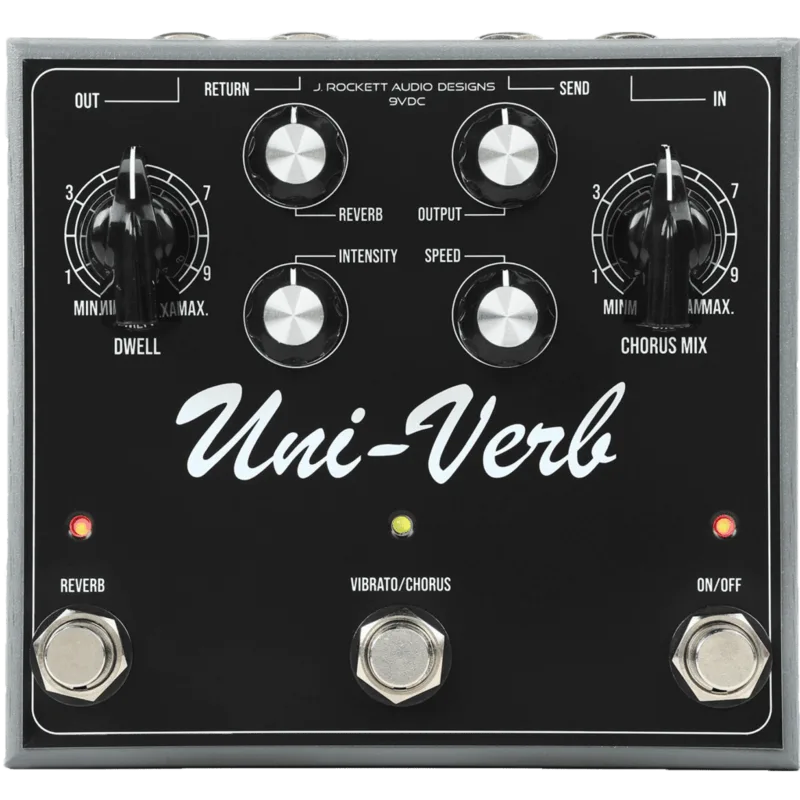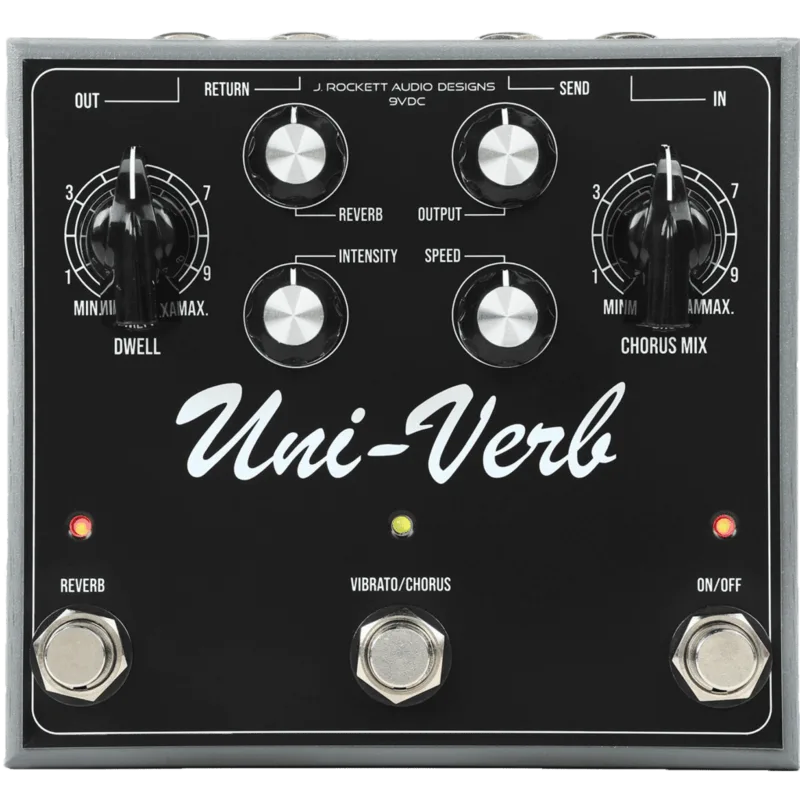


The J. Rockett Audio Designs Uni-Verb is a Uni-Vibe pedal with a spring reverb built into the same enclosure. The vibe side is a photocell analog circuit based on the original 1960s Uni-Vibe, and the reverb side emulates a classic spring tank, with the two effects usable together or independently1. It was announced in July 2022 as the second pedal in J. Rockett's Classic Series, after five years of development, at a list price of $44923. MusicRadar's launch coverage gave a higher launch figure of $5292.
A Uni-Vibe and spring reverb in one enclosure
J. Rockett describes the Uni-Verb as a "painstakingly accurate photocell analog vibe" based on the original Uni-Vibe pedal, with a spring reverb added1. Inside, the vibe circuit follows the vintage design: Guitar.com's reviewer found "that distinctive arrangement of four LDRs huddled around a bulb like cowboys gazing into a campfire," the light-dependent-resistor arrangement that gives the original its characteristic swirl6. The reverb side is digital, generated through an Accutronics Digi-Log module rather than a physical spring tank3.
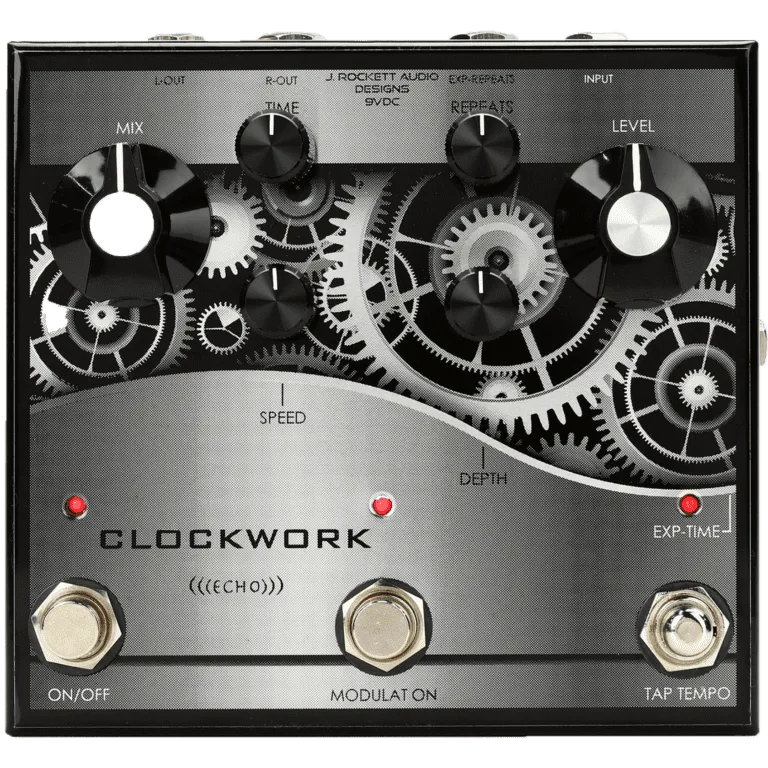
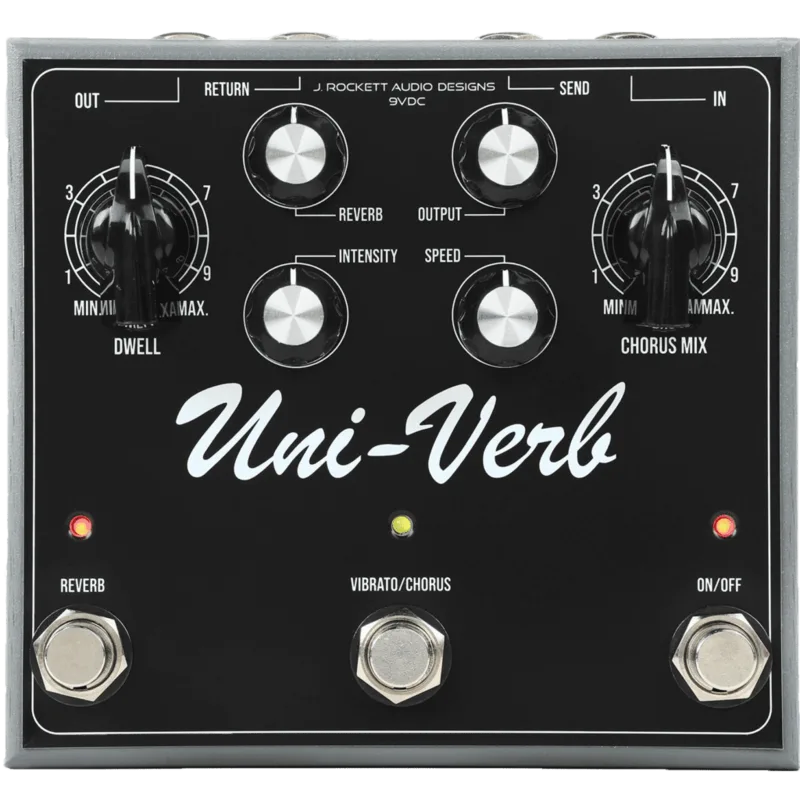
The pedal offers the original's two modulation modes. Vibrato is a fully wet signal, while Chorus blends dry and wet signal, as on the vintage unit7. The enclosure is styled as an homage to the original Shin-ei Uni-Vibe, with a gray steel casing, black control panel, chicken head knobs and "clock" position markers63. Guitar.com notes the format matches J. Rockett's Clockwork Echo: a wide enclosure with three footswitches, four small knobs in the middle and two larger ones near the edges, with all the jacks along the top6.
The controls and footswitches
There are three footswitches: one engages the reverb, one toggles between Vibrato and Chorus, and one is the bypass for the modulation7. The original Uni-Vibe selected its two modes with a rocker switch; here that selection is footswitchable, so you can change modes mid-performance58.
| Control | What it does |
|---|---|
| Speed | Sets the modulation rate |
| Intensity | Sets the depth of the vibe effect |
| Chorus Mix | Blends dry and wet signal; affects the chorus mode only, not the vibe5 |
| Output | Sets the overall output level of the pedal4 |
| Dwell | Sets the length of the reverb tail7 |
| Reverb | Sets the reverb level9 |
There is also an internal trimpot for adjusting the vibe's tone6. One limitation worth knowing: there is no expression pedal option for the rate, which Premier Guitar's reviewer found makes the pedal "a little less" flexible in function than it might otherwise be3.
Using the vibe and reverb separately
A send and return loop sits between the Uni-Vibe side and the reverb, so the two effects can be used as individual pedals, placed at different points in a pedalboard chain, or run together7. The loop also lets you put drives, fuzzes or other effects between the vibe and the reverb, which is a common arrangement for players who want fuzz into a Uni-Vibe10. As Premier Guitar's demo put it, you can use the two effects individually or simultaneously8.
History: a five-year project
The Uni-Verb was a five-year project for J. Rockett. Chris Van Tassel, the project lead, described the goal: "This was a five year project to create the most authentic Univibe pedal we could while adding modern features players would want"11. Delicious Audio reports it took the Rockett engineers those five years to perfect the circuit and make it sound like the Shin-Ei/Univox original, while making the vibe section more musical and useable than the vintage unit5.
The pedal runs internally at 24 volts, like the original vintage effect, but accepts a modern 9V supply: a charge pump inside the pedal bumps the standard 9V feed (negative tip) up to 24V512. There is no battery option; it is powered by a 9-volt supply only6.
The Uni-Verb takes a standard 9V DC power supply with a negative tip, but it converts that to 24V internally. It cannot run on a battery, and the power supply is not included with the pedal57.
What reviewers said
Reviews were positive about the core modulation sound. MusicRadar's verdict: "It gets the classic Uni-Vibe tones right"4. Guitar World's Trevor Curwen went further:
"As a Uni-Vibe clone this is the real deal, and if you want that particular form of modulation in all of its gloopy glory then you'll find it here in extended form7."
The Guitar World review found the Uni-Verb convincing as a Uni-Vibe-style pedal, concluding that "As a Uni-Vibe clone this is the real deal, and if you want that particular form of modulation in all of its gloopy glory" then you'll find it here in extended form7. The same review noted that the Vibrato mode is a fully wet signal, while Chorus incorporates a blend of dry and wet7.
Premier Guitar's reviewer found the reverb, generated via the Accutronics Digi-Log module, "immersive, engaging and fun," while noting the missing expression pedal option as a functional drawback3. Delicious Audio's Paolo De Gregorio observed that the Uni-Verb takes the modulation-plus-reverb combo idea in a more classic direction than the ambient and psychedelic-targeting combos that came before it5.
Videos
Premier Guitar
Sweetwater
J. Rockett Audio Designs
Questions
Is the J Rockett Uni-Verb analog?
Partly. The modulation section is an analog photocell circuit with four light-dependent resistors arranged around a bulb, like the original Uni-Vibe. The reverb side is digital, generated through an Accutronics Digi-Log module that emulates a spring tank.
Does the Uni-Verb take an expression pedal?
No. Premier Guitar's reviewer noted there is no expression pedal option for the rate, which makes the pedal a little less flexible than some Uni-Vibe clones on that point. Speed is set with the knob on the face of the pedal.
Does the Uni-Verb run on batteries?
No. It is powered by a 9-volt DC power supply only, with no battery option. It runs off a standard 9V feed with a negative tip, which a charge pump bumps up internally to 24 volts, matching the internal operating voltage of the vintage original.
Is the Uni-Verb true bypass?
Yes. Both MusicRadar and Guitar World list true bypass among the pedal's features, and Premier Guitar's launch coverage confirms it. When the pedal is off, your signal passes through without buffering.
What reverb module does the Uni-Verb use?
The reverb is generated via an Accutronics Digi-Log module. It is a digital emulation of a spring tank rather than an actual spring, with Dwell and Reverb knobs controlling the length of the tail and the effect level.
Can you use the vibe and reverb separately?
Yes. A send and return loop sits between the Uni-Vibe side and the reverb, so the two effects work as individual pedals, at different points in your chain, or together. You can also place drives or fuzzes between them via the loop.
Sources (12)
- Archer Ikon, Rockett Pedals, 2026-03-31
- The new J-Rockett Uni-Verb pedal combines Uni-Vibe with vintage spring reverb, MusicRadar, 2022-07-22
- Love the Uni-Vibe? Try J Rockett’s Uni-Verb., Premier Guitar, 2022-10-13
- J Rockett Audio Designs Uni-Verb review, musicradar.com, 2022-11-30
- J. Rockett Uni-Verb, Delicious Audio, 2022-10-31
- J Rockett Uni-Verb review: A vintage-style vibe with added ambience, Guitar.com, 2022-09-13
- J Rockett Uni-Verb review, Guitar World, 2022-11-01
- J. Rockett Uni-Verb Demo, Premier Guitar, 2022-08-23
- The 9 Best Uni-Vibe Pedals In 2024: A Guide To UniVibe Clones, Delicious Audio (delicious-audio.com), 2024-02-16
- J. Rockett Audio Designs Uni-Verb Chorus Vibrato Reverb, Pedal of the Day, 2022-07-18
- J. Rockett Audio Designs Unveils the Uni-Verb, Premier Guitar, 2022-07-19
- J. Rockett Audio Uni-Verb: Classic Univibe + Reverb, gearnews.com, 2022-07-18