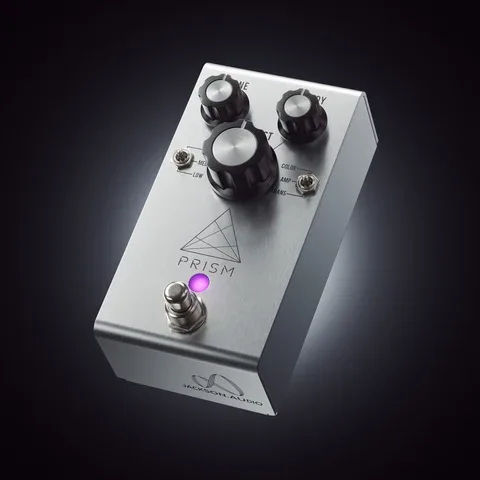


The Jackson Audio PRISM is a boost, buffer, preamp, EQ and overdrive all in one compact stainless steel enclosure1. It was the first pedal from Jackson Audio, the pedal offshoot of Jackson Ampworks, and it was conceived between Brad and Nigel as a tool players could use to unify their rigs regardless of the guitars and amplifiers they play1. The idea is one box at the front of your board that can lift your level, shape your tone with an active EQ, and add anything from a clean volume jump to treble-booster-style breakup.
The pedal is housed in a custom designed stainless steel enclosure with laser engraved artwork, measuring 2.5" x 4.875"1. It launched at $2602, and Jackson Audio's product page lists it at £2273.
What it does: buffer, boost, preamp and EQ in one
The PRISM packs several jobs into one box. It is a boost pedal with three selectable circuits, an active two-band EQ with up to 15dB of boost or cut on each band, a preamp, and a buffer at the end of the signal path13. Each boost circuit is completely discrete and placed in its own true-bypass loop, which Jackson Audio says allows every voice to retain its individual character3.
At the very end of the PRISM there is a high current buffer, which the maker describes as being there "to strengthen your signal and preserve your" tone regardless of pedalboard complexity or cable run length1. Because the buffer sits after the true-bypass switching, your signal is driven even when the pedal is off, which matters on large boards with long cable runs.
Jackson Audio recommends placing the Prism at the beginning of your signal chain, where its active EQ has the clearest access to your guitar and the Color treble-booster circuit can respond naturally to your pickups and volume control3.
Three boost voices: Color, Amp and Trans
A three-position Circuit Select switch chooses between the pedal's three boost circuits3:
| Voice | Circuit | Character |
|---|---|---|
| Color | Vintage silicon treble booster | Focused attack, harmonic energy, cleans up dramatically from your guitar's volume knob3 |
| Amp | MOSFET boost | Designed to respond like the front end of an overdriven vacuum-tube amplifier3 |
| Trans | 18V-powered JFET boost | Preserves core tone while delivering more output, clarity and headroom3 |
Pedal of the Day's 2017 review described the three voices in player terms: Color "features a vintage silicon treble booster style circuit (think Brian May) for rhythm and lead tones," Amp "is a musical-sounding MOSFET boost," and Trans "is an ultra-transparent JFET boost, for louder yet crystal clean tonal shaping"5.
The controls
The control panel is deliberately simple, with a Pre Gain switch doing much of the tonal work3:
| Control | What it does |
|---|---|
| Boost | Sets overall output level; works with the Pre Gain switch to balance clean volume against circuit gain3 |
| Tone | Adjusts high frequencies with a +/-15dB boost/cut1 |
| Body | Adds or removes up to 15dB of low-frequency content3 |
| Circuit Select | Chooses Color, Amp or Trans3 |
| Pre Gain | Low, Medium or High gain setting for the selected circuit3 |
| Footswitch | Controls relay bypass; hold five seconds for programming mode3 |
The Pre Gain switch sets how hard the selected circuit is driven. Low gives an open, clean response with the greatest available dynamic range; Medium is a balanced setting for mild breakup and responsive rhythm tones; High adds more gain and harmonic intensity for heavier breakup and lead tones3. Pedal of the Day summed up the three positions as clean headroom on Low, "more mild breakup and rhythm-types of tone" on Med, and "heavy breakup and scorching lead tones" on High5.
A useful detail for EQ users: the manual states the pedal has "ZERO interaction between the BODY and TONE controls"1, so the two bands can be set independently without one dragging the other.
The soft-touch footswitch controls the relay bypass, and holding it for five seconds enters a programming mode where you can adjust the indicator brightness and choose whether the pedal powers up on or off3.
Power: 9V, 100mA, with an internal 18V charge pump
The PRISM requires a 9V DC power supply, center negative, with a minimum of 100mA1. Internally it runs an 18V charge pump3, which is what gives the Trans voice its extra output and headroom.
Feed the Prism 9V only. Jackson Audio says feeding it 18V "will not increase headroom or improve its sound and may shorten the internal" regulator's lifespan3. The 18V rail is generated inside the pedal.
Versions and finish options
The Prism has been offered in several finishes: Stainless Steel, Anodized Black, Galaxy Edition, Anodized Blue, an Anniversary LTD of 250 units, and Rose Gold3. Orders placed on the maker's page were expected to ship within 3 to 4 weeks3.
What reviewers said
Guitar.com reviewed the Prism in 2018 as part of its best premium pedals coverage, calling it "an impressive debut from a new company that lives up to the ethos" of Jackson Ampworks6. Pedal of the Day's earlier review walked through all three voices and the Pre Gain settings in detail, framing the pedal as a five-in-one buffer, boost, EQ, overdrive and preamp5.
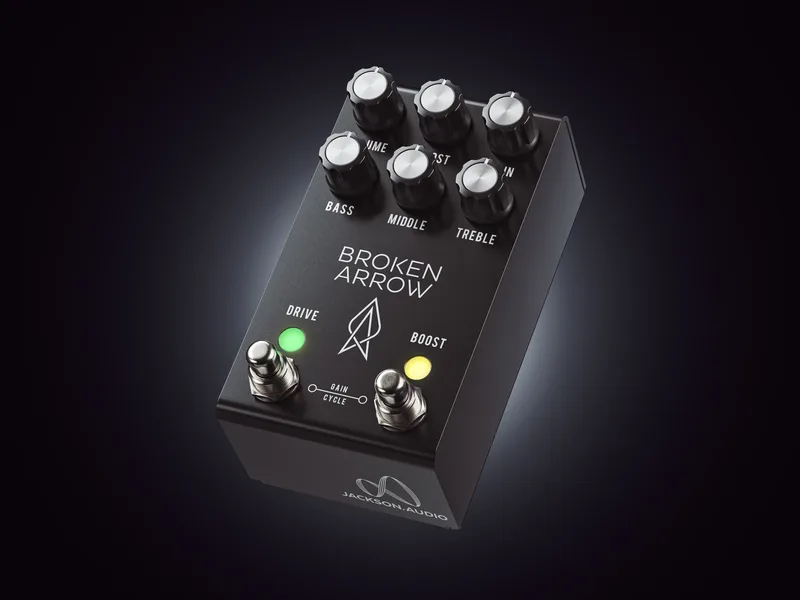
Writing at Guitar Pedal X in 2024, Stefan Karlsson looked back at the Prism while searching for a preamp/boost replacement and concluded that "no other Preamp / Boost delivered the same magic as the Prism"7. The Prism later became the first of a trilogy of footswitch-controlled Jackson Audio pedals, completed in 2019 by the Broken Arrow V2 MIDI programmable overdrive2.
Videos
Premier Guitar
Jackson Audio
Jackson Audio
Questions
Is the Jackson Audio Prism true bypass?
Yes. The Prism is a true bypass pedal using Jackson Audio's own silent switching circuitry, with relays driven by a soft touch momentary contact footswitch. Each boost circuit sits in its own true-bypass loop, so every voice stays independent when not selected.
Where should the Prism go on my pedalboard?
Jackson Audio recommends placing the Prism at the beginning of your signal chain. That position gives its active EQ the clearest access to your guitar and lets the Color treble-booster circuit respond naturally to your pickups and volume control.
Does the Prism have a buffer?
Yes. At the very end of the Prism's signal path there is a high current buffer, which Jackson Audio says strengthens your signal and preserves your tone regardless of how complex your pedalboard is or how long your cable runs are.
Who designed the Jackson Audio Prism?
The Prism was conceived between Brad and Nigel at Jackson Audio, as a tool players could use to unify their rigs regardless of the guitars and amplifiers they use. It was the company's first pedal, following its amplifier work under Jackson Ampworks.
Sources (7)
- PRISM User Manual, Jackson Audio
- Guitar Pedal X, Guitar Pedal X, 2019-05-06
- PRISM - Jackson Audio, Jackson Audio
- Jackson Audio Prism Preamp / Boost, Delicious Audio, 2019-04-24
- Jackson Audio PRISM Boost Overdrive, Pedal of the Day, 2017-10-03
- Gear of the Year 2018: Best premium pedals, Guitar.com, 2018-12-12
- Guitar Pedal X, Guitar Pedal X, 2024-04-22