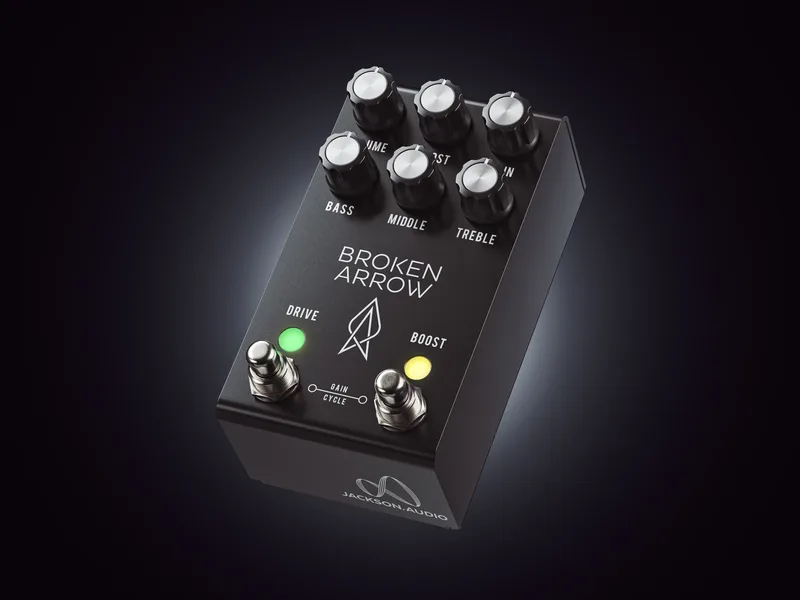


The Jackson Audio Broken Arrow V2 MIDI is an overdrive pedal with an independent boost built in and full MIDI control. Jackson Audio describes it as a flexible overdrive platform combining four clipping voices, four boost presets, Gain Cycle, and a studio-grade active EQ1. Under the hood it is a soft-clipping circuit, but one Jackson Audio says is built without a permanently imposed mid hump: with the EQ controls centered, the response is relatively flat1.
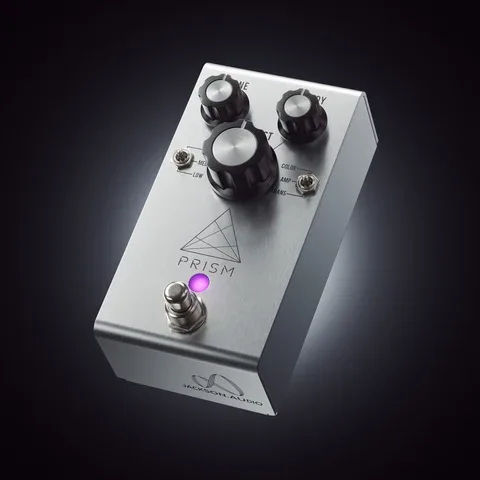
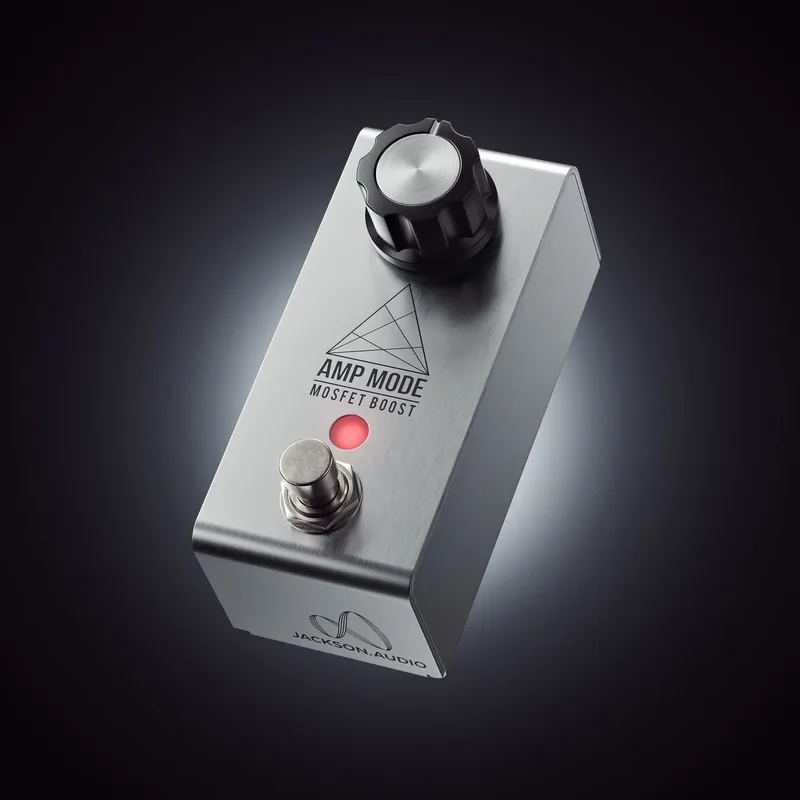
The boost is a MOSFET design that the manual says is much like the AMP MODE found in Jackson Audio's PRISM Preamp pedal2. It lives in its own true-bypass loop, so it can push the drive circuit, another pedal, or the front of your amp1. MIDI arrived in 2020 as version 2 of the Broken Arrow, which Jackson Audio added in response to player requests2.
The controls
The face of the pedal carries six knobs and two footswitches. The knobs cover Volume, the master output for the overdrive circuit; Boost, which sets the output of the independent boost; Gain, which sets the maximum value used by Gain Cycle; and active Bass, Middle, and Treble controls. Pressing both footswitches together activates Gain Cycle1.
| Control | What it does |
|---|---|
| Gain | Sets the maximum value used by Gain Cycle1 |
| Volume | Master output for the overdrive circuit1 |
| Bass | Active low-frequency boost or cut1 |
| Middle | Active boost or cut centered around 660Hz1 |
| Treble | Active high-frequency boost or cut1 |
| Boost | Sets the output of the independent boost1 |
The EQ is a Baxandall-style active EQ that Jackson Audio calls guitar-focused, providing wide control while remaining flat at noon1. The manual describes it as a studio-grade EQ with high bandwidth and flat response at the 12:00 position, with ±12dB of boost or cut on either side of center2.
Four clipping voices and four boost presets
The overdrive side offers four clipping voices, each built from a different diode arrangement, and each level matched so you hear the actual difference in response and character rather than a jump in volume1.
| Preset | Clipping voice |
|---|---|
| Green (01) | Two symmetrical silicon diodes: familiar compression and classic soft-clipping drive1 |
| Magenta (02) | Three asymmetric silicon diodes: a more complex response suited to aggressive rhythm tones1 |
| Blue (03) | Four symmetrical silicon diodes: a focused and direct clipping response1 |
| Amber (04) | Symmetrical red LED clipping: greater headroom with a more open, less compressed feel1 |
The boost side has its own four presets, each EQ'd slightly differently3:
- Bright (01): a thinner, brighter response that can add definition to thick overdrive sounds1
- Mid (02): retains more lows than Bright mode while adding a focused midrange push1
- Tailored (03): a balanced voice designed to complement a wide variety of overdrive settings1
- Full Range (04): transparent output with no intentional tonal coloring1
An internal jumper on the boost gives you two further choices: STND, the full boost character without control noise, or ALT, slightly more maximum gain with the traditional crackle you hear when rotating the Boost control1.
Gain Cycle: four gain steps from one knob
Gain Cycle is the feature Jackson Audio built the pedal around. You set the Gain knob as your maximum, then press both footswitches simultaneously to cycle through four percentages of that setting1:
- 25%: edge of breakup
- 50%: defined overdrive
- 75%: heavy overdrive
- 100%: maximum saturation of the Gain knob setting1
Guitar Pedal X described it at launch as ramping the gain up in 25% step increments out of the maximum gain set on the knob when both footswitches are pressed4. In practice it turns one drive setting into four, from a low-gain edge to full saturation, without touching the knob.
MIDI control
The V2 MIDI version receives MIDI through the ring connection of a TRS connector, so a MIDI DIN-5 to TRS conversion cable is required1. The pedal ships on MIDI Channel 1; to change channels, hold the Drive footswitch while applying power, then tap Boost to increment the channel1.
| CC | Function |
|---|---|
| CC #1 | Drive on/off (0/127) |
| CC #2 | Boost on/off (0/127) |
| CC #3 | Clipping preset (1-4) |
| CC #4 | Gain Cycle (1-4) |
| CC #5 | Boost EQ (1-4)1 |
That means a MIDI controller can switch the drive and boost on and off, change clipping voices, step through Gain Cycle, and change boost EQ presets remotely1.
Power
The Broken Arrow V2 runs on 9V DC maximum, center negative, and requires a minimum of 150mA12. Do not power it at 18V; the manual states the voltage input is 9V MAX1. The 150mA draw is well above what a typical compact overdrive needs, so check that your power supply can deliver it on one output.
From the Broken Arrow to the V2 MIDI
Videos
Hey Worship Leader
Federico Vese
Best Smart Kitchen
Questions
Can the Broken Arrow V2 run at 18V?
No. Jackson Audio specifies 9V DC maximum for the Broken Arrow V2, and the manual states the voltage input is 9V MAX. Powering it at 18V exceeds what the pedal is rated for, so it should only be run on a 9V DC supply.
What MIDI cable does the Jackson Audio Broken Arrow need?
The Broken Arrow V2 receives MIDI through the ring connection of a TRS connector, so you need a MIDI DIN-5 to TRS conversion cable to connect it to a standard MIDI output. A regular 5-pin MIDI cable on its own will not plug into the pedal's TRS jack.
How do you change the MIDI channel on the Broken Arrow V2?
The pedal ships on MIDI Channel 1. To change it, hold the Drive footswitch while applying power, then tap the Boost footswitch to increment the channel. Release the Drive footswitch when you reach the channel you want.
Which Broken Arrow clipping mode sounds like a TS808?
The Green clipping preset, which uses two symmetrical silicon diodes, is the TS808-style voice. Guitar Pedal X described it as approximately a TS808 when the Broken Arrow launched in 2019. It provides familiar compression and classic soft-clipping drive.
What does the internal boost jumper on the Broken Arrow do?
It selects between two boost behaviors. STND gives the full boost character without control noise, while ALT gives slightly more maximum gain but with the traditional crackle you hear when rotating the Boost control, like an old-style potentiometer.
Is the Broken Arrow boost based on the Jackson Audio Prism?
Yes. The manual describes the boost circuit as a MOSFET-based boost much like the AMP MODE found in the PRISM Preamp pedal, and the product page calls it a Prism-inspired MOSFET boost living in its own true-bypass loop.
Sources (4)
- BROKEN ARROW v2, Jackson Audio
- Broken Arrow V2 MIDI User Manual, Jackson Audio
- Jackson Audio, Delicious Audio, 2019-08-21
- Guitar Pedal X, Guitar Pedal X, 2019-05-06