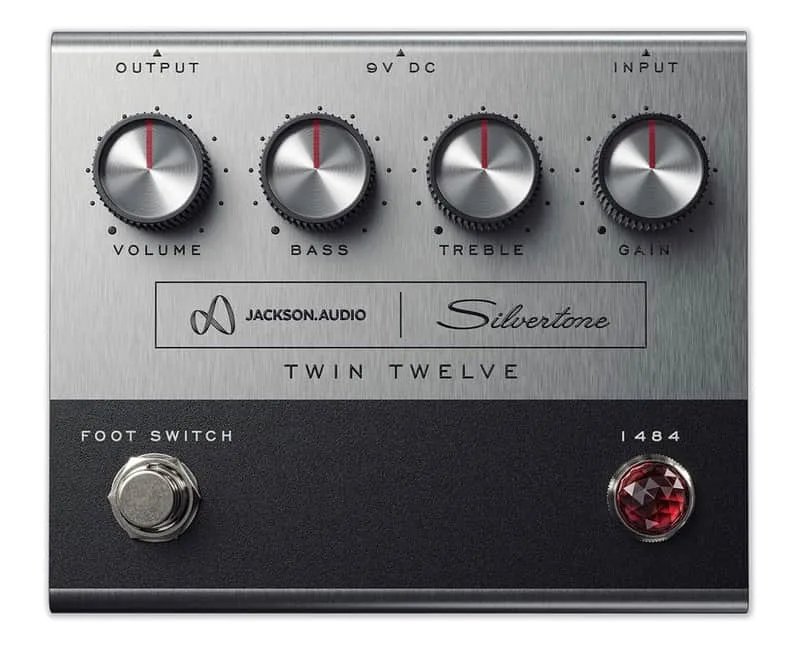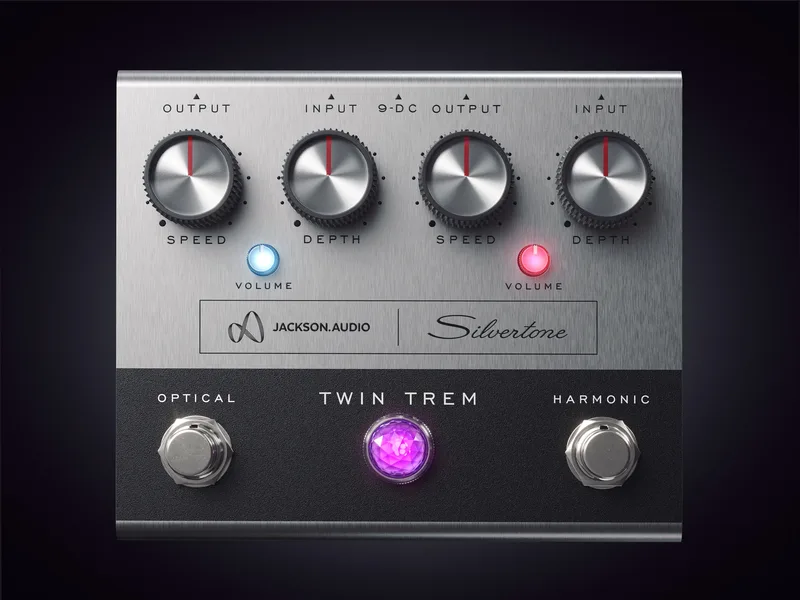


The Jackson Audio Twin Trem is a tremolo pedal with two fully analog tremolo circuits in one enclosure: a harmonic tremolo and an optical tremolo, each with its own controls, footswitch and input and output jacks12. It was designed in collaboration with Silvertone and uses the same format, enclosure and distinctive knobs as the Silvertone 1484 Twin Twelve Preamp that came before it3.
Because each circuit has its own jacks, you can run the two tremolos as one pedal, split them into different parts of your chain, or patch another effect between them, with reverb between the harmonic and optical circuits being the maker's own example1. Run together, the two circuits can produce complex rhythms and percussive textures that a single tremolo cannot1.
Two analog tremolos in one pedal
The Twin Trem puts two different tremolo designs side by side. On the left is an optical tremolo circuit; on the right is a harmonic tremolo5. Both are analog circuits, not digital recreations45.
The pedal has three modes, set by which footswitches you engage1:
- RED, Harmonic tremolo: Jackson Audio describes it as "Warm, dimensional movement that shifts between frequency bands and moves around your playing."1
- BLUE, Optical tremolo: "The deep, smooth pulse of a vintage amplifier, musical, familiar, and instantly inspiring."1
- MAGENTA, both combined: "Let both circuits collide for complex rhythms, percussive textures, and patterns that evolve beneath your playing."1
The two circuits work differently, and that difference is the point of the pedal. A classic, or optical, tremolo changes the overall volume of the guitar up and down in a smooth pulse, the kind of tremolo built into vintage amplifiers6. A harmonic tremolo, first developed in Fender "brown face" amps, works differently: it splits the signal into high and low frequency bands and volume-attenuates them out of phase from each other, so bass and treble alternately swell and dip rather than the whole signal76. The result is a swirling, dimensional movement rather than a straight volume pulse.
One practical note from Premier Guitar's review: the modulation speeds run slower than the equivalents in amplifier tremolos. At its slowest, the optical side cycles from minimum to maximum volume in just a little under a full second7.
The controls
Each tremolo has its own three-knob array: Speed, Depth and Volume427. There are two footswitches, one for each channel3.
| Control | What it does |
|---|---|
| Speed (each channel) | Sets the rate of that tremolo's modulation42 |
| Depth (each channel) | Sets how deep the modulation goes42 |
| Volume (each channel) | A smaller knob that boosts or cuts the output of that individual circuit7 |
| Footswitch (each channel) | Engages that channel's tremolo3 |
The Volume knobs are worth noting: they will boost or cut the output of each circuit independently7, so you can balance the two tremolos against each other or against your bypassed level.
Power and connections
The Twin Trem runs on 9V DC, center negative, through a 2.1 mm plug, and draws 35mA35. No power supply is included1.
The center negative polarity and 2.1 mm plug are the standard pedalboard convention, but no supply comes in the box, so you will need your own 9V DC source13.
Each circuit has its own input and output jacks, mounted on the top of the pedal35. That opens up several routing options2:
- Run the two tremolos in series inside the pedal, as a normal dual tremolo.
- Separate the two tremolos and place them in different parts of your signal chain.
- Patch another effect between them, such as a reverb between the harmonic and optical circuits1.
- Use the independent outputs for stereo configurations or split-chain routing2.
guitar.com's reviewer Eric Dahl found this routing flexibility "also less of a gimmick than it might seem," noting that the independent jacks let you fit each circuit into your chain independently5.
History: a collaboration with Silvertone
The Twin Trem was announced in November 2024 as a collaboration between Jackson Audio and Silvertone3. It followed the 1484 Twin Twelve tremolo/amp combo pedal the two makers released together, and it uses the same Twin Twelve format and enclosure, with the same distinctive knobs32. The brushed aluminum chassis is, in guitar.com's words, "pretty much the same as the Twin Twelve"35.
The Twin Twelve name goes back to the Silvertone 1484 Twin Twelve amplifier, a guitar amp head sold through the Sears catalog from 1963 to 196789. In its day it was not regarded as a premier amplifier, but it became a classic pawnshop amp, now rare and coveted, and a favorite of players including Beck and Jack White8. Artists such as Beck, Death Cab For Cutie, Vampire Weekend, The White Stripes and even Coldplay have used the Twin Twelve amp on stage9. The pedal line borrows both the name and the look of that amp.
What reviewers said
Jackson Audio describes the Twin Trem as fully analog, built in the Twin Twelve format and enclosure, with independent footswitches for each channel43. The pedal should be imminently available at international dealers too3.
On the enclosure, Guitar Pedal X's Stefan Karlsson wrote that while he would have preferred a more compact or vertical format, "I feel the dual footswitches and the independent ports justify the format more for this Twin Trem, than for the previous" pedal in the line3.
Videos
Premier Guitar
Jackson Audio
Philip Czarnecki
News
Questions
Can you put a reverb between the two tremolos on the Twin Trem?
Yes. Each tremolo circuit has its own input and output jacks, so you can separate the two tremolos and patch another effect between them. Jackson Audio specifically suggests placing a reverb between the harmonic and optical circuits, and reviewers found this routing flexibility genuinely useful rather than a gimmick.
Does the Jackson Audio Twin Trem come with a power supply?
No. Jackson Audio lists the pedal with no power supply included, so you need your own 9V DC center negative supply with a 2.1 mm plug. At 35mA it draws little current, but the center negative polarity means you should match your power source carefully.
Is the Twin Trem analog or digital?
It is fully analog. Both the harmonic and optical tremolo circuits are analog designs, not digital recreations. Jackson Audio describes the pedal as fully analog and crafted with precision, and guitar.com's reviewer confirmed the circuits are all-analogue.
How much does the Jackson Audio Twin Trem cost?
The pedal launched at $299 MAP / RRP in the United States, with European pricing at €349 and UK pricing at £299. Jackson Audio's own product page lists it at £227, and reviews have put the US price at $299, just short of $300.
What is the difference between harmonic and optical tremolo?
Optical tremolo is the classic kind: it changes the overall volume of the guitar with a deep, smooth pulse, like a vintage amplifier's tremolo. Harmonic tremolo, first developed in Fender brown face amps, instead alternately changes the volume of bass and treble frequencies, splitting the high and low bands and attenuating them out of phase for a swirling, dimensional movement.
Sources (9)
- Twin Trem, Jackson Audio
- Silvertone & Jackson Audio Twin Trem, Delicious Audio, 2025-06-25
- Guitar Pedal X, Guitar Pedal X, 2024-11-15
- Twin Trem by Jackson Audio, RockBoard PedalPedia, 2026
- Silvertone Twin Trem review: pretty much the best, guitar.com, 2025-03-03
- Coda Effects, Coda Effects (www.coda-effects.com), 2016-05
- Jackson Audio Silvertone Guitar Pedal Review, Premier Guitar, 2025-01-09
- JHS Twin Twelve Channel Drive, Delicious Audio, 2015-03-27
- Guitar FX Layouts: JHS Twin Twelve V1, tagboardeffects.blogspot.com, 2017-10-25