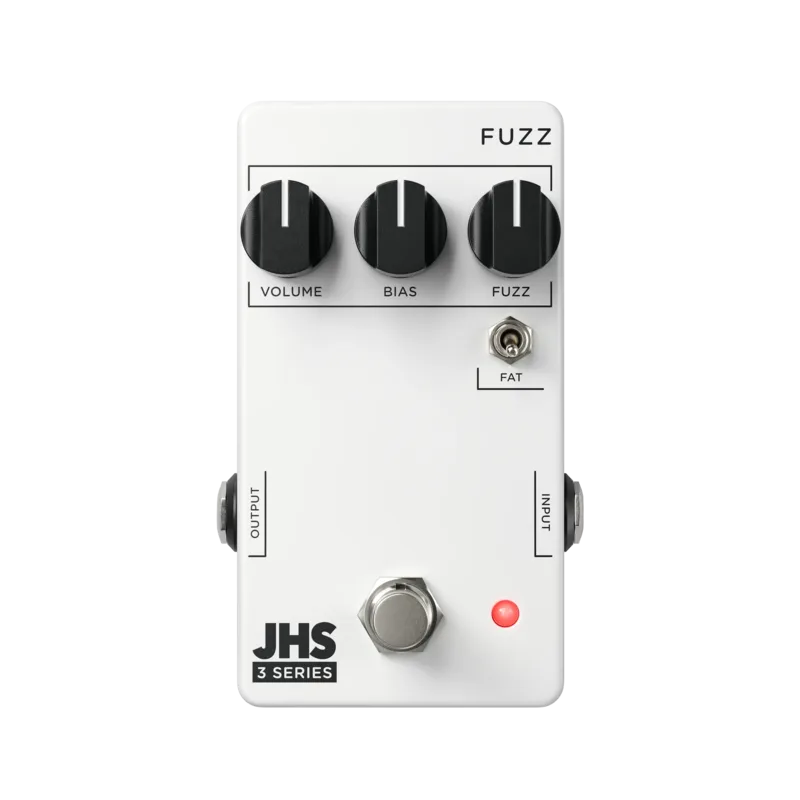


The JHS 3 Series Fuzz is a fuzz pedal from JHS Pedals, part of the company's affordable 3 Series line. It is a versatile fuzz box that JHS says cleans up well with your guitar's volume knob, and the maker describes its sound as "the perfect balance of vintage and modern with soaring sustain and clear articulation"1. The circuit is built around classic 1960s-style two-transistor fuzzes, done in a way that gives maximum flexibility from the circuit, according to JHS's own launch announcement2.
It launched in October 2020 as one of the first pedals in the 3 Series, a range of $99 effects JHS introduced as a surprise addition to its lineup34.
Volume, Bias, Fuzz and the Fat switch
The control layout is three knobs and one toggle. Guitar World's launch coverage described it as "Boasting Volume, Bias and Fuzz knobs and a bass-boosting Fat toggle"6, and gearnews.com listed the same set: Volume, Bias and Fuzz, with a Fat switch7.
| Control | What it does |
|---|---|
| Volume | Sets the output level6 |
| Bias | Gives the Fuzz a more gated sound as you turn it up5 |
| Fuzz | Sets the amount of fuzz215 |
| Fat toggle | Engages a bass boost for an overall fatter, more powerful sound5 |
The Bias knob is the control that separates this from a straight vintage reissue. MusicRadar's Rob Laing explained that it "gives the Fuzz a more gated sound as you turn it up"5, and Guitar Pedal X's Stefan Karlsson highlighted the "added fully variable Bias control" as part of what makes the pedal flexible8. Where many 1960s two-transistor fuzzes are fixed at one bias point, a variable control lets you sweep from an open, sustaining sound toward a tighter, choppier gated character.
The Fat toggle is the other flexibility point. MusicRadar described it plainly: "The Fat toggle engages a bass boost for an overall fatter, more powerful sound"5. Vintage Guitar's reviewer called it a mini-toggle that "increases fatness on the Fuzz"9, and Guitar Pedal X named it a "Fat Bass-Boost switch"8. For a player finding vintage-style fuzzes thin with single coils or on drop-tuned parts, that switch is the fix.
JHS says the pedal "cleans up well with your guitar's volume knob"1, a claim MusicRadar also reported at launch5. That behavior, rolling the guitar's volume back to pull the gain down, is a hallmark of the two-transistor fuzz circuits the pedal is based on.
The 3 Series line
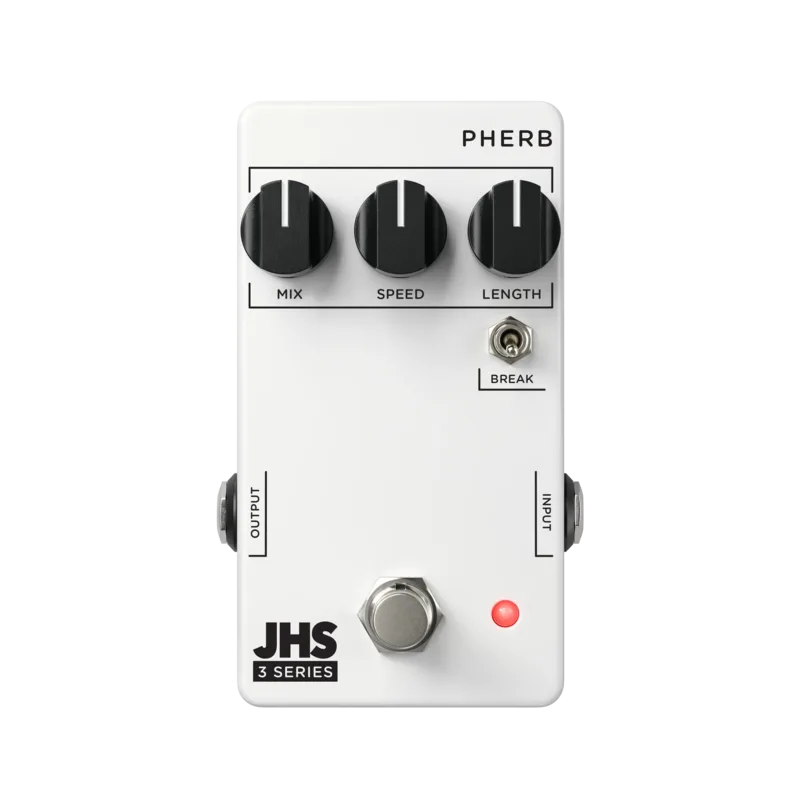
The 3 Series is JHS Pedals' collection of pedals designed to give affordability and simplicity without compromising quality, with each pedal carrying three simple controls and one toggle that offer a wide range of sounds, in the maker's words "perfect for beginners and profess[ionals]"1. The Fuzz was among the first wave when the range launched in October 2020 at $99 per pedal51.
JHS's own announcement framed the Fuzz's place in the line: "this is based around classic 1960s style two-transistor fuzzes, done in a way that gives maximum flexibility from the circuit"2.
What reviewers said
MusicRadar's best-fuzz buying guide, written by Richard Blenkinsop and Matt McCracken, characterized it as "a '60s-style fuzz, though its aim is for all the settings to be usable (unlike many vintage models!)"4. The same guide's verdict on the pedal was positive on the whole: among its reasons to buy were "Simple to use," "lots of great tones," "can sound huge" and "affordable," while its reason to avoid was that it is "not wild enough for some" players4.
Guitar Pedal X included it in a best-of roundup of new fuzz pedals for 2020, crediting the Bias control and Fat switch for the flexibility8, and Delicious Audio's guide to fuzz clones noted it as an entry into the JHS $99 pedal lineup3.
Videos
Eirik Stordrange
R.J. Ronquillo
The Gear Cage
Questions
What does the Bias knob do on the JHS 3 Series Fuzz?
The Bias knob gives the Fuzz a more gated sound as you turn it up. It is fully variable, so you can sweep from an open, sustaining fuzz to a tighter, choppier gated character, which is a range many vintage two-transistor fuzzes do not offer.
What does the Fat switch do on the JHS 3 Series Fuzz?
The Fat toggle engages a bass boost for an overall fatter, more powerful sound. Vintage Guitar's reviewer described it as a mini-toggle that increases fatness on the Fuzz, and Guitar Pedal X called it a Fat Bass-Boost switch.
What power supply does the JHS 3 Series Fuzz need?
It runs on 9V DC negative center power. That is the standard boss-style supply used across the 3 Series line, so it will share a power brick with most modern pedals.
How much current does the JHS 3 Series Fuzz draw?
It consumes 9mA, according to JHS Pedals' own product page. That is a very light draw, so it leaves plenty of headroom on a multi-output power supply.
Does the JHS 3 Series Fuzz clean up with the guitar's volume knob?
Yes. JHS Pedals describes it as a versatile fuzz box that cleans up well with your guitar's volume knob, and MusicRadar's launch coverage repeated that claim. Rolling back the volume takes the gain down without losing the signal.
Where is the JHS 3 Series Fuzz made?
Each 3 Series pedal is made by JHS Pedals in Kansas City, Missouri, using high-quality parts, quality control, and attention to every build, according to the maker's product page.
Sources (9)
- 3 SERIES FUZZ, JHS Pedals
- OUR SUCKIEST PEDALS YET, JHS Pedals
- Best Fuzz Face Clones And Evolutions In 2024, Delicious Audio, 2024-04-17
- Best fuzz pedals: add some extra dirt to your guitar tone, MusicRadar, 2022-05-17
- JHS pedals launch surprise $99 guitar effects pedal 3 Series, MusicRadar, 2020-10-02
- JHS launches $99 pedal range, Guitar World, 2020-10-02
- The new JHS Series 3 pedals are priced at $99 each, gearnews.com, 2020-10-02
- Guitar Pedal X, Guitar Pedal X, 2020-12-18
- JHS 3 Series, Vintage Guitar magazine, 2021-12-07