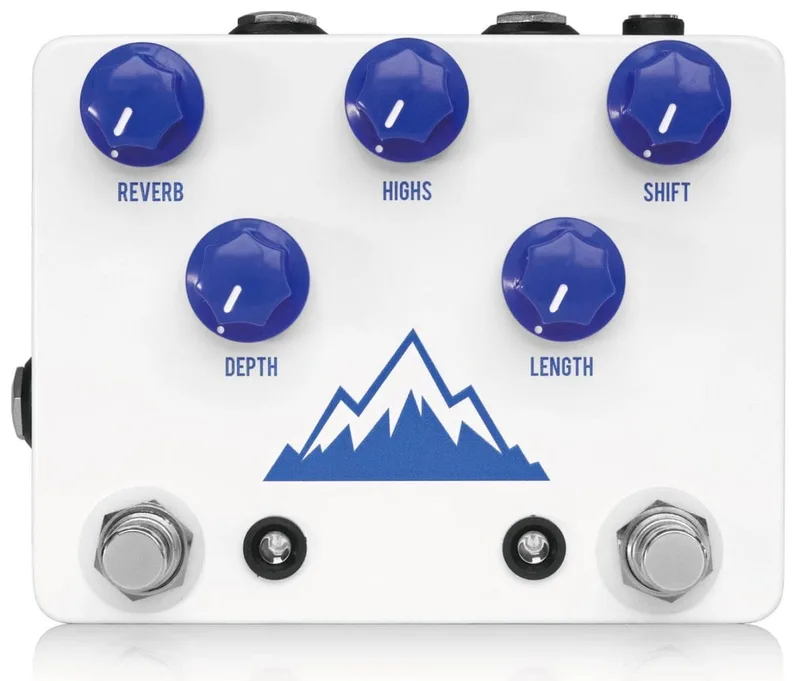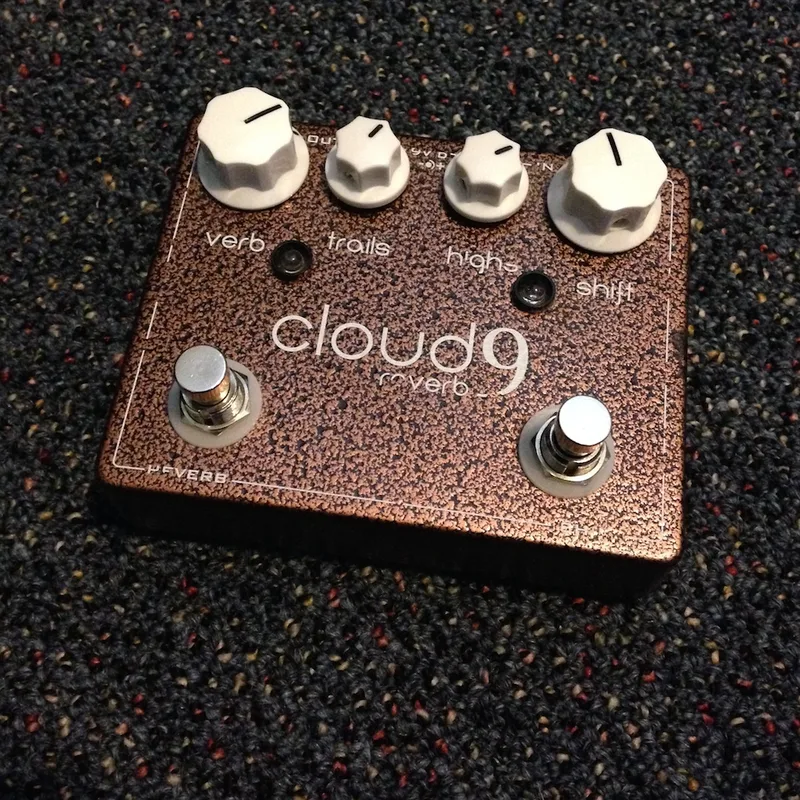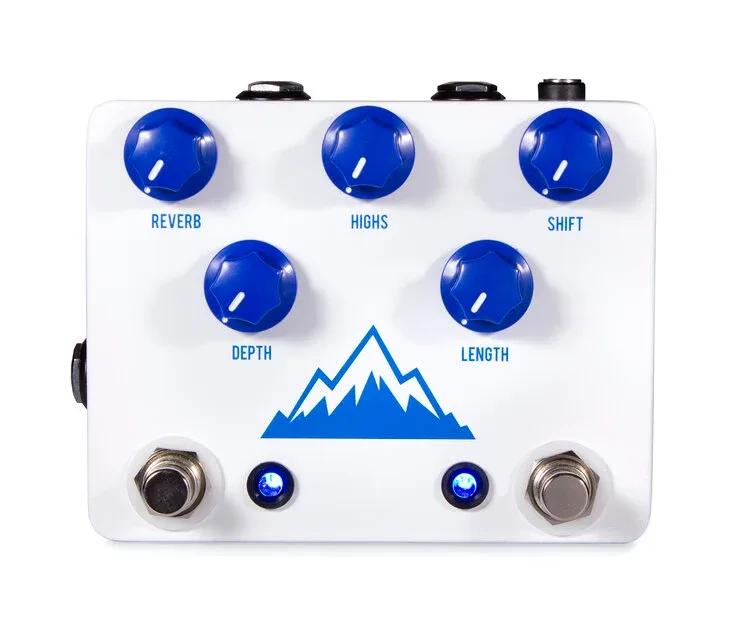


The JHS Alpine is a reverb pedal from JHS Pedals, built on the circuit of the Sky Pedals Cloud 9 after JHS acquired Sky Pedals and redesigned the design. JHS describes it as a highly tweakable, versatile reverb that does the simple as well as the complex, from a realistic and believable Spring reverb to washed out ambient layers1. It stands out from most reverb pedals in two ways: a second footswitch that switches between two reverb sounds on the fly, and an effects loop that sits inside the reverb signal itself.
Footswitches, mix control and jacks
The Alpine carries two footswitches. The left one turns the pedal on and off. The right one is the Shift footswitch, which engages the Shift knob, a second Reverb control for on-the-fly adjustment between two preset sounds1. Pedal of the Day's reviewer, Mike B, described the layout as a main bypass footswitch plus a second switch assigned to the Shift control3.
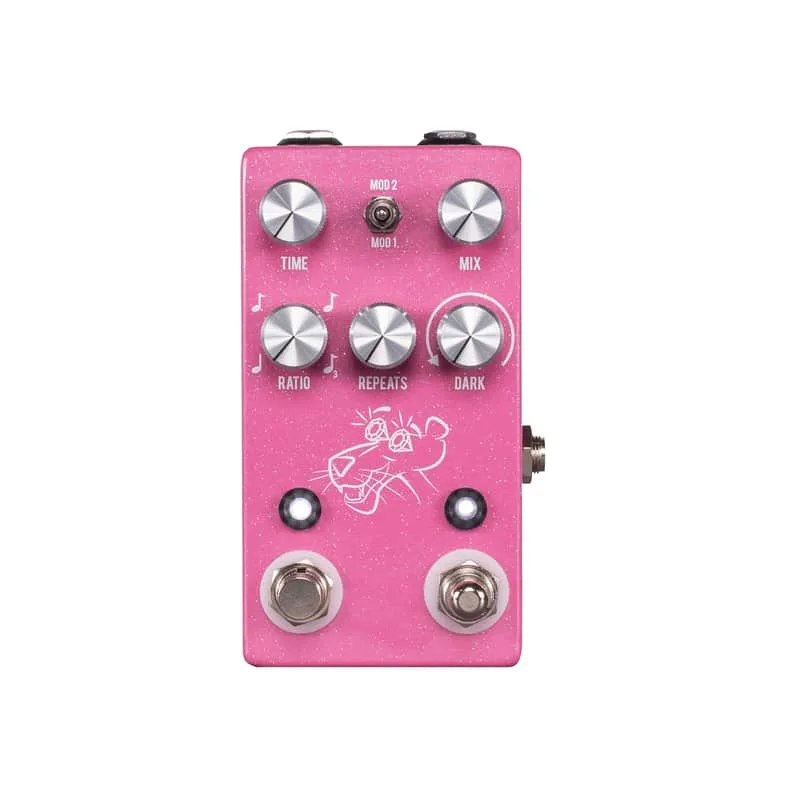
The Reverb control itself is, in JHS's words, essentially a wet/dry mix knob that lets a player set the balance and feel of how saturated the effect is2. On the jack side, the pedal has two top-mounted 1/4" input/output jacks like most pedals, and on the left side a TRS EFX loop jack, the same arrangement found on the JHS Panther Cub Analog Delay, for inserting any pedal or effect unit within the reverb signal2.
The Alpine is not true bypass. JHS says it uses a high quality buffered bypass that restores lost signal in a rig by correcting impedance and driving the load of the signal to the amp2. Players who build boards around entirely true-bypass signal paths should account for the buffer.
The EFX loop and the dip-switch
Inside the pedal is a small switch labeled EFX LOOP with two positions, SHIFT ONLY and ALWAYS ON1:
- SHIFT ONLY: the EFX loop only engages when the Shift footswitch setting is engaged. This is the position the pedal ships in1.
- ALWAYS ON: the EFX loop is on whenever the pedal is on or Shift is engaged1.
In practice, the loop means a player can put, say, a delay or another reverb pedal inside the Alpine's reverb tail rather than after it, shaping only the wet signal.
From the Sky Pedals Cloud 9 to the Alpine
The Alpine's circuit is based on the Sky Pedals Cloud 9, which JHS redesigned and improved after acquiring Sky Pedals. JHS's product page gives special thanks to Jim Coleman of Sky Pedals "for giving us a great foundation to build on," adding that "The Cloud 9 lives on in the Alpine"1. Coleman designed the Cloud 9, saying in a JHS demo video, "I started building the uh the Cloud9 a couple years ago"4. Pedal of the Day noted that Sky Pedals is no longer creating gear but passed along the basic concept and design of the Cloud 9 to JHS3.
The Alpine was announced in November 2014, with JHS's Josh Scott saying in the announcement video, "We're proud to bring you the final result several months later in the JHS Pedals Alpine Reverb"4. That video also explains that the pedal uses the new version 3 brick, which gives it a depth control and, in Scott's words with Jim Coleman, "makes it more tweakable," covering sounds from Spring to bigger rooms, tile rooms and a reverb delay sound4.
What reviewers said
Pedal of the Day reviewed the Alpine in September 2015, with Mike B calling it "An improvement on an almost instant classic pedal," saying JHS "have once again stepped up their game, and created a truly unique" pedal that blends the new partner's design with new twists3.
A JHS demo video from the announcement shows the pedal in action, with Josh Scott and Jim Coleman walking through the Cloud 9 background and the version 3 brick's depth control4.
Videos
ProGuitarShopDemos
Premier Guitar
Sweetwater
Questions
Is the JHS Alpine true bypass?
No. JHS says the Alpine uses a high quality buffered bypass that restores lost signal in a rig by correcting impedance and driving the load of the signal to the amp. A buffer is always in the path, so the pedal is not true bypass, which is worth knowing if a player prefers pedals that remove all circuitry when off.
What is the EFX loop on the JHS Alpine for?
The TRS EFX loop jack on the left side, the same arrangement found on the JHS Panther Cub Analog Delay, lets a player insert any pedal or effect unit within the reverb signal. An internal dip-switch sets whether the loop engages only with the Shift footswitch setting or whenever the pedal is on or Shift is engaged.
What does the Shift footswitch do on the JHS Alpine?
The right footswitch engages the Shift knob, a second Reverb control that works as a second preset sound. That lets a player move between two reverb settings on the fly without bending down to turn knobs, while the left footswitch turns the pedal on and off.
Can the JHS Alpine make a spring reverb sound?
Yes. JHS describes the Alpine as doing the simple as well as the complex, from a realistic and believable Spring reverb to washed out ambient layers. The version 3 brick adds a depth control that JHS says makes the reverb more tweakable, from Spring to bigger rooms, tile rooms and a reverb delay sound.
Sources (4)
- ALPINE - JHS Pedals, JHS Pedals
- ALPINE HAND PAINT, JHS Pedals
- JHS Pedals Alpine Reverb Pedal, Pedal of the Day, 2015-09-01
- the story of the JHS Pedals Alpine, JHS Pedals (YouTube channel), 2014-11-25