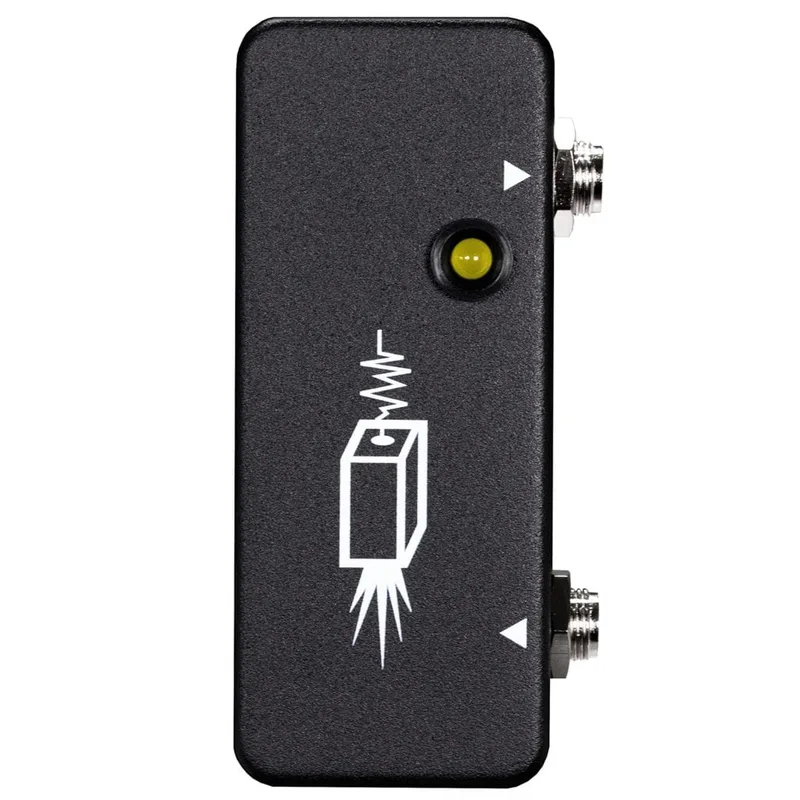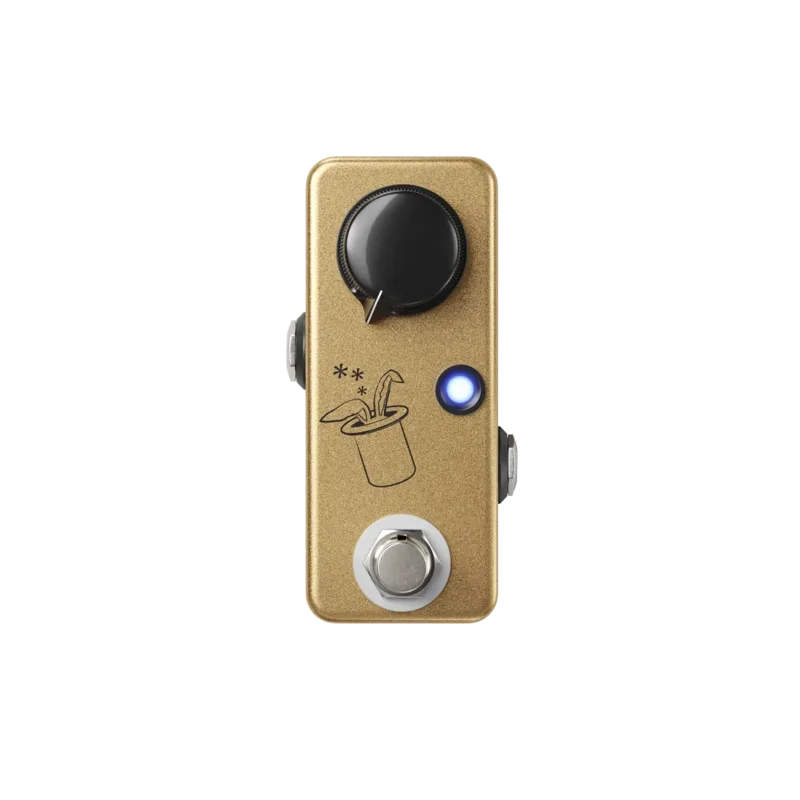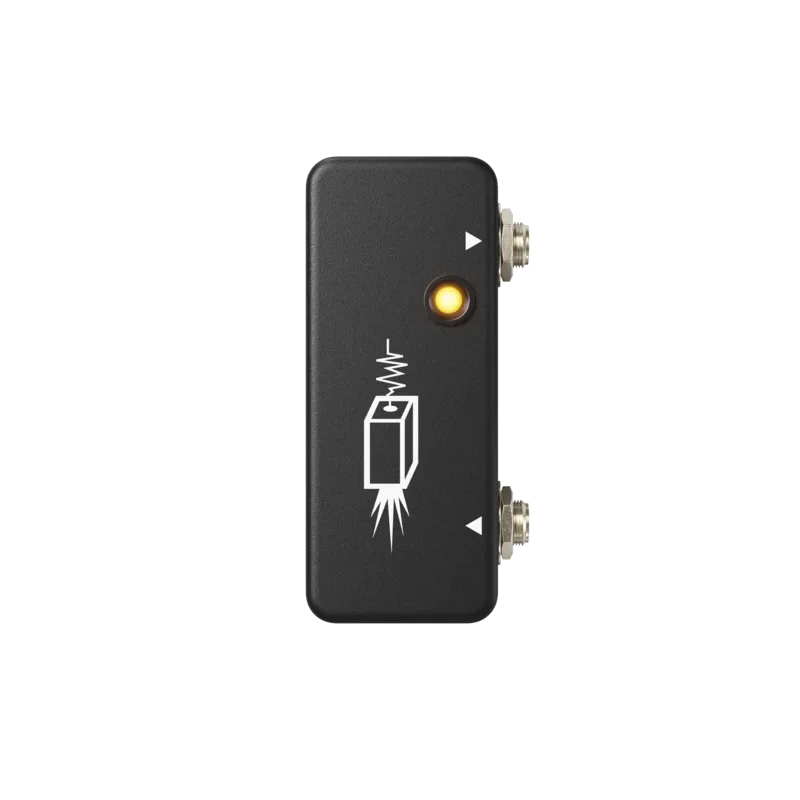


The JHS Little Black Buffer is a buffer utility pedal from JHS Pedals. Its job is simple: it sits at the front of your signal chain, converts your guitar's high-impedance (hi-Z) output to a low-impedance (lo-Z) one, and drives the rest of your cables and pedals from there. JHS says that with it in place you "restore all the high-end detail, output level, and tonal character that involved pedal chains and long cable runs" take away1. You plug your guitar straight into its input and run its output into your pedal chain, and that is the whole operation: there are no knobs.
Power, signal level and connections
The buffer takes standard 9V DC negative power and consumes 19mA1. That is a light load: a single output on almost any multi-output pedalboard supply covers it, and it will not crowd out hungier digital pedals on your power budget. Because it is an active circuit, it needs that power to do its job, unlike passive utility boxes that pass signal with no supply at all.
Signal handling has one published limit worth knowing. JHS states the Little Black Buffer is designed to work with signal levels up to +4dBu, and that exceeding +4dBu will cause clipping1. For a straight guitar into the front of a board that limit is never in play; it becomes relevant only if something unusually hot feeds the input.
Connections are one input and one output. The maker's own explanation of how buffers work gives the electrical picture: the pedal presents a 1 megaohm input (high impedance) to the guitar and a 100 ohm output (low impedance) to everything downstream2. That low output impedance is what lets long cable runs and large pedal chains keep their high end.
| Specification | Value |
|---|---|
| Power requirement | 9V DC negative1 |
| Current draw | 19mA1 |
| Maximum signal level | +4dBu (above this, clipping)1 |
| Input impedance | 1 megaohm (high impedance)2 |
| Output impedance | 100 ohm (low impedance)2 |
| Dimensions | 3.6" x 1.5" x 1"1 |
| Controls | None |
What the circuit is
Independent circuit analysis published on the Guitar FX Layouts blog traced the pedal from gutshots posted on the blog's forum by a user named hahafender3. On the circuit's topology, the tracing states:
"the left hand side is a generic opamp buffer and that's the important bit"
In other words, the core is a straightforward opamp unity-gain buffer of the kind builders have used for decades, in a small powder-coated enclosure. Builders on that thread reported quiet, working results, one noting after a 2020 build that it "works great, dead quiet but brings back some sparkle" lost to a long chain, using a 4558D opamp substituted for the TL072 the layout called for3.
The same thread documents the circuit's flexibility for DIY purposes:
- Wiring the input to the layout's unused second opamp, set up the same as the first, gives the equivalent of JHS's own buffered splitter3.
- The circuit can be retrofitted into a volume pedal, with a 100K log pot suggested so the full range of frequencies gets through without filtering out low end3.
- Builders who ran into radio frequency interference found a 470p (or lower) cap from input to ground cured it3.
- 2M resistors were confirmed to work in place of the 2M2 values in the layout3.
A modded "improved" version was added to the original layout post, then removed after a couple of builders reported issues with it3.
How it differs from the other Little Black boxes
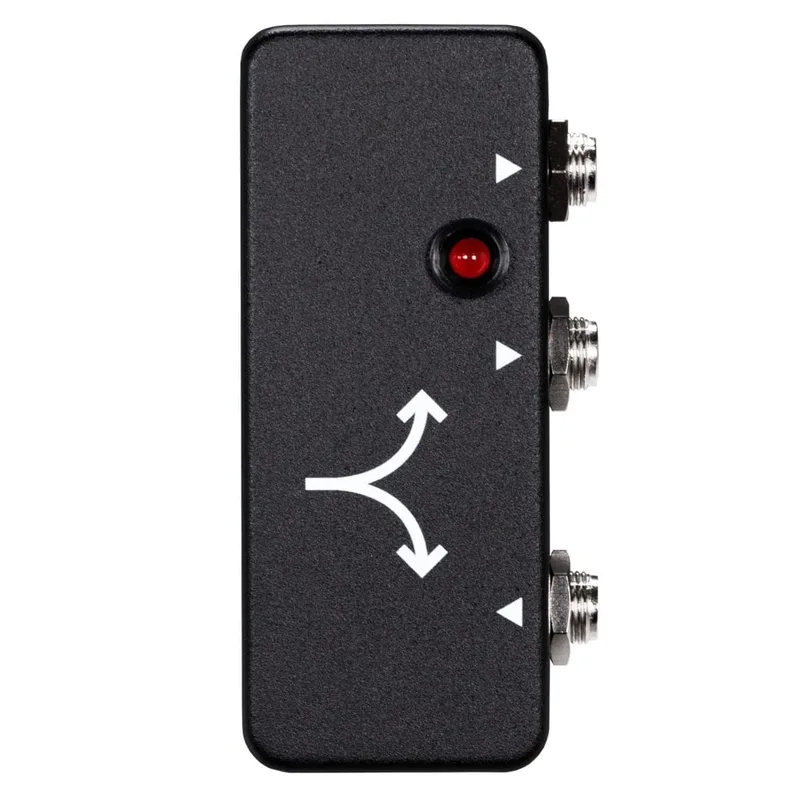
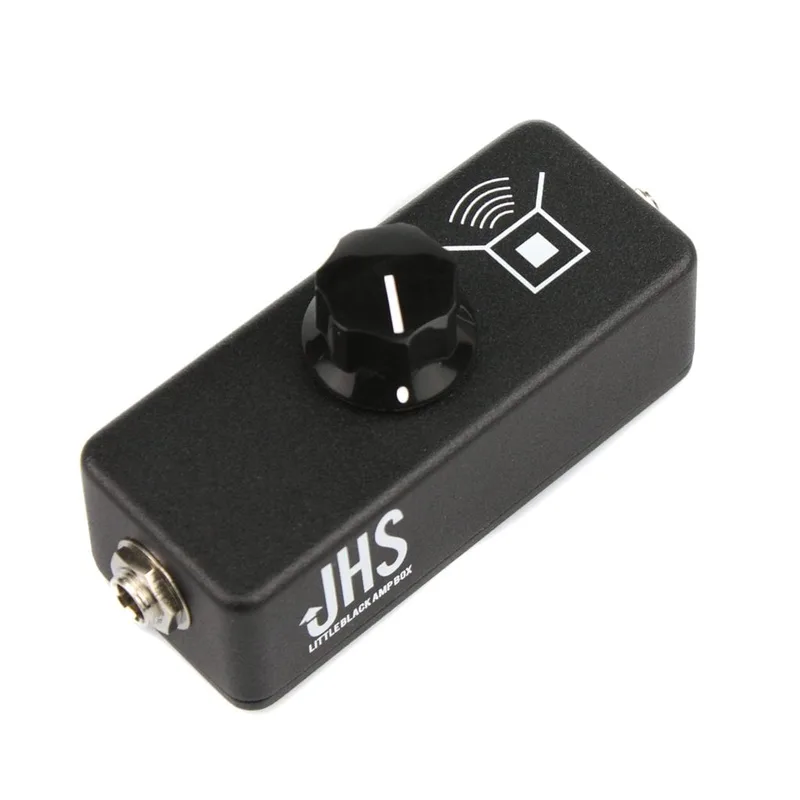
JHS sells the buffer inside a family of same-sized black utility boxes, and they do different jobs. The JHS Pedals Buffered Splitter is the two-output version of the same buffering idea, and JHS also installs its Little Black Buffered Splitter circuit as a mod inside Ernie Ball volume pedals4. The Little Black Amp Box, by contrast, is a volume utility: a passive design that needs no power at all, meant to be placed in an amp's effects loop to retain the response and tone of the amp's sweet spot at lower levels5. Performer Magazine's reviewer noted of the Amp Box that "it's a passive circuit so there's no issue of overloading anything"6, which is the opposite trade-off from the buffer: the Amp Box needs no power but does not convert impedance, while the Little Black Buffer needs 9V DC and does.
Same box, different jobs: the Little Black Buffer is an active impedance converter that requires 9V DC power; the Little Black Amp Box is a passive volume control that requires no power15. Both measure 3.6" x 1.5" x 1"15.
Videos
A MINOR ERROR
TooNyTooN
JHS Pedals
Questions
What voltage does the JHS Little Black Buffer need?
It requires standard 9V DC negative power, the same center-negative supply most pedalboards already use. It draws 19mA, so it is an easy load for a typical multi-output power supply.
Does the JHS Little Black Buffer use a battery?
JHS specifies standard 9V DC negative power for the Little Black Buffer, so it is powered from a pedalboard supply rather than an internal battery. Plan a spot on your power supply for it.
How much current does the JHS Little Black Buffer draw?
The maker lists a current draw of 19mA. That is a light load, well within what a single output on most isolated power supplies delivers, and it leaves plenty of headroom for the rest of a pedalboard.
What is the maximum input level of the Little Black Buffer?
JHS designs it to work with signal levels up to +4dBu. Feeding it a hotter signal than that will cause clipping, which matters mainly if something with a strong output, like an active bass or a boosted line-level source, hits its input.
Is the JHS Little Black Buffer an active or passive buffer?
It is an active buffer, built around an opamp circuit and requiring 9V DC power. That is what lets it convert the guitar's high-impedance signal to a low-impedance output that drives long cables and pedal chains without losing high-end detail.
How big is the JHS Little Black Buffer?
It measures 3.6 by 1.5 by 1 inches, a tiny enclosure that fits in a gap at the front of a pedalboard. It shares that exact size with the JHS Little Black Amp Box, a passive volume control from the same maker.
Sources (6)
- LITTLE BLACK BUFFER, JHS Pedals
- UNDERSTANDING BUFFERS, JHS Pedals
- Guitar FX Layouts: JHS Little Black Buffer, Guitar FX Layouts (tagboardeffects.blogspot.com), 2017-11-11
- ERNIE BALL ACTIVE NO LOSS MOD, JHS Pedals
- LITTLE BLACK AMP BOX, JHS Pedals
- JHS Little Black Amp Box Review, Performer Magazine, 2016-05-24