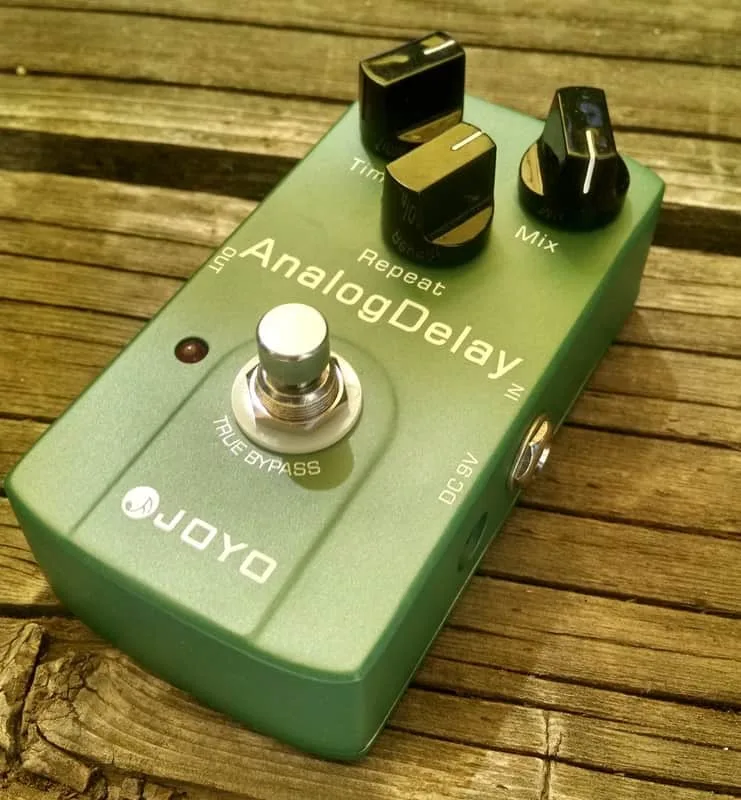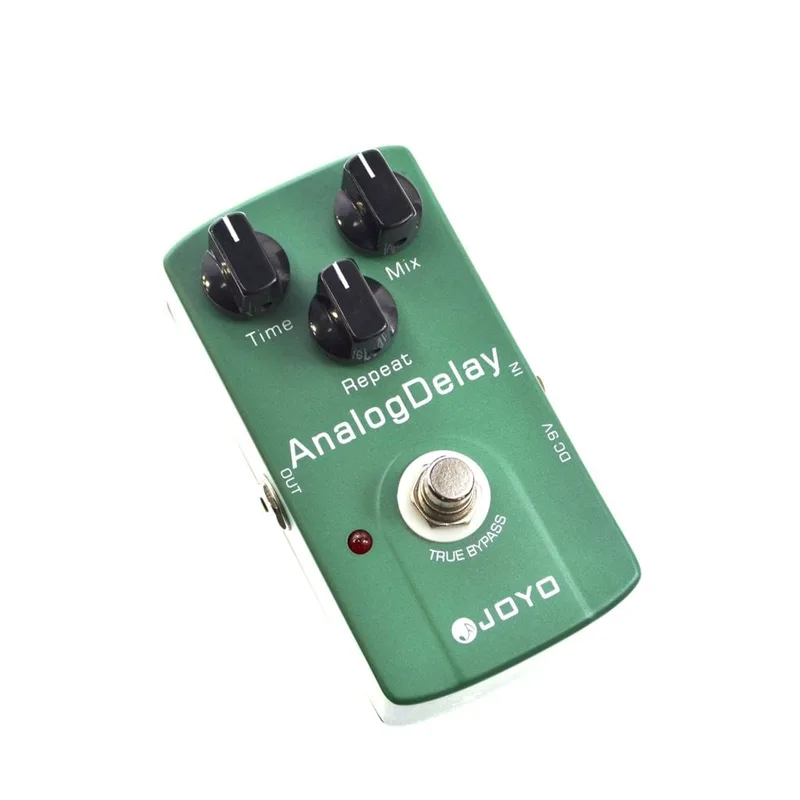
The Joyo Analog Delay, sold as the JF-33, is a compact delay pedal from Chinese maker Joyo that uses a bucket brigade device (BBD) chip rather than digital processing to create its echoes. That puts it in the same circuit family as classic analog delays: the signal is passed through a series of capacitor stages inside the chip, and each pass degrades it slightly in a way players generally hear as warm and musical1.
MusicRadar's reviewer, Trevor Curwen, describes it as Joyo's take on the BBD analog delay genre, noting that "BBD chip, analogue delay emulating pedals are getting better all the time"2. In use, he found it covers the standard analog delay territory: "This pedal can do all the usual bathtub reverb, slapback and dub regeneration tricks and offers longish delay times too"2.
What it does to your sound
A delay is a spatial effect that duplicates the input signal to simulate an echo4. In an analog delay like this one, the duplication happens in the BBD chip, and the repeats come out darker and softer than the original note rather than as exact copies.
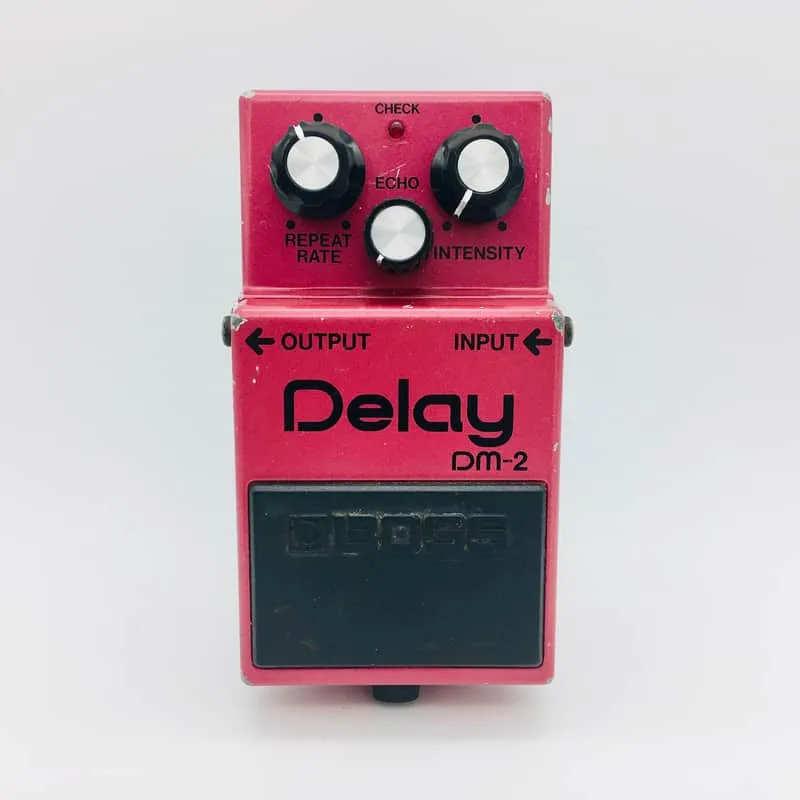
That darkening is the appeal for many players. GuitarPlayer's buying guide puts it plainly: "In practice, analog delays tend to sound warmer, thicker, and slightly darker, with repeats that blend into your playing more naturally"1. Guitar World's history of the Boss DM-2, the circuit most BBD pedals trace back to, adds that "the dark tone beds into a mix better, and ambient players often like to stack them, as the echoes tend to interfere less" with the dry signal5.
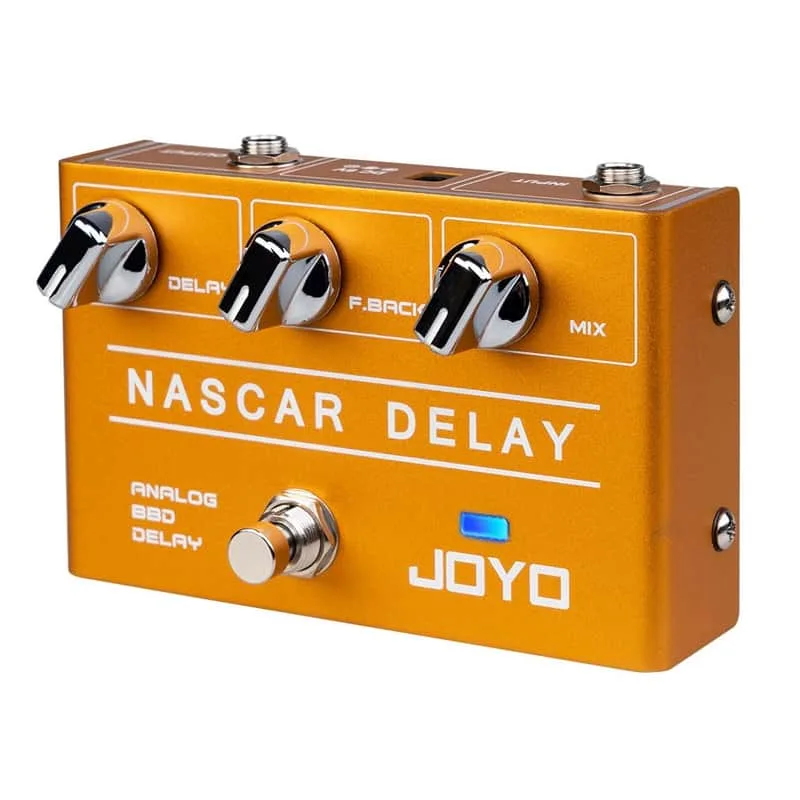
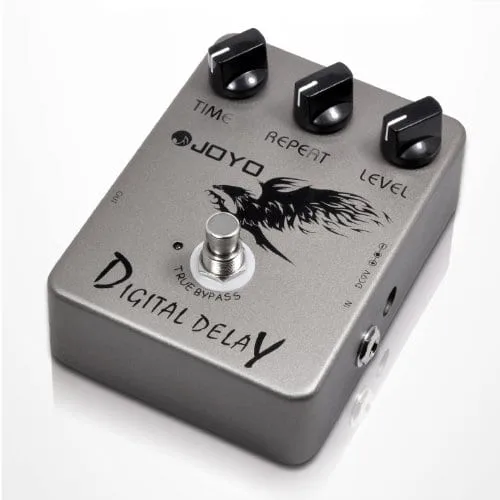
Joyo makes other delays in the same family. The Joyo R-10 Nascar Analog Delay uses the same BBD approach with delay times that max out around 500ms, which Pedal of the Day called fairly standard for analog delays6. Players comparing analog and digital circuits can also look at the Joyo Digital Delay for the other side of that divide.
Controls and power
The pedal keeps it to three knobs, which MusicRadar lists as "controls for delay time, repeat and mix"2:
| Control | What it does |
|---|---|
| Delay time | Sets the spacing between repeats2 |
| Repeat | Sets how many echoes feed back before fading2 |
| Mix | Balances the dry signal against the repeats2 |
Power comes from a 6F22 9V battery or a DC 9V adapter, per Joyo's product page3. MusicRadar's review notes the battery is reached through four-screw access, meaning the back plate has to come off to swap the cell2.
If you plan to run this on a pedalboard, a DC 9V adapter is the practical choice: the four-screw battery door makes mid-gig battery changes slow2.
Why analog repeats sound darker
The darkness of BBD repeats is not a design choice so much as a property of the chip. Strymon's sound designer Pete Celi explained the mechanism in an interview on the company's site: the filtering used to reduce aliasing artifacts makes analog bucket brigade delays "traditionally dark sounding," while charge lost between stages, which he compares to water spilling as it is handed along a bucket line, creates the grungy, noisy side of the character7.
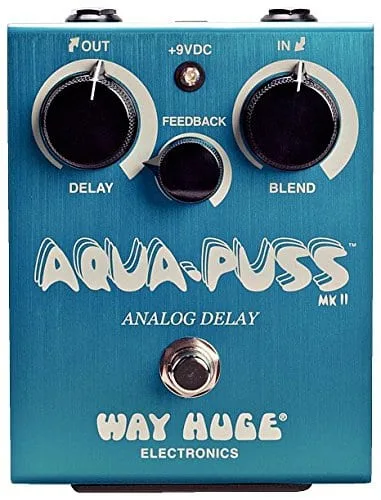
Premier Guitar's review of the Way Huge Aqua-Puss MkII adds another layer: "analog delays add a slight amount of even-order distortion to each repeat, yielding a comfy, lived-in tone"8. Each repeat is slightly softer and more colored than the one before it, so echoes fade into the background instead of competing with what you are playing.
Pedal of the Day's review of the R-10 Nascar describes the practical result: "The dark repeats associated with the analog echoes wash away in the background and don't get in the way of your original" guitar signal6.
What reviewers said
MusicRadar's review of the Joyo Analog Delay lists "compact size; comprehensive range of analogue delay sounds" among its reasons to buy2. The review frames it as part of a wave of affordable BBD pedals that keep improving, with Joyo's version following the familiar formula of the genre2.
The related R-10 Nascar drew a warmer write-up from Pedal of the Day, which praised its "warm and natural sound" and its suitability for both electric guitar and bass6.
Questions
Does the Joyo Analog Delay take a battery?
Yes. Joyo's product page lists power as a 6F22 9V battery or a DC 9V adapter, and MusicRadar's review notes four-screw battery access, so changing the cell means unscrewing the back plate rather than sliding a door. A 9V adapter avoids that hassle if you run it on a pedalboard.
Does the Joyo Analog Delay use a BBD chip?
Yes. MusicRadar's review describes it as a BBD chip analog delay, the same bucket brigade circuit family used across analog delays from Joyo's own R-10 Nascar to pedals from many other makers. BBD chips pass the signal through a series of capacitor stages, which is what gives analog repeats their character.
Why do analog delays sound darker than digital delays?
Two reasons. The signal passing through a bucket brigade chip loses a little charge at every stage, which adds grunge and noise, and makers add filtering to reduce aliasing artifacts, which rolls off treble. Reviewers also note analog delays add slight even-order distortion to each repeat, so repeats get warmer and darker as they fade.
Sources (8)
- Best delay pedals 2026: from slapback to space age, GuitarPlayer (www.guitarplayer.com), 2023-07-26
- Joyo Analog Delay review, MusicRadar, 2012-07-11
- JF-33 Analog Delay_JOYO, JOYO
- The analog delay, or rather... the analog-voiced delay, Anasounds, 2020-05-14
- Classic gear: Boss DM-2, Guitar World, 2020-09-18
- JOYO R-10 Nascar Analog Delay, Pedal of the Day, 2020-10-12
- The Sound of Strymon: Sound Designer Pete Celi, Strymon (www.strymon.net), 2015-11-12
- Way Huge Aqua-Puss MKII Analog Delay Pedal Review, Premier Guitar, 2010-04-15