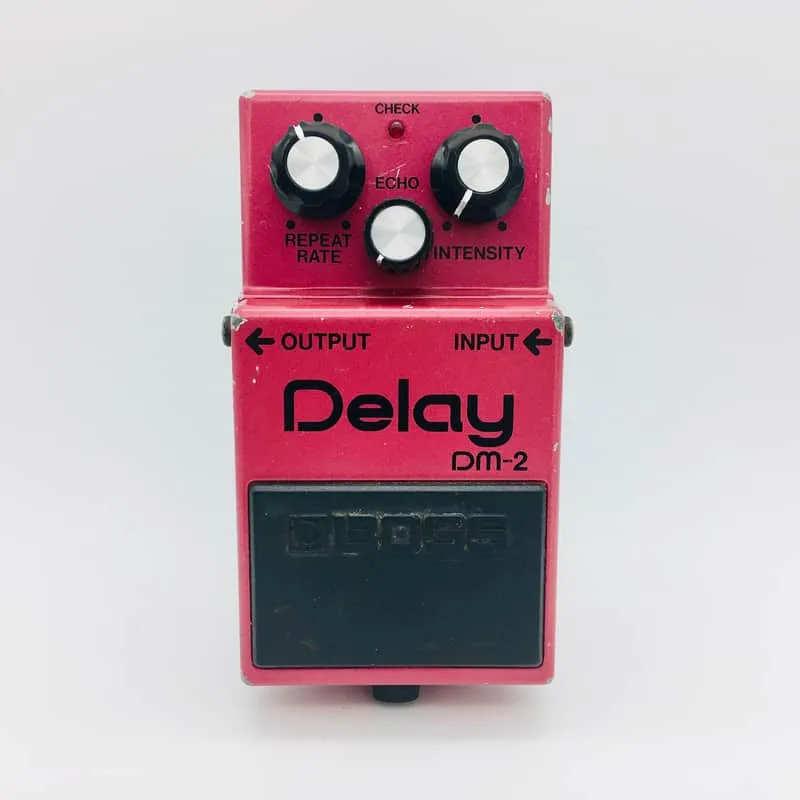


The Boss DM-2 is an analog delay pedal introduced by Boss in 1981, the first analog delay in the company's compact pedal lineup1. Instead of the digital sampling used by later delays, it passes the signal through a bucket-brigade device (BBD), a chip that hands the signal along a chain of capacitors, and that circuit is what gives the pedal its character: Boss describes the result as lush delays that become more saturated with each repeat, creating organic ambience12. It was discontinued in 1984 as players moved to cleaner digital delays, but it never went away quietly, and Boss's own history article notes it remains highly sought after on the used market more than 30 years later13.
An analog bucket-brigade delay, up to 300ms
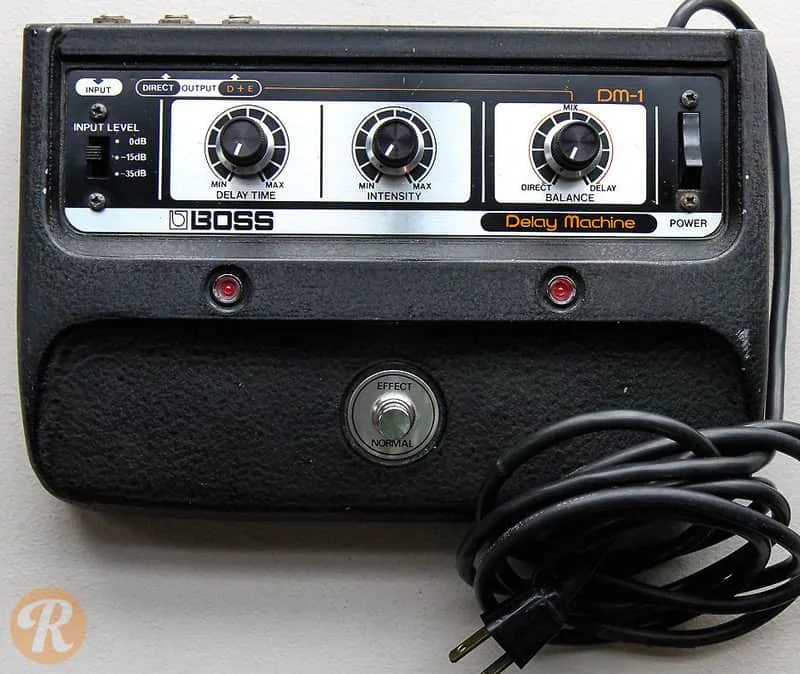
The DM-2's place in the lineup came from a circuit change. Boss's earlier DM-1 Delay Machine used a CCD, but for the DM-2 the engineers employed a bucket-brigade device instead, and they had to stretch the capabilities of the BBD chip to reach a maximum of 300 milliseconds of delay time1. That 300 ms ceiling became the pedal's best-known limitation. In his demo video, Pete Thorn noted the original "had some limitations only 300 milliseconds of delay time available"5.
For comparison, Guitar Player listed the pedal's practical echo range as 33 ms to 330 ms and called it a classic analog delay that specializes in short echoes6. What players get inside that range is the analog signature: repeats that darken and saturate rather than repeating identically, which is why the pedal found a second life after the digital era began. In a Boss interview, engineer Mike Crawford observed that "after a few years of using crystal clear digital delay, a lot of players realized they really liked the sound of the earlier analog delay," and that the DM-2's simplicity became one of its most appealing traits7.
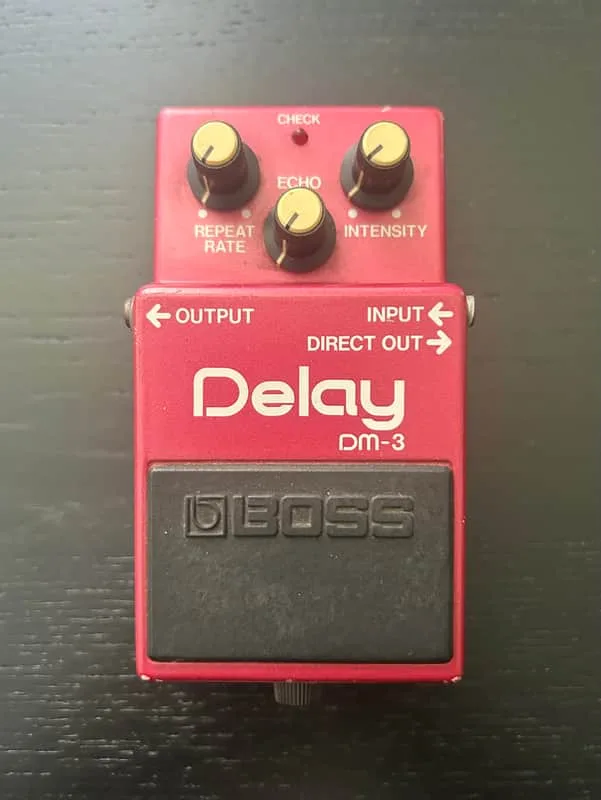
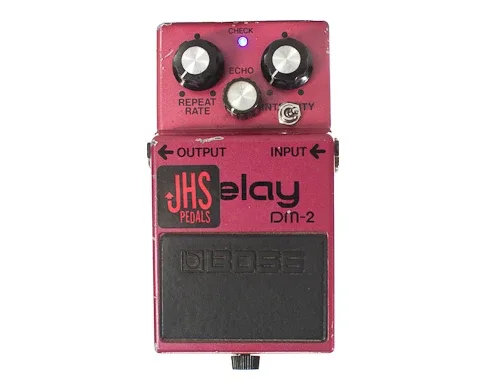
The pedal sits in a plum purple compact enclosure, a color JHS's staff picked as a favorite among Boss's vintage palette8. It was succeeded in the lineup by the DM-3, and Boss later built a modern reissue into its Waza Craft series, covered below.
The controls
The DM-2 keeps its control set to three knobs, and reviewers consistently point to that simplicity as part of the appeal67.
| Control | What it does |
|---|---|
| Repeat Rate | Controls the repetition rate of the delayed effect, in other words the delay time9 |
| Echo | Adjusts the output level of the echo9 |
| Intensity | Sets the amount of feedback on the repeats; pushed far enough it drives the pedal into self-oscillation29 |
The Intensity knob is the one that gets the most attention. Boss's product page describes it plainly: "Turning up the Intensity knob drives the effect into gritty self-oscillation for expressive textures"10. Pedal of the Day's reviewer went further, calling Intensity "probably the control that propels the DM-2 past most other delays in this category" and suggesting that this lone knob might be worth the price of the pedal on its own9.
"Once you crank it up past about noon, this crazy self-oscillation begins, making some out-of-this-world feedback tones."
That behavior is a feature of the analog feedback loop rather than a defect: with enough regeneration, the repeats build on themselves into pitched feedback the player can shape with the Repeat Rate knob. Players who want that trick in a modern pedal will find it carried over in the DM-2W91011.
The pedal has found its way onto real boards. Mark Hosking of Karnivool named it his pick in a Boss interview: "For me it's the DM-2. I've used that a lot over the years. It's great for all that quick, on-the-fly expressive stuff"12.
The two chip versions: 3005 and 3205
Not every DM-2 sounds the same, and the difference is inside. Production units were built with two different BBD chips, the 3005 and the 3205, and Pedal of the Day reports they sound slightly different: the 3005 chip gives a thicker, darker sound, while the 3205 chip is brighter and clearer9. The same review notes that which chip is in a given unit can have a drastic effect on how much that DM-2 is worth, so buyers shopping the used market often check the chip before paying9.
The DM-2 and the DM-2W
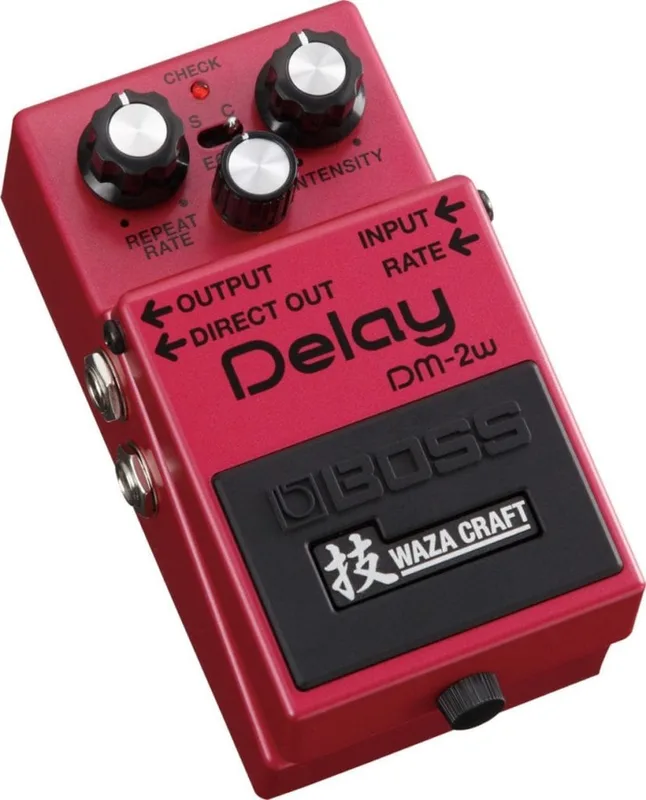
In 2014 Boss brought the DM-2 back as the DM-2W Delay Waza Craft, part of the first wave of its Waza Craft series of premium remakes1314. Premier Guitar's announcement described the original as "universally revered by tone aficionados for its warm, 'bucket brigade' analog delay sound" and noted the DM-2W's Standard mode reproduces the original's lush sound and 20 to 300 ms delay range4.
The differences between the two pedals come down to what the Waza version adds131516:
- Circuit: The DM-2W uses 100-percent analog circuitry with a BBD delay line, matching the original's approach13.
- Delay time: The original DM-2 reaches a maximum of 300 milliseconds; the DM-2W's Custom mode expands delay times out to 800 ms5116.
- Modes: The DM-2W introduces switchable sound modes and greater versatility, where the original has a single fixed voicing13.
- Warranty: The DM-2W carries a Boss five-year warranty13.
Guitar World's review of the first Waza Craft pedals summarized the delay times as "ranging from 20-300ms in standard mode and up to 800ms in custom mode"15. For players who want the original's character with longer delays and a warranty, the DM-2W is the current route; the original remains a used-market purchase.
What reviewers said
Published reviewers have been consistent about the DM-2's standing. MusicRadar called it "the gold standard for bucket-brigade delay pedals"17. Guitar Player's history of the stompbox described it as a classic analog delay specializing in short echoes6, and a later Guitar Player news piece called it "a bona fide vintage classic of Boss's compact pedal range," noting it is now available as the DM-2W in the Waza Craft series11.
Pete Thorn's demo video walks through both the original's appeal and its limits, including the 300 ms ceiling and the character of the repeats5.
Buying one today
The DM-2 has been out of production since 1984, so everything on the market is used or modified stock. Analog Man reported that clean examples commonly sold for $200 or more on the used market, alongside the DM-3, and that both remained popular1813. Boss's history article confirms the pedal is still highly sought after more than 30 years after discontinuation1. Two other routes exist for players who want the circuit without hunting a vintage unit: JHS offers a Boss DM-2 Mod service19, and Aion FX sells a DM-2 delay kit at $98.0020.
The DM-2 is a discontinued, 40-year-old pedal. Condition and which BBD chip is inside (3005 or 3205) both affect value and sound, and used prices reflect that918.
Videos
NirvanaGuitars
shnobel
Leon Todd
Questions
What is the difference between the 3005 and 3205 chip DM-2?
The DM-2 was built with two different bucket-brigade chips over its production run, and reviewers say they sound slightly different. The 3005 chip version is described as thicker and darker, while the 3205 chip version is brighter and clearer. Pedal of the Day notes the chip inside a given unit can have a drastic effect on how much that DM-2 is worth on the used market.
How much is a used Boss DM-2 worth?
Analog Man reported that clean examples of the DM-2 commonly sold for $200 or more on the used market, alongside the DM-3, and that both remained popular. Boss's own history article says the pedal remains highly sought after on the used market more than 30 years after it was discontinued, so prices for clean examples have stayed strong.
When was the Boss DM-2 discontinued?
The DM-2 was discontinued in 1984. Guitar World reports that players at the time were gravitating toward cleaner, more pristine digital delays, but the pedal was not forgotten, and demand for it returned as players came back around to analog delay character.
What is the difference between the DM-2 and the DM-2W?
The DM-2W is Boss's Waza Craft remake of the original, using all-analog circuitry with a bucket-brigade delay line. Its Standard mode reproduces the original's 20 to 300 ms delay range, while a Custom mode extends delay times up to 800 ms. The original DM-2 has no mode switching and tops out at 300 milliseconds.
How do you make a DM-2 self-oscillate?
Turn the Intensity knob up past about the noon position. Pedal of the Day found that at that point the pedal begins self-oscillation, producing feedback tones the reviewer described as out of this world. Boss describes the same behavior on its product page, noting that turning up Intensity drives the effect into gritty self-oscillation for expressive textures.
Sources (20)
- Echoes in Time: The History of BOSS Delay Pedals, BOSS (articles.boss.info), 2024-01-10
- BOSS - PX-1 | Plugout FX, BOSS (boss.info)
- Classic gear: Boss DM-2, Guitar World, 2020-09-18
- Boss Introduces Waza Craft Compact Pedals, Premier Guitar, 2014-07-15
- BOSS Waza Craft DM2w Delay, demo by Pete Thorn, YouTube (Pete Thorn channel), 2015-10-17
- The Best Guitar Effects Pedals of All Time, GuitarPlayer (www.guitarplayer.com), 2021-06-25
- Behind the Board: Mike Crawford with Portishead, Massive Attack, and Goldfrapp, BOSS (articles.boss.info), 2024-08-08
- IS PEDAL COLOR IMPORTANT?, JHS Pedals
- Boss DM-2 Analog Delay, Pedal of the Day, 2016-03-29
- BOSS - PX-1 | Plugout FX, BOSS (www.boss.info)
- If You Like Analog Delay You'll Love the New Boss DM-101 Delay Machine, GuitarPlayer (www.guitarplayer.com), 2023-06-22
- Reverberations: Karnivool, BOSS (articles.boss.info), 2026-07-02
- BOSS DM-2W Delay, Delicious Audio, 2023-05-18
- SUMMER NAMM 2014: Roland introduces new BOSS Waza Craft pedals, MusicRadar, 2014-07-15
- Review: Boss Waza Craft BD-2W, DM-2W, and SD-1W Pedals, Guitar World, 2015-11-23
- Boss DM-2W Delay review, MusicRadar, 2017-10-24
- J Rockett Audio Designs Clockwork Echo review, MusicRadar, 2021-12-23
- Maxon AD-9 VS. Ibanez AD-9 Shootout, Legendary Tones (published on maxonfx.com, Godlyke, Inc.), 2004
- BOSS DM-2 MOD, JHS Pedals
- Vector Ambient Delay / MP Deep Blue Delay, Aion FX, 2019-03-03