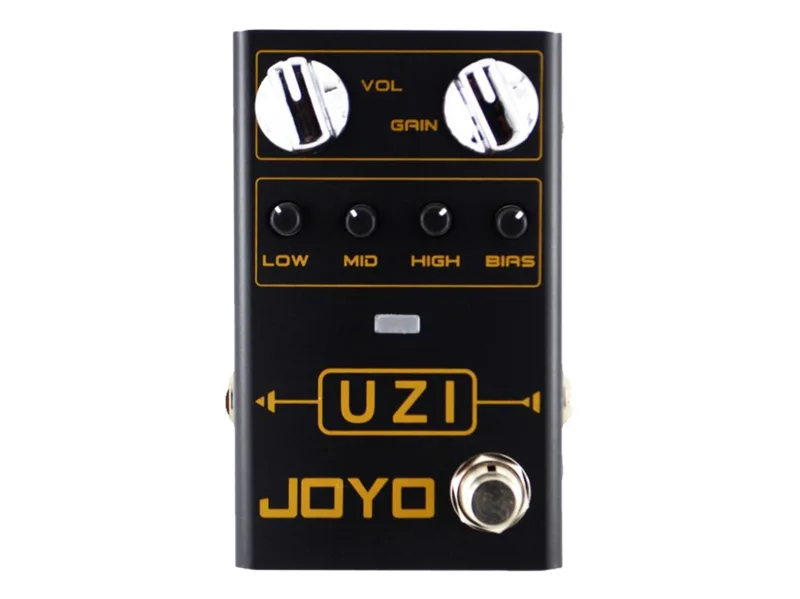


The Joyo Uzi is a metal-focused distortion pedal, announced in late November 2018 in the brand's R-series. Guitar.com describes it as a versatile drive pedal serving up a variety of tones, from warm amp-driven overdrive to piercing high-gain sounds, and MusicRadar's Michael Astley-Brown called it a pedal that "could be the affordable metal distortion pedal to beat" [1]2 2.
Where the tones come from
Guitar.com reports that the Uzi's drive sounds are modeled after classic Marshall amps such as the JCM 800 and JCM 900 1. Gearnews, writing as the pedal was announced, put it this way:
"the ability to cover both British and American drive tones. These are based around the legendary Marshall JCM 800 and JCM900 amps, so it should suit both classic heavy rock and metal styles."
That British-and-American spread is the pedal's main selling point: Guitar World describes it as containing "a bevy of classic British and American distortion tones," aimed at classic heavy rock and metal styles 4 3.
The controls
The Uzi keeps things simple: three knobs and a three-band EQ 1 [1]2.
| Control | What it does |
|---|---|
| Volume | Sets the pedal's output level 1 |
| Gain | Sets the amount of distortion; MusicRadar notes that adjusting it does not affect the volume, making tonal tweaks easy 2 |
| Bias | Sweeps between American and British dirt; Guitar.com says different settings dial in classic presets or a heavier, grungy distortion 2 1 |
| Three-band EQ | Shapes low, mid and high frequencies 1 |
The gain-independent volume is worth noting for players who stomp between clean and dirty sounds: turning the Gain knob up or down will not shift your level, so the Volume knob stays where you set it 2.
The ambient light
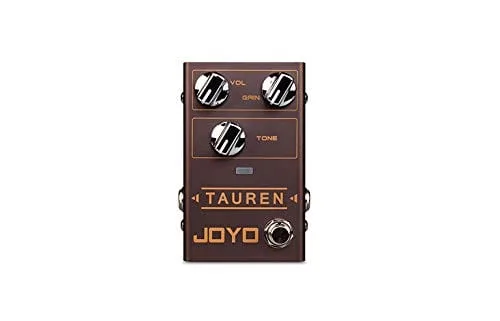
One unusual feature carried over from the Tauren Overdrive, the pedal that preceded the Uzi in Joyo's dirt box lineup: an LED ambient lighting system. Guitar.com notes it "can come in handy on a dark stage" 1. Gearnews adds that the light can be toggled on and off using a switch on the base of the unit, so it need not stay lit if you find it distracting 3.
Where it sits in Joyo's range
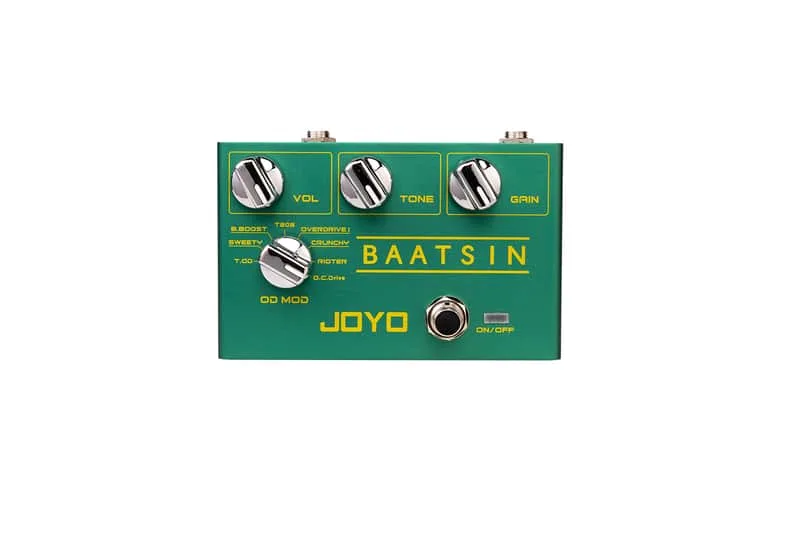
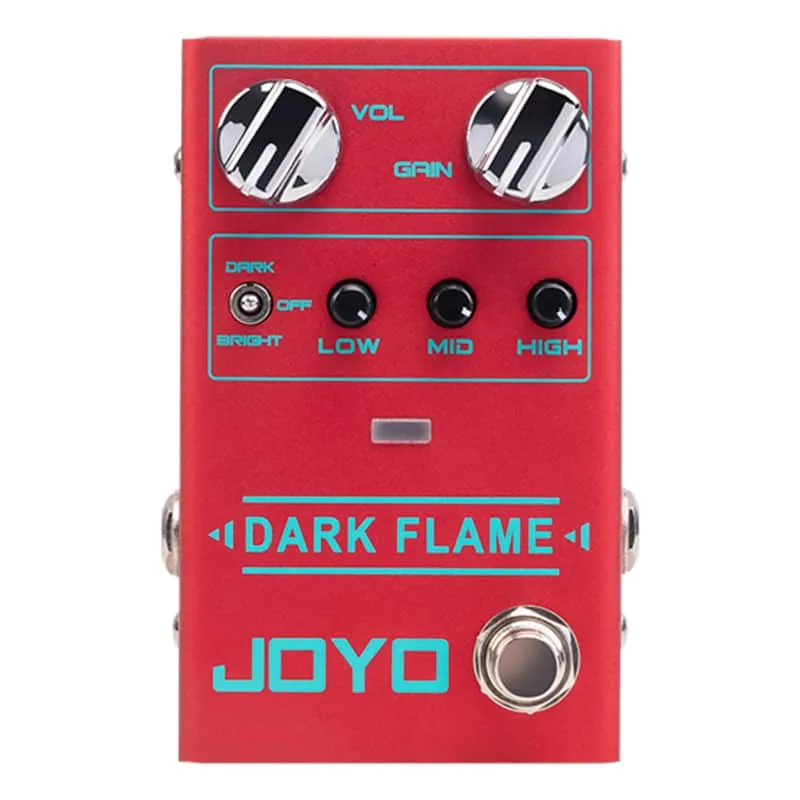
The Uzi was the second pedal in Joyo's new dirt box collection, following the Tauren Overdrive's launch the week before 1. It sits in the R-series alongside later drives such as the Joyo R-11 Baatsin and the Joyo R-17 Dark Flame. For more on the wider category, see Distortion Pedals.
Videos
JOYO AUDIO
Guitar MAX
Guns and Guitars
Questions
What amps is the Joyo Uzi Distortion based on?
Guitar.com reports that the Uzi's drive sounds are modelled after classic Marshall amps such as the JCM 800 and JCM 900. Gearnews describes the pedal as covering both British and American drive tones built around those amps, suiting classic heavy rock and metal styles.
What does the Bias knob do on the Joyo Uzi?
The Bias knob sweeps between American and British distortion tones, according to MusicRadar. Guitar.com says it can be tweaked to dial in classic American and British distortion presets, or, with a different combination of settings, a heavier, grungy distortion.
Does the Joyo Uzi have an EQ?
Yes. The Uzi carries a three-band EQ alongside its Volume, Gain and Bias knobs, giving you control over the low, mid and high character of the distortion on top of the overall drive shaping.
What is the LED lighting on the Joyo Uzi for?
The Uzi has an LED ambient lighting system, which Guitar.com notes can come in handy on a dark stage. Gearnews adds that the light can be toggled on and off using a switch on the base of the unit, so it does not have to stay lit.
Which Joyo series is the Uzi part of?
The Uzi is part of Joyo's R-series of pedals, where it carries the model number R-03. Guitar.com notes it was the second pedal in the brand's new dirt box collection, following the Tauren Overdrive.
Sources (4)
- Joyo unveils the Uzi Distortion, Guitar.com, 2018-11-26
- Joyo's Uzi could be the affordable metal distortion pedal to beat, MusicRadar, 2018-11-28
- Joyo extends new R Series with R-03 UZI distortion pedal, gearnews.com, 2018-11-26
- Joyo Unveils New Uzi Distortion Pedal, Guitar World, 2018-11-28