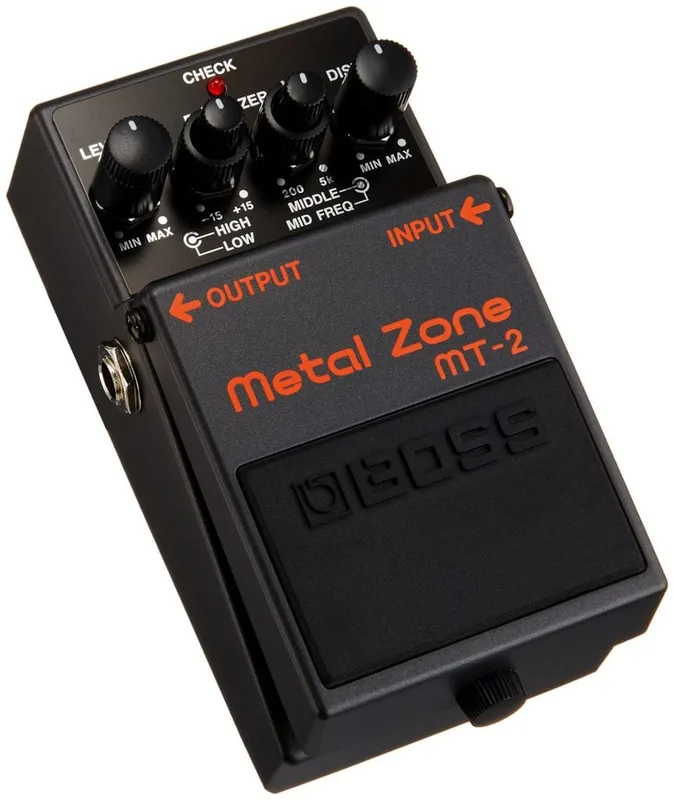
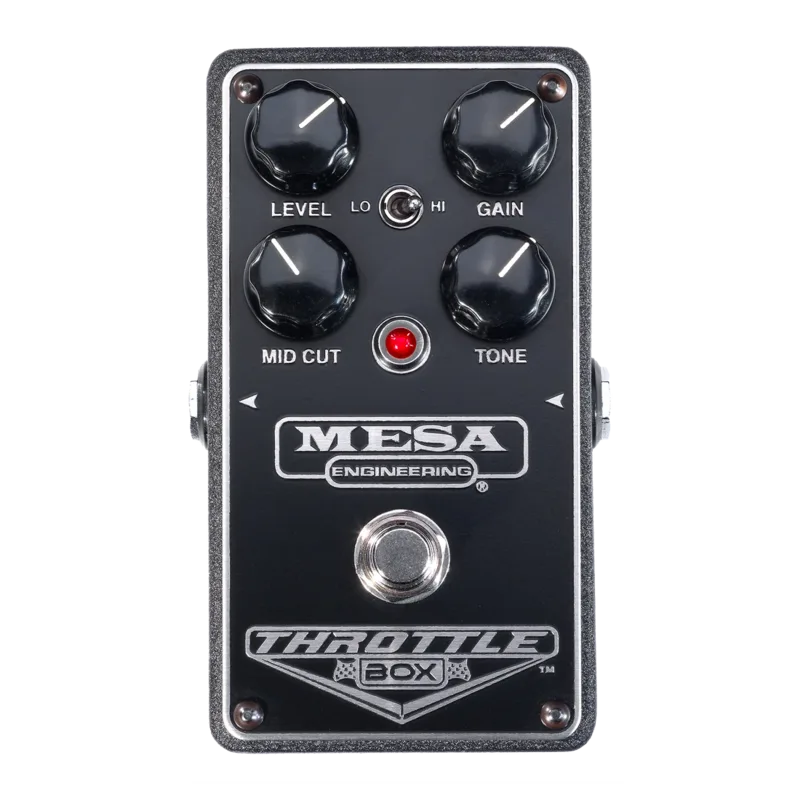
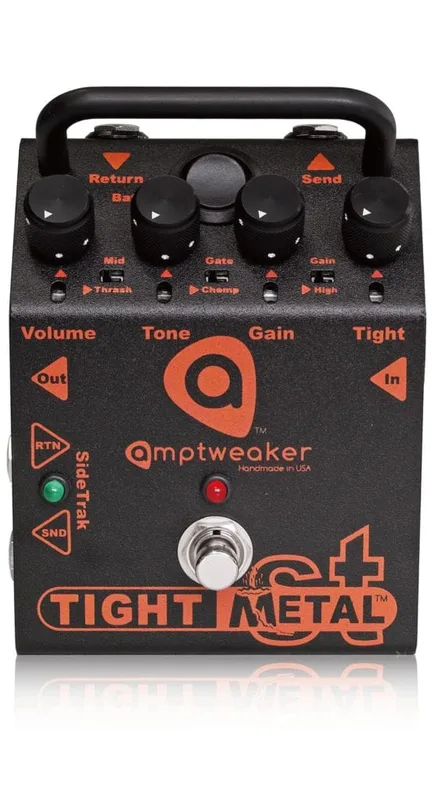
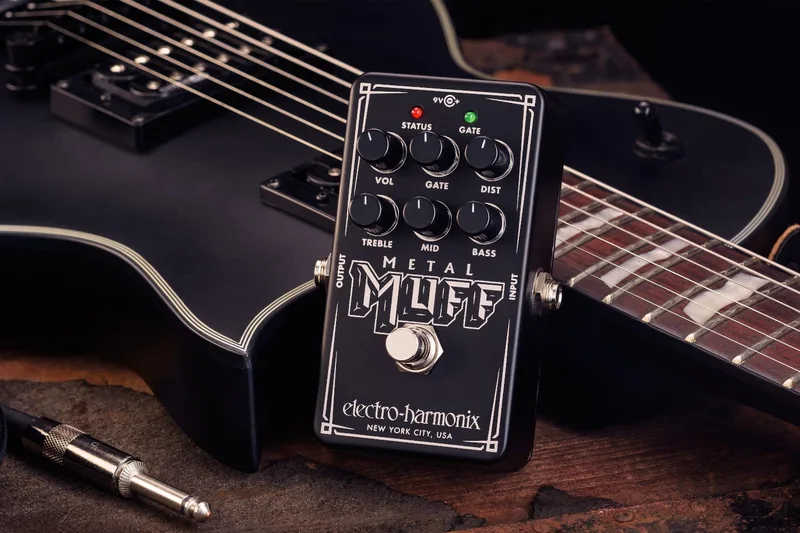
High-gain distortion pedals are the stompbox answer to metal amp gain: they clip the guitar signal hard, in the pedal rather than in the amplifier, so a clean or modest amp can still deliver saturated, aggressive distortion for rhythm and lead work. This page puts five of them side by side, the Boss MT-2 Metal Zone, the Electro-Harmonix Metal Muff, the Pro Co Rat 2, the Mesa Boogie Throttle Box and the Amptweaker TightMetal ST, and sets out what published sources say about how they work, how they are controlled, and how their circuits differ.
All five are distortion pedals, the category of drive pedal that clips the signal more heavily than an overdrive and less idiosyncratically than a fuzz. Where they differ from one another is in the details of the clipping circuit, the tone shaping wrapped around it, and the extra features, such as noise gates, that a high-gain design calls for.
The pedals side by side
The five pedals in this comparison come from five different makers, and each takes its own approach to high-gain distortion:
- Boss MT-2 Metal Zone, from Boss
- Electro-Harmonix Metal Muff, from Electro-Harmonix, described by the maker as a distortion pedal1
- Pro Co Rat 2
- Mesa Boogie Throttle Box
- Amptweaker TightMetal ST, from Amptweaker
Of the five, the Metal Muff is the one documented in the most detail, so it anchors the circuit and control sections below. The others are linked to their own pages, where their specifications and histories are covered.
The Metal Muff line has also come in more than one size. MusicRadar reported in January 2021 that Electro-Harmonix had "scaled down" the pedal with the Nano Metal Muff, a compact version of the circuit2. That matters for players building a small board: the same family of high-gain distortion is available in a full-size housing and a downsized one.
The two pedals share the same basic design: a distortion circuit with a three-band EQ and a boost stage. The full-size Metal Muff with Top Boost came first, and the Nano Metal Muff is the smaller version of it2.
How the circuits differ
A distortion pedal's character comes from its clipping stage: the part of the circuit that reshapes the guitar's waveform into the distorted signal that reaches the amp. High-gain designs like these push that clipping further than a typical overdrive, which is why the category is associated with metal rhythm tones. MusicRadar frames the Nano Metal Muff squarely in these terms, placing it among pedals "when it comes to high gain" distortion2.
The published details on circuit differences among these five are uneven. For the Metal Muff family, the maker's own product page identifies the pedal as a distortion unit, the full-size version carrying the "Top Boost" name that marks its additional boost stage1. The Top Boost is a separate control section on the pedal, distinct from the main distortion controls, and it is the feature the full-size Metal Muff is named for.
For the Nano version, Premier Guitar's buying guide of high-gain pedals documents what the smaller housing carries over, including its EQ range and its noise gate, covered below3.
Controls and EQ
Tone shaping is where high-gain pedals earn their keep, because heavy clipping can overwhelm the low end or shrivel the highs. The Metal Muff family's approach to this is documented by Premier Guitar's guide:
"This pedal offers +/- 14 dB of bass, a powerful noise gate, and an LED to let you know when the gate is on."
That bass control is a wide range by pedal standards: 14 dB of cut or boost on the low end alone, which lets a player either tighten up a flubby low end or add weight to a thin-sounding rig3. The gate and its indicator LED are covered in the next section.
The full-size Metal Muff with Top Boost adds its own control layer on top of the distortion and tone controls, with the Top Boost section giving an extra gain stage the player can dial in independently1. Players comparing the two versions are effectively choosing between that expanded control set and the Nano's smaller footprint.
| Control or feature | Metal Muff with Top Boost | Nano Metal Muff |
|---|---|---|
| Type | Distortion pedal1 | Distortion pedal2 |
| Bass EQ range | +/- 14 dB3 | |
| Noise gate | Yes, with on/off LED3 | |
| Boost stage | Top Boost section1 |
Noise gates and high gain
Heavy gain amplifies everything, including the hiss and hum that a quiet guitar signal carries. That is the practical reason the noise gate question comes up with metal distortion pedals, and it is why some builders put the gate inside the pedal itself. The Nano Metal Muff takes that route: Premier Guitar's guide highlights its "powerful noise gate" and the LED that shows when the gate is active, so a player can see at a glance whether the silence-between-notes function is engaged3.
For pedals without a built-in gate, a separate noise gate pedal placed after the distortion in the signal chain does the same job, and that comparison is covered in its own right elsewhere on the site.
Related comparisons
Players weighing these five against a wider field may also want to look at the site's broader comparison of guitar pedals for metal, its overview of overdrive, distortion and fuzz pedals as categories, and its guide to drive pedal categories for how amp-in-a-box and boost designs relate to straight distortion. The Big Muff family covers Electro-Harmonix's other famous high-gain line, the fuzz side of the house.
Questions
Do metal distortion pedals need a noise gate?
High gain circuits amplify the noise floor along with the signal, so many metal pedals build a gate in. The Electro-Harmonix Nano Metal Muff, for example, includes what Premier Guitar's buying guide calls a powerful noise gate, with an LED that shows when the gate is engaged. If a pedal has no gate, a separate gate pedal placed after it in the chain does the same job.
Sources (3)
- Metal Muff with Top Boost, Electro-Harmonix (ehx.com)
- Electro-Harmonix scales down with the new Metal Muff Nano, MusicRadar, 2021-01-04
- High-Gain Pedals: Transform Your Tone with Fire, Premier Guitar, 2024-12-24