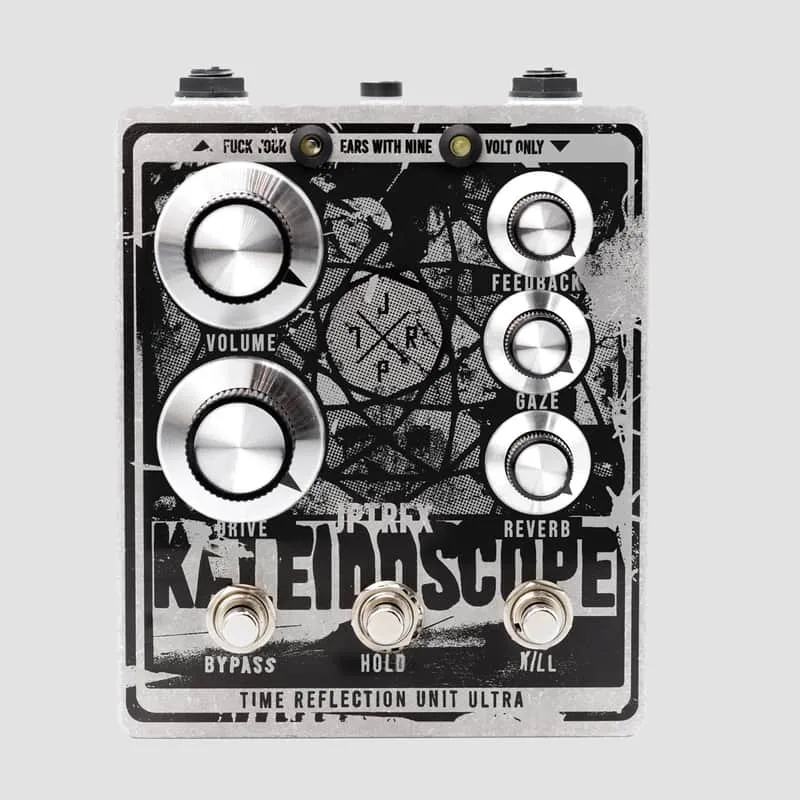


The JPTR FX Kaleidoscope is a reverb pedal from [JPTR FX] that works differently from a conventional reverb: rather than producing one tail, it reflects your signal, once or more, with each duplicate meshing together while adding compression, modulation and large amounts of feedback to the sound1. Delicious Audio's Paolo De Gregorio, writing when the pedal launched in December 2021, placed it among textural reverbs that run "from subtle spring-like tones, to vast ambient soundscapes and anywhere in between"1. It belongs on any shortlist of unusual reverb pedals.
What it does to your sound
JPTR FX describes the Kaleidoscope's core idea as a signal that is duplicated and reflected, with the duplicates meshing together while compression, modulation and heavy feedback are layered on2. The maker says the design is meant to evoke a "Fender Twin" with the reverb cranked, where the amp's power stage compresses and further drives the reverberation2. That amp behavior is simulated with the pedal's Comp knob2.
The circuit layout is what sets it apart. In a 2023 buying guide, Delicious Audio's reviewers called it "A very unusual reverb circuit with a Gain & Compression circuit placed after the reverb, which can squash your tails prolonging them for an ambient sustain" and noted it can even produce fuzzy results3. Compression normally sits before a reverb in a signal chain; here it acts on the tails themselves, which is why the pedal can stretch and saturate its decay in ways a standard reverb cannot.
Controls and footswitches
The Kaleidoscope Ultra carries five knobs: Volume, Drive, Feedback, Gaze and Reverb4. The maker suggests one starting point: roll back the Reverb and dime the Feedback control for "lush, rhythmic wobbles that twist and gyrate along to your sound"2.
| Control | What it does |
|---|---|
| Volume | Overall output level4 |
| Drive | Drive stage ahead of the reverb2 |
| Feedback | Amount of feedback on the reflections; dime it with Reverb rolled back for rhythmic wobbles2 |
| Gaze | One of the five main controls on the Ultra4 |
| Reverb | Reverb level; roll back for rhythmic wobbles, turn up for a saturated, sustained sound2 |
| Comp | Sets the simulated amp compression that pushes the reverb tails2 |
The original Kaleidoscope was reviewed with three footswitches, of which one is just an on/off switch and the other two carry functions1. On the Ultra, the Hold switch is kept pressed down to achieve a ramp of feedback that sends the reverb into self-oscillation2. Delicious Audio also describes three separate control stages offering instant shifts in depth, texture and oscillation, including an all-wet, crispy whisper via the Kill-Dry switch1.
The Kaleidoscope Ultra is a new version of the original Kaleidoscope, and the 10YRS edition is a limited release marking ten years24. The two versions share the core design, but the Ultra adds the Comp knob and the Hold self-oscillation function described above2.
Power
The Kaleidoscope runs on a regular 9 V DC supply with a 2.1 mm center-negative connector and draws less than 120 mA1. That is within reach of most pedalboard power supplies, but it is above what a few low-current outputs deliver, so give it an output with enough headroom.
Beyond guitar
JPTR FX says the Kaleidoscope was designed to complement and adapt to all musical styles and input signals, naming guitar, bass, drums, synths and even vocals2. Delicious Audio's 2021 write-up made the same point, listing the same range of sources1. For a player, that means the pedal is not tied to a guitar chain: it can sit on a synth line, a drum bus or a vocal as readily as on a board.
Videos
JPTR FX
BassTheWorld.com
Jackson Brooksby
Questions
What kind of reverb is the JPTR FX Kaleidoscope?
It is a reverb pedal that JPTR FX and reviewers describe as a multi reflector unit: instead of a single reverb tail, it reflects your signal once or more, with each duplicate meshing together while adding compression, modulation and large amounts of feedback. Delicious Audio describes its range as textural reverbs, from subtle spring-like tones to vast ambient soundscapes.
Does the JPTR FX Kaleidoscope work with bass, synth, and drums?
Yes. JPTR FX says the Kaleidoscope was designed to complement and adapt to all musical styles and input signals, and names guitar, bass, drums, synths and even vocals as intended sources. That makes it usable beyond guitar, including on a mixer or in a studio chain.
What power supply does the JPTR FX Kaleidoscope need?
It runs on a regular 9 V DC power supply with a 2.1 mm center-negative connector and draws less than 120 mA of current. A standard pedalboard supply with enough spare current on one output will run it.
What does the compression stage after the reverb do?
The Kaleidoscope places a Gain & Compression circuit after the reverb, which Delicious Audio describes as very unusual. It can squash the reverb tails, prolonging them for an ambient sustain, and at extremes even produce fuzzy results. On the Ultra, the Comp knob sets a simulated amp compression that pushes the reverb tails.
How many footswitches does the JPTR FX Kaleidoscope have?
Three. Delicious Audio's Paolo De Gregorio notes that two of the three footswitches have very cool functions, while the other one is just an on/off switch. On the Kaleidoscope Ultra, the Hold switch is kept pressed down to ramp feedback into self-oscillation.
Sources (4)
- JPTR FX Kaleidoscope, Delicious Audio, 2021-12-06
- JPTR FX Kaleidoscope Ultra, JPTR FX (jptrfx.com)
- The Best Reverb Pedals With Modulation Or Fuzz/Distortion In 2023, Delicious Audio, 2023-01-30
- JPTR FX Kaleidoscope ULTRA, JPTR FX