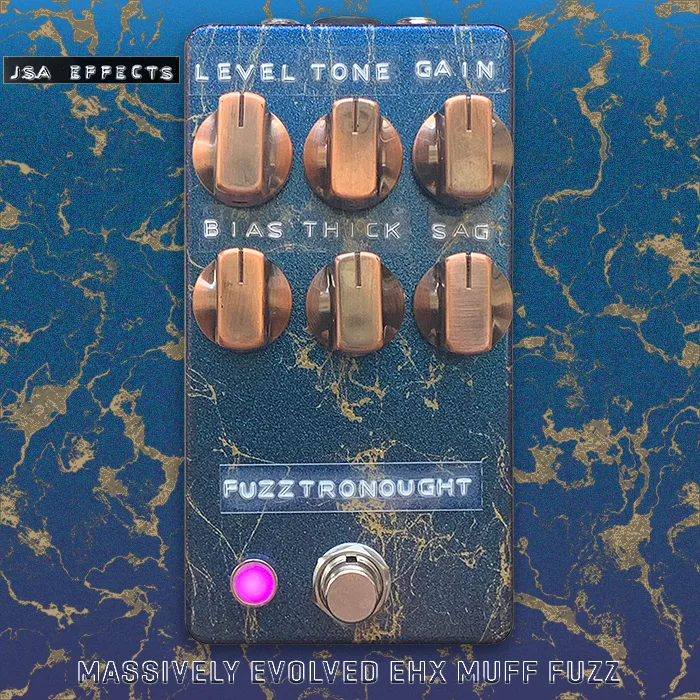
The JSA Effects Fuzztronought is a fuzz pedal built on the late '69 Electro-Harmonix One-knob Plug-in Muff Fuzz, an early single-knob ancestor of the Big Muff family. Designer Simon expanded that one-knob circuit into a six-knob design, adding Bias, Thick and Sag controls alongside the usual Level, Tone and Gain. Guitar Pedal X's Stefan Karlsson called it "a six-knob evolution of the late '69 EHX One-knob Plug-in Muff Fuzz"1.
Only five Fuzztronoughts exist. Simon made them for the Leeds Pedal Show, priced at £150 each, and they pretty much sold out at the show. As of the May 2026 review, none were listed on the JSA Effects Reverb.com store1.
Controls
| Control | What the review says |
|---|---|
| Level | Output level |
| Tone | Tone shaping |
| Gain | Fuzz amount |
| Bias | Best left of noon; past noon you can choke out the signal |
| Thick | Highly interactive with Gain and Bias |
| Sag | Best left of noon; past noon you can choke out the signal |
The Bias and Sag controls are the ones that need a light touch. Guitar Pedal X found that "Bias and Sag sound best left of noon", because past that point you can choke out the signal1. Simon notes that the bottom three controls, Gain, Bias and Thick, are incredibly interactive, and if things start to choke out you need to dial back the Bias further1.
Circuit
The Fuzztronought runs on three silicon transistors, two BC549C and one 2N3904, with a 2N7000 MOSFET at the start of the circuit acting as a boost stage1. The MOSFET boost ahead of the fuzz stages is part of how the pedal drives its Muff-style core.
What reviewers said
Guitar Pedal X's review, published 8 May 2026, is the main published account of the pedal. Stefan Karlsson's verdict1:
"For me the Fuzztronought is an instant satisfaction fuzz - relatively easy to dial in - and so wonderfully full-on"
He described the pedal as delivering full-on sustain and varied fuzz textures, and found all six controls matter, calling it pretty much a perfect circuit overall1. He also compared it favourably to the already exceptional LNS Overdrive Modded OD-1 he picked up at the same show1.
Availability and demo
The Fuzztronought is a show exclusive that sold out: five units, all gone, and none listed on the JSA Effects Reverb.com store as of May 20261. There is also no demo yet of this particular fuzz, so the Guitar Pedal X review is the main record of how it sounds1.
Questions
Is the JSA Effects Fuzztronought still available?
No. Simon of JSA Effects made five Fuzztronought pedals for the Leeds Pedal Show in April 2026, and they sold out at the show. As of the Guitar Pedal X review in May 2026, none were listed on the JSA Effects Reverb.com store, so the pedal is effectively gone from retail.
How many Fuzztronought pedals were made?
Five. Simon made five units for the Leeds Pedal Show, priced at £150 each, and they pretty much sold out at the show itself. It is a limited edition in the strictest sense: no further run is mentioned.
What circuit is the Fuzztronought based on?
The late '69 Electro-Harmonix One-knob Plug-in Muff Fuzz, an early ancestor of the Big Muff line. JSA Effects expanded that single-knob circuit into a six-knob design with Level, Tone, Gain, Bias, Thick and Sag controls.
What do the Bias and Sag knobs do?
Bias and Sag shape how the circuit behaves under strain, in the manner of a starving or sagging power supply. Guitar Pedal X found they sound best left of noon, because past noon you can choke out the signal. They also interact heavily with the Gain and Thick controls.
What transistors does the Fuzztronought use?
Three silicon transistors: two BC549C and one 2N3904. There is also a 2N7000 MOSFET at the start of the circuit, which acts as a boost stage.
Is there a demo of the Fuzztronought?
Not as of the May 2026 Guitar Pedal X review, which noted there was no demo yet of this particular fuzz. The review itself is the main published account of how the pedal sounds and behaves.
Sources (1)
- Guitar Pedal X, Guitar Pedal X, 2026-05-08