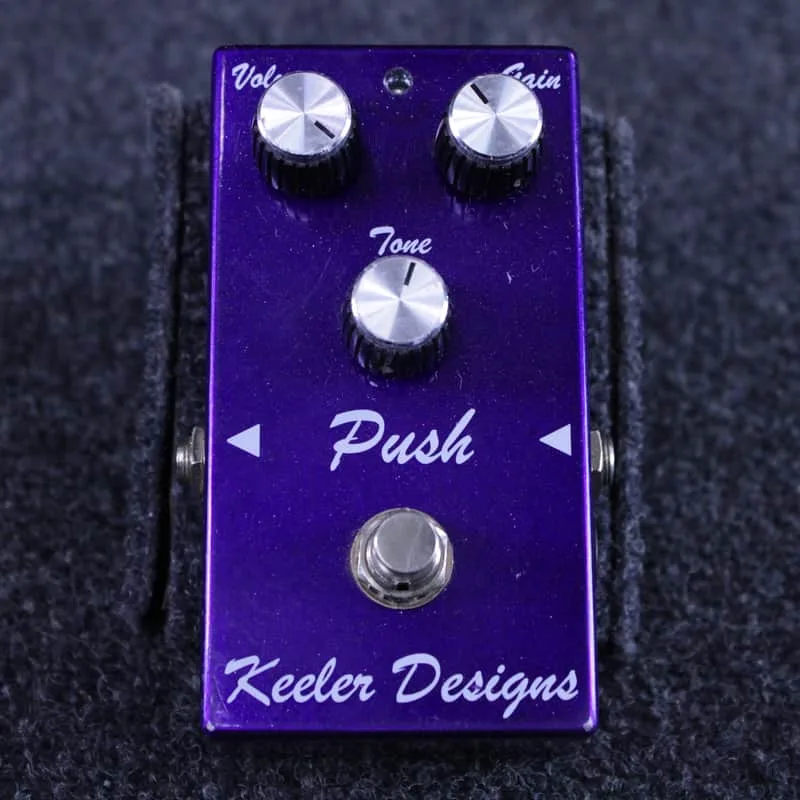


The Keeler Designs Push is an overdrive pedal from Keeler Designs, Rob Keeler's pedal company. MusicRadar's review places it in the Tube Screamer family of drives, noting that "the Push has much in common with other boutique Tube Screamer-style drive stompboxes," and describes its sounds as "versatile and satisfyingly crunchy pro-spec overdrive sounds" that also "work well as a clean boost at lower drives settings too."1 For players weighing it against the classics of that circuit family, our Boss SD-1 vs Ibanez TS9 Tube Screamer comparison covers the originals, and our Overdrive Pedals page sets out the wider field.
What it does and how it is controlled
The Push keeps things simple: three knobs cover the whole pedal. MusicRadar describes them "sculpting a range of tones from a low gain, high volume boost perfect for pushing a valve amp into" breakup through to "more saturated, searing lead tones."1 That low-gain, high-volume end of the range is where the pedal doubles as a clean boost, in the same role covered by dedicated units on our Boost Pedals page.
The switching is true bypass, on what MusicRadar calls a "chunky true bypass footswitch," so the pedal is fully out of the chain when off.1
"Another impressive stompbox from Keeler that lives with the very best of the competition."
MusicRadar adds that "Rob Keeler's pedals have impressed us lately and the Push overdrive is no exception."1
Build
The pedal is housed in what MusicRadar calls "the unit's robust Hammond-style enclosure," the standard diecast aluminum box format familiar from most boutique pedals.1
The DIY angle: a published layout
For builders, Guitar FX Layouts posted a self-drawn vero (stripboard) layout and schematic for the Push in June 2017, with the contributor noting "This one is work of mine, and thus, ok to post." A builder verified the layout in the comments.2
A few points from that thread are worth knowing before you build:
- Diode placement: D1 sits in parallel in the schematic and in series in the vero layout. The blog's contributor confirms "Both work, in the schematic is en parallel and the vero is in series."2
- Polarity protection: the blog favors series polarity protection "due to its non-destructive behaviour when reverse polarity" power is applied.2
- Wiring note: Volume 2 connects to output, per the note on the layout.2
On voicing, a builder reported: "I just built this one and I like the sound quite a bit. It's dark though and I have to dime the tone knob." The same builder found a fix: "I swapped the 6.8nf cap for a 4.7, which helped a bit."2 So if you build one and find it dark, the tone cap is the component to look at.
Videos
fatback2
Joe Perkins
Stanislav Jelínek
Questions
Is the Keeler Designs Push true bypass?
Yes. MusicRadar's review describes the Push as having a chunky true bypass footswitch, so the pedal is out of the signal path entirely when switched off. That matters if you run a long pedalboard chain or want the pedal to leave your amp's input untouched when it is not engaged.
Can the Keeler Push be used as a clean boost?
Yes. MusicRadar found that the Push works well as a clean boost at lower drive settings, with the three knobs covering a range from a low gain, high volume boost suited to pushing a valve amp into breakup, up to more saturated lead tones.
What is the Keeler Push based on?
MusicRadar's review notes that the Push has much in common with other boutique Tube Screamer-style drive stompboxes. It is a three-knob overdrive in that family, voiced to run from a boost into a valve amp through to searing lead tones.
Is there a DIY layout for the Keeler Push?
Yes. Guitar FX Layouts published a self-drawn vero (stripboard) layout and schematic for the Push in June 2017, and a builder verified the layout in the comments. Builders there also noted a difference in diode placement between the schematic and the stripboard version, saying both work.
Why does the Keeler Push sound dark?
A builder on Guitar FX Layouts reported that the Push sounds dark and that the tone knob needs to be dimed. Swapping the 6.8nF cap for a 4.7 helped a little, according to that builder, so the tone voicing is something a DIY builder can adjust.
Sources (2)
- Keeler Designs Push overdrive pedal review, MusicRadar, 2010-12-19
- Guitar FX Layouts: Keeler Designs Push, Guitar FX Layouts (tagboardeffects.blogspot.com), 2021-02-14