


The Keeley DDR Drive Delay Reverb is a multi-effect pedal that combines overdrive, delay and reverb in one compact box, built around two footswitches: one for the Drive channel and one for the Wet (delay and reverb) side. It was announced at NAMM 2019 and became available on 23 May 2019 for $17912.
The idea behind the pedal is to cover the three most common effects in a single unit. MusicRadar reported Keeley's own positioning for it, that it is "intelligently designed to be the only pedal you may ever need"3. In practice, that means a drive side with two overdrive voices feeding a wet side with two reverb types and two delay styles, plus an effects loop so the pedal can sit inside a larger rig rather than replace it.
Overdrive, delay and reverb in one pedal
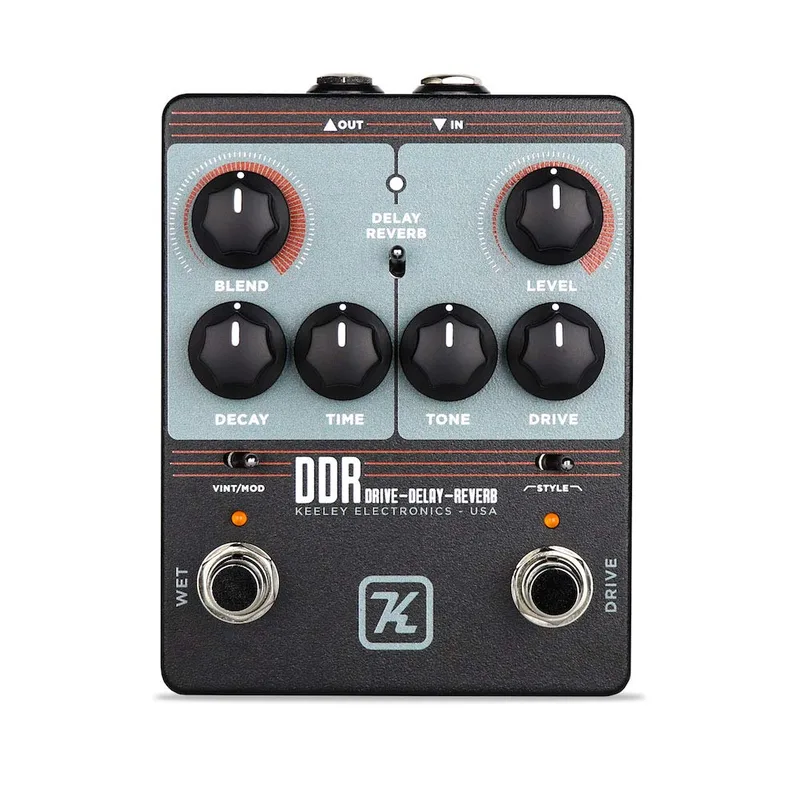
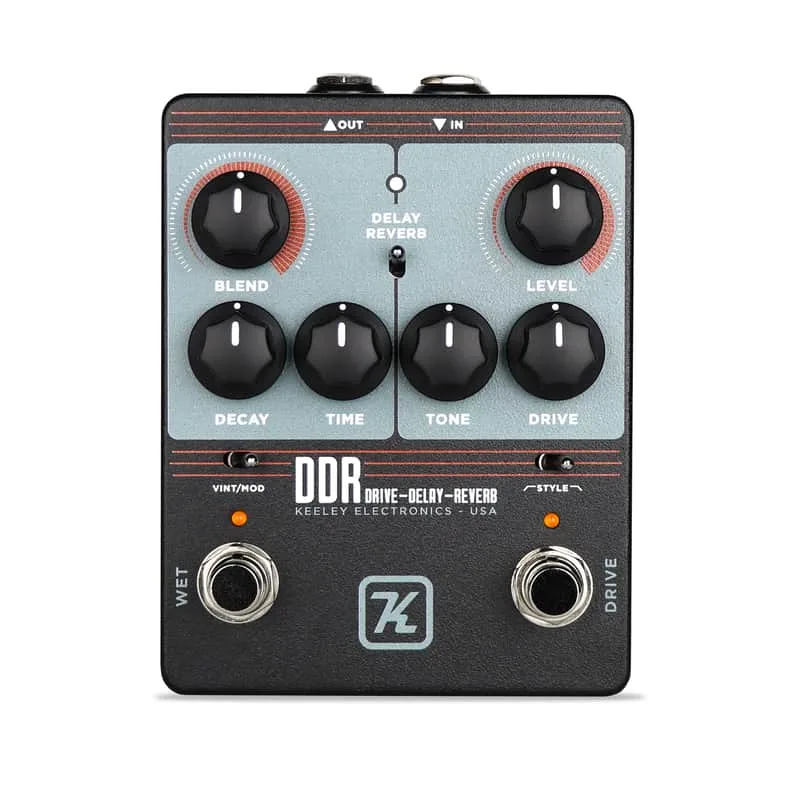
The DDR splits its circuit into two halves. The Drive channel offers two overdrive styles, Crunch and Lead, while the Wet side offers two reverb types (Spring or Plate) and two delay styles (analog or digital)1. Gearnews described the two overdrive voices as Crunch, a British valve-amp combo sound, and Lead, a mid-pushed overdrive tone2.
The pedal is designed so the two halves work together: drive into ambience, the way most players order these effects on a board. Delicious Audio's write-up noted that an on-board effects loop lets you insert pedals between the drive and ambience sections, which helps integrate the DDR into a bigger setup rather than forcing an either-or choice1.
The effects loop jacks are top-mounted and can also be used to split the signal, so the same jacks serve pedal insert or split duties depending on how you cable them1.
The controls
The DDR keeps its control set small, with three knobs per side and toggle switches for voicing415.
| Control | What it does |
|---|---|
| Drive channel: Volume, Tone, Drive | Level, brightness and gain for the overdrive side1 |
| Style switch | Selects Tube-amp Crunch or Lead-channel Sustain1 |
| Wet channel: Blend, Decay, Time | Mix level, tail length and delay time or reverb decay for the delay/reverb side14 |
| Delay/Reverb switch | Center toggle, selects which wet effect is active16 |
| Vintage/Modern switch | Toggles Spring and Plate reverb, or analog and digital delay1 |
| True-Bypass/Trails switch | Side-mounted selector for the bypass behavior1 |
The Vintage/Modern switch is the voicing control for the wet side: in reverb mode it chooses between Spring and Plate, and in delay mode between analog and digital1. Gearnews' NAMM coverage described the same pair of switches, a Vintage/Modern switch for the delay/reverb sound and a Delay/Reverb selector at the top6.
Power and connections
The DDR runs on 9V DC at 100 mA and has no battery option1. That means it needs a mains adapter or a powered pedalboard output; there is no way to run it on a 9V battery the way many compact analog overdrives can.
The top-mounted jacks handle the effects loop and split functions described above1. Bypass behavior is set by the side-mounted switch: true bypass takes the whole circuit out of the signal path, while trails mode lets delay and reverb tails ring out after the effect is switched off12.
History: a Robert Keeley design
The DDR was one of four new pedals Keeley Electronics announced at NAMM 20191. It was designed and made in the USA1, and Guitar.com credited it as a Robert Keeley design, writing that "With the DDR, Robert Keeley has united both the wet and dry ends of the signal chain in just one box"7.
The pedal went on sale on 23 May 2019 at a list price of $1791, with Gearnews noting orders could be placed directly from the Keeley website from 23 May at an RRP of USD 179 plus shipping and taxes2.
What reviewers said
Published reviews were broadly positive about the pedal's concept and sound, with some reservations about its depth827.
Premier Guitar's quick-hit review praised the pedal's design, singling out its "Smartly designed effects loop" and "Great spring reverb emulation"4. Guitar.com, reviewing it for its 2019 multi-effects awards coverage, found it packed a lot into a small box:
"Impressive amount of functionality for its size, which saves you the trouble of reaching for a full multi-effects unit7."
Guitar.com, 20197
The same review was positive about both halves of the circuit, writing that "The drive side of the DDR has spank and snarl, but refined and expressive even as we dial in more volume and drive," and that "The analogue delay is just as good as the reverb; the repeats degrade beautifully and it is more than wet enough on its own"7.
Guitar World's review took a more measured view of the wet side's depth, writing that "DDR: Delay and reverb fiends may want more versatility than the pedal provides"8. Gearnews made a similar point at launch, saying the pedal "is aimed at players who want a fairly standard guitar tone, but it may be a little too 'middle of the road' for some"2.
Pete Thorn demoed the pedal on his YouTube channel when it shipped, covering the drive, delay and reverb sounds and the switching between them9.
Pedal of the Day also reviewed the DDR, concluding that "delay and reverb fiends may want more versatility than the pedal provides"8, and Delicious Audio later covered it, noting its two overdrive voices, Crunch and Lead, and quoting its claim of being "intelligently designed to be the only pedal you may ever need"3.
Videos
Sweetwater
Keeley Electronics
Questions
Does the Keeley DDR have an effects loop?
Yes. The DDR has a built-in effects loop between the Drive and Wet (delay and reverb) sides of the circuit, with top-mounted jacks for pedal insert or split. This lets you place another pedal, for example a modulation effect, between the overdrive and the ambience sections so it integrates into a larger board.
Is the Keeley DDR delay analog or digital?
Both. The Wet side of the circuit offers two delay styles, analog and digital, selected by a Vintage/Modern toggle switch. Guitar World described the range as analog (vintage) or digital (modern) delays from slapback to about 1.2 seconds, and Guitar.com found the analog repeats degrade beautifully.
Can the Keeley DDR run on a battery?
No. The DDR runs on 9V DC at 100 mA and has no battery option, so it needs a power supply or a powered pedalboard. Its 100 mA draw is modest by multi-effect standards, but it rules out a 9V battery.
Does the Keeley DDR have true bypass or trails?
Both, selectable. A side-mounted switch lets you choose true bypass or trails switching for the delay and reverb. Trails mode lets the reverb and delay tails continue to ring out after you switch the effect off, while true bypass removes the circuit from the signal path entirely.
What overdrive circuit is in the Keeley DDR?
The Drive channel is a pair of modified super-drives, selectable between two voices: Crunch, described as a dimed and chimey British combo flavor, and Lead, a thick, mid-focused sound aimed at solos. Controls are Volume, Tone and Drive.
Sources (9)
- Keeley Electronics DDR Drive Delay Reverb, Delicious Audio, 2019-07-22
- Keeley DDR Drive Delay Reverb: A Swiss Army knife effect pedal?, www.gearnews.com, 2019-05-23
- Keeley's DDR Drive Delay Reverb is designed to be "the only pedal you may ever need", MusicRadar, 2019-05-22
- Quick Hit: Keeley DDR Review, Premier Guitar, 2019-07-07
- Keeley Electronics Unveils the DDR - Premier Guitar, Premier Guitar, 2019-05-24
- NAMM 2019: Keeley announces new Synth-1, DDR, Fuzz Bender and Eccos, gearnews.com, 2019-01-24
- Gear Of The Year: Best multi-effects pedals of 2019, Guitar.com, 2019-12-03
- Keeley DDR Drive Delay Reverb & Fuzz Bender pedals review, Guitar World, 2020-02-07
- DRIVE, DELAY, REVERB.. in 1 PEDAL! KEELEY DDR, youtube.com, 2019-07-20