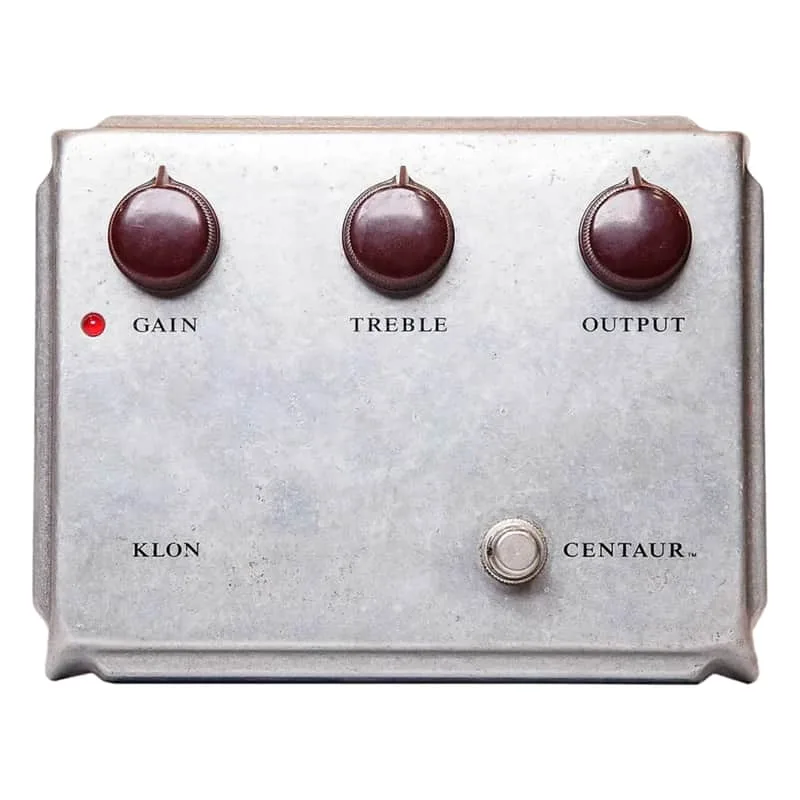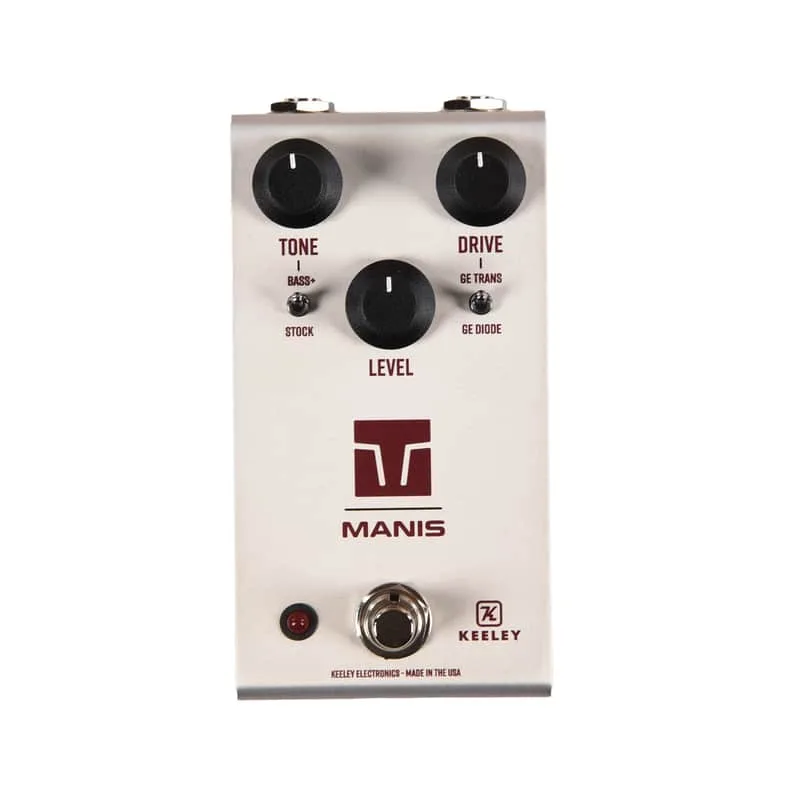


The Keeley Manis is an overdrive pedal from Keeley Electronics, built on the Klon Centaur circuit and released in June 2025. Robert Keeley's twist on the recipe: alongside the germanium diodes the original Klon used for clipping, the Manis adds Russian Cold War-era germanium transistors as a second, switchable clipping option, combined with the diodes for more compression and saturation123.
The pedal keeps the classic three-knob layout of Tone, Drive and Level, and adds two toggle switches: one selects between germanium diode and germanium transistor clipping, the other engages a bass boost. It was presented as a replacement and upgrade for the Keeley Oxblood, which had been out for several years with an almost identical topology3. It launched at $199, shipping from June 19, 20251.
A Klon-style overdrive with germanium transistor clipping
The Manis takes the basic Klon Centaur architecture and asks a simple question: what if you swapped the mythical germanium diodes for germanium transistors? Robert Keeley found his answer in Soviet-era germanium transistors, obtained from Ukraine, which do the work of the original's diodes when you flip the clipping toggle112. On the JHS Pedals video, Keeley explained that the transistors are wired as diodes, using only the base and emitter legs with the collector left unconnected12.
The two clipping positions give the pedal two personalities:
| Position | What it does |
|---|---|
| GE Diode | The iconic Klone sound: classic mid-forward boost character43 |
| GE Trans | More compression, saturation and sustain; softer, more tube-amp-like attack, less mid-forward2412 |
Keeley told MusicRadar that in the transistor position "you get a different cut-off voltage, and that increases the saturation, the compression, the sustain. So you have a Klon" with more gain on tap and more second-order harmonics that sound more tube-like1. Pete Thorn described the two modes as "basically like a smoother, darker, sort of more vintagey thing and a more puncher, fatter, more modern thing in the diode" position13.
The pedal came out of a direct request. Trey Anastasio's tech Justin Stabler texted Keeley saying it was the perfect time to send Trey a bunch of Klon ideas to audition, and boards were ordered and units sent out within a week or two of the idea125. Craighton Hale, who worked with Keeley on the pedal, had also been working on the bass boost that lets more bass into the clipping section5. The name comes from the era before Clovis, a nod to JHS's tube clone12.
The controls
The three knobs are carried over from the original Klon: Tone, Drive and Level14. The two toggles are where the Manis departs from the recipe.
| Control | What it does |
|---|---|
| Drive | Sets the amount of gain1 |
| Tone | Shapes the treble response1 |
| Level (Volume) | Sets the output level41 |
| GE Trans / GE Diode toggle | Selects germanium transistor or germanium diode clipping2110 |
| Bass+ / Stock toggle | Bass boost on or off1049 |
| Footswitch | Engages the pedal; press and hold two seconds to toggle true/buffered bypass13 |
The Bass+ switch pushes the lower half of the pedal's mid-focused response down by one octave and increases the output by +3dB23. Keeley describes it as the "perfect low end recovery and push for single-coil guitars," and told Guitar World it is "enough to make any single-coil feel proud of itself"19. Premier Guitar's demo notes it is perfect for making single coils sound fatter, fuller, and more powerful4.
The bypass is selectable on the fly: the Manis ships in buffered mode as standard with silent switching, and holding the footswitch for two seconds toggles to true bypass1. Buffered switching prevents the pops and clicks of true-bypass switching, and the buffer improves signal clarity in larger setups while true bypass preserves tone in simpler rigs214.
Power: 9V to 18V, 15mA
The Manis runs on a 9V to 18V DC adaptor from a pedalboard power supply, drawing 15mA according to Guitar World's review1910. Gearnews lists the current draw as 17mA, so the published figures disagree8. The adaptor is not supplied9.
Pedal of the Day called it the first Klone you can power with 18 volts for increased headroom15. Inside, a 12V regulator sits before the charge pump to protect the pedal from overvoltage, as Josh Scott noted on the JHS Pedals video12.
No battery option is mentioned in any of the coverage; the pedal is powered by a DC adaptor only, and the adaptor is not included with the pedal10.
Versions and finishes
At launch the Manis came in three colorways: standard Brushed Silver, a Gold finish exclusive to Guitar Center, and a Black finish exclusive to PGH9. All use the same durable aluminum enclosure14. It is a standalone pedal, distinct from Keeley's multi-pedal drive enclosures that hold two clone circuits per box12.
What reviewers said
Reviews were positive across the board. Guitar World's Trevor Curwen found that with both switches down, diodes and no extra bass, the pedal "nails" the sound of an original Klon, and that switching to transistor mode gives "more of a valve-like feel as those driven tones become a little more saturated and compressed"10. His verdict: "Robert Keeley has taken the basic Klon architecture and come up with something with much more versatility in a pedalboard-friendly package"11.
Guitar Pedal X's Stefan Karlsson called it "a pretty cool Mod of the Klon - where the Bass Boost works really well," and found the core Klon voicing very decent with a unique take overall6. Pedal of the Day said it "sounds fantastic" and placed it at the top of their Klone list immediately15. Pete Thorn, comparing it against his Rocket Archer, called it "a great recreation of that type of circuit"13.
Keeley himself told MusicRadar the goal was to "absolutely nail the original Klon sound," verified by A/B comparison against a reference Klon unit, and that the pedal is "really kind of a miracle cure for those that have the Klon blues"1. In a later Guitar World interview he said:
Robert Keeley's own explanation of the sound centers on the Russian germanium transistors. He said he found a magic ingredient with them that he could not have simulated any other way, describing the result as getting lucky with a great sound, and he called the 3 dB bass boost remarkably well voiced9.
Premier Guitar's John Bohlinger demoed the pedal at launch and concluded that "The Manis is an evolution of the original circuit," not just a mod2.
Videos
JHS Pedals
Pete Thorn
News
Questions
Is the Keeley Manis true bypass?
It is selectable. The Manis ships in buffered mode with silent switching, and you can toggle to true bypass by pressing and holding the footswitch for two seconds. The buffer suits larger pedalboards where signal clarity matters, while true bypass suits simpler rigs.
What settings make the Keeley Manis sound like an original Klon?
Set both toggle switches down: germanium diodes for clipping and no bass boost. Guitar World's reviewer found that this setting nails the sound of an original Klon. The germanium diode position gives the classic mid-forward boost sound the Klon is known for.
Does the Keeley Manis replace the Keeley Oxblood?
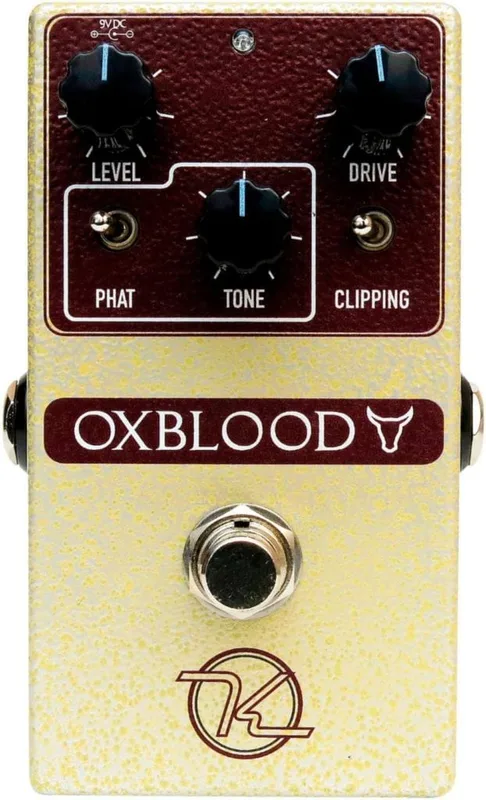
It resembles the Oxblood and was presented as its replacement and upgrade. The Oxblood had been out for several years with an almost identical topology, including a Phat switch and a clipping switch, so the Manis carries that idea forward with new germanium transistor clipping.
What does the Bass+ switch on the Keeley Manis do?
It drops the low-end frequency response by a full octave and boosts the whole signal by 3dB. Keeley describes it as the perfect low end recovery and push for single-coil guitars, and Premier Guitar notes it makes single coils sound fatter, fuller, and more powerful.
Does the Keeley Manis come with a power supply?
No. It runs on a 9V to 18V DC adaptor that is not supplied, drawing about 15mA. A 12V regulator before the internal charge pump protects the pedal from overvoltage, and 18V operation gives increased headroom.
What colors does the Keeley Manis come in?
It launched in three colorways: standard Brushed Silver, a Gold finish exclusive to Guitar Center, and a Black finish exclusive to PGH. All are built in the same aluminum enclosure.
Sources (15)
- “It's really kind of a miracle cure for those that have the Klon blues”: Keeley Electronics' new Manis Overdrive remixes the classic K-style drive recipe for those who don't like the original (and those who do), MusicRadar, 2025-06-17
- Ultimate Klon Killer? The Keeley Manis Overdrive Demo with John Bohlinger, Premier Guitar, 2025-06-16
- Guitar Pedal X, Guitar Pedal X, 2025-06-16
- Keeley Electronics Introduces Manis Overdrive, Premier Guitar, 2025-06-16
- Keeley Electronics’ Robert Keeley’s guitar pedals, Premier Guitar (www.premierguitar.com), 2025-08-07
- Guitar Pedal X, Guitar Pedal X, 2025-09-03
- The Year In Gear 2025, Premier Guitar, 2025-11-07
- Keeley Manis Overdrive: Cold War-era Germanium, gearnews.com, 2025-06-16
- Keeley Electronics puts its own spin on the Klon Centaur recipe, Guitar World, 2025-06-18
- Keeley Manis review, Guitar World, 2025-09-30
- Best Klon clones 2026: Klon Centaur Klones for every budget, Guitar World, 2022-06-09
- The Keeley Manis: A Deep Dive on the Klon Centaur Circuit, JHS Pedals (youtube.com), 2025-06-15
- IS THIS A BETTER KLON? Keeley MANIS OVERDRIVE, Pete Thorn (YouTube), 2025-10-31
- Keeley Manis Overdrive (Klon Evolution), Delicious Audio, 2025-11-05
- Keeley Electronics Manis, Pedal of the Day, 2025-06-16