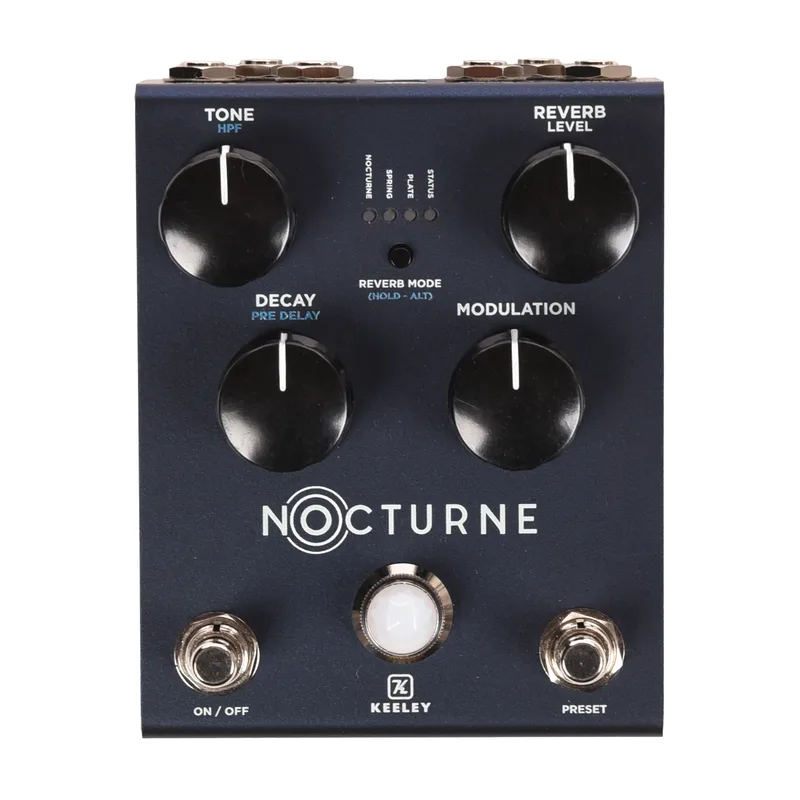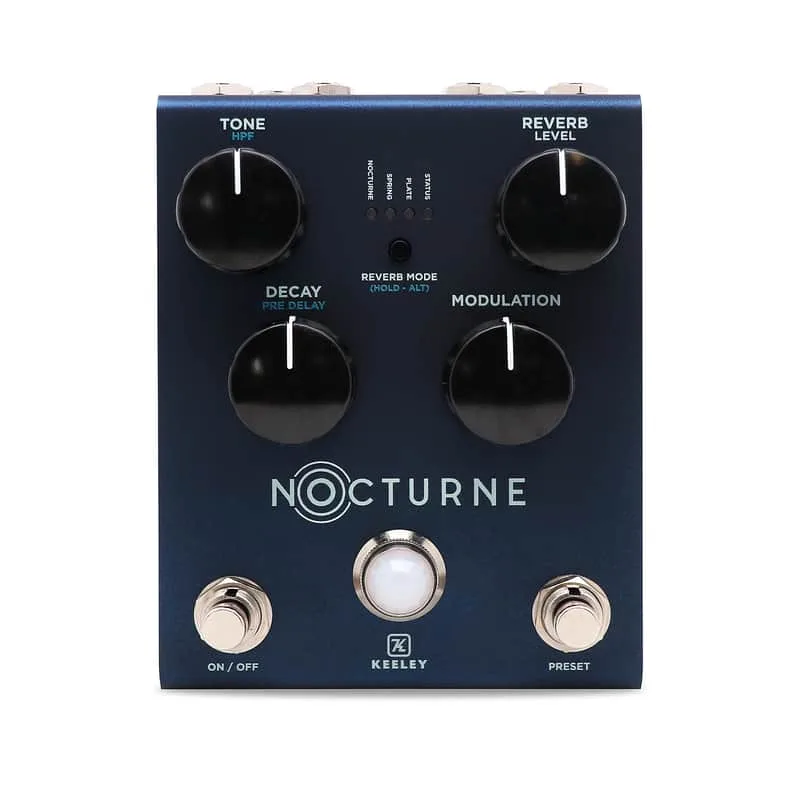


The Keeley Nocturne is a stereo reverb pedal co-designed by Robert Keeley and Andy Timmons, the latest in a line of signature collaborations between the two that also includes the Super AT Mod, Muse Driver and Halo Dual Echo1. Robert Keeley calls it his company's flagship reverb2. It is a modulated reverb with three selectable modes, preset banks, MIDI control and an expression pedal input, handbuilt in Oklahoma, USA314.
The pedal grew out of Timmons' work with the Keeley Halo, a stereo delay pedal. The signature Nocturne mode is adapted from Keeley's Halo algorithm, taking what Timmons liked about that pedal's spatial sound and moving it into a reverb. On That Pedal Show, the presenters described the underlying idea as taking Andy's delay sound, filtering out the attack and mixing it into a reverb52.
- I/O: Stereo input and output, jacks on top; expression pedal input62
What it does: Andy Timmons' reverb in a pedal
The Nocturne is designed to put the spatial side of Andy Timmons' recorded and live guitar tone into a pedal. Delicious Audio describes the Nocturne mode as designed to replicate the lush, trailing spatial quality that defines his sound, while gearnews characterizes it as a combination of ambient reverb and delay, roughly equivalent to Timmons' signature sound from the Halo63.
On That Pedal Show, the presenters explained where that character comes from: the circuit takes Andy's delay sound, derived from two Memory Man delays run together, filters out the attack and mixes it into a reverb. They described the Nocturne algorithm as a big hall with modulation and pre-delay5.
They also found it practical with gain, noting that the pre-delay keeps the effect from turning muddy: "because it's got that bit of pre-delay there, it's not like straight into crazy reverb"5.
"because it's got that bit of pre-delay there, it's not like straight into crazy reverb"
Three modes: Nocturne, Spring and Plate
A mode switch toggles between the three reverb modes4.
| Mode | What it is |
|---|---|
| Nocturne | The signature ambient voicing, adapted from Keeley's Halo algorithm; a combination of ambient reverb and delay62 |
| Spring | An old-school spring emulation; MusicRadar reports "serious amounts of drip when you crank it"2 |
| Plate | Based on a stereo tube plate reverb that has been a prized piece of hardware in the Austin City Limits studio2 |
The Spring and Plate modes give the pedal conventional reverb sounds alongside the signature mode, so it can cover ambient washes and classic emulations from one box62.
The controls
The pedal has four knobs: Tone, Level, Decay and Modulation62. The manual describes the Tone knob as controlling the tone of the reverb trail, darker counter-clockwise and brighter clockwise4.
| Control | What it does |
|---|---|
| Tone | Darker reverb trail counter-clockwise, brighter clockwise4 |
| Level | Sets the reverb level6 |
| Decay | Sets the reverb decay6 |
| Modulation | Sets the modulation depth of the reverb61 |
There are dual footswitches: an on/off footswitch and a preset footswitch12. Four mode LEDs display the current state1. One detail from the manual worth knowing: if you change any parameter away from its stored preset value, the LED blinks until you return that parameter to the preset value, so you can always see when a knob has moved off the saved sound4.
Presets, MIDI and connections
You can save a favorite sound with the preset button6. In MIDI mode, 23 additional preset banks become available, each holding one preset per reverb mode42.
The Nocturne is controllable via MIDI62. On That Pedal Show, the presenters called it the first fully MIDI-controlled pedal from Keeley5. The MIDI channel is selectable at power up by pressing and holding the mode switch while applying power; the default is channel 14.
Connections and control options:
- Stereo input and output, with jacks on the top of the pedal62
- Stereo operation as wet/dry or wet-only32
- Expression pedal input for full expression pedal control32
- Remote momentary/latching function6
- Switchable true and buffered bypass, with buffered bypass as the default24
Reverb trails can be turned on or off2, which pairs with the bypass choice: buffered bypass preserves the trail when you switch the effect off, while true bypass cuts it dead.
Nocturne and Halo: what's the difference?
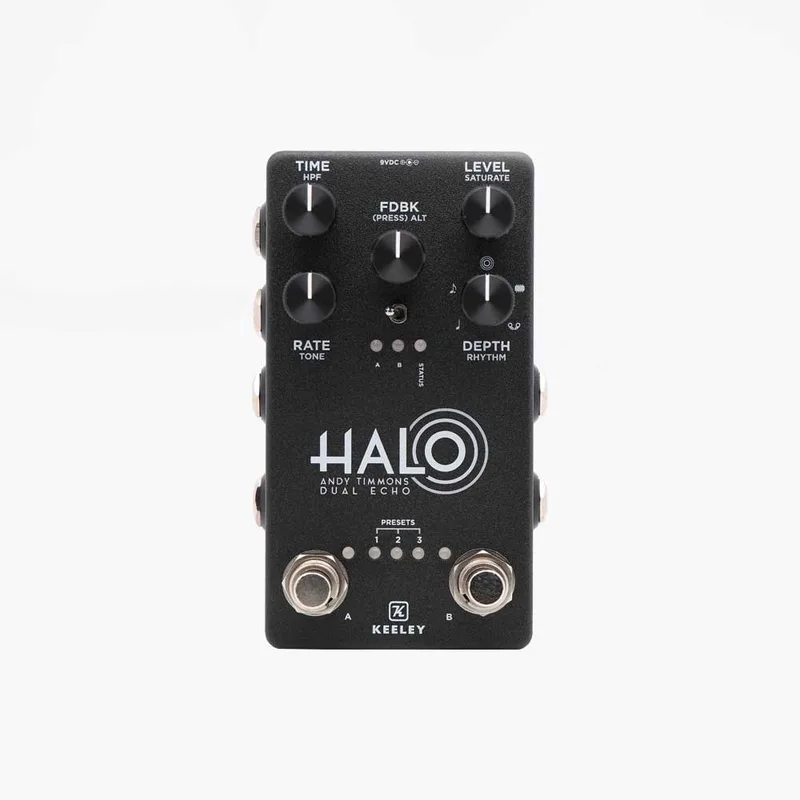
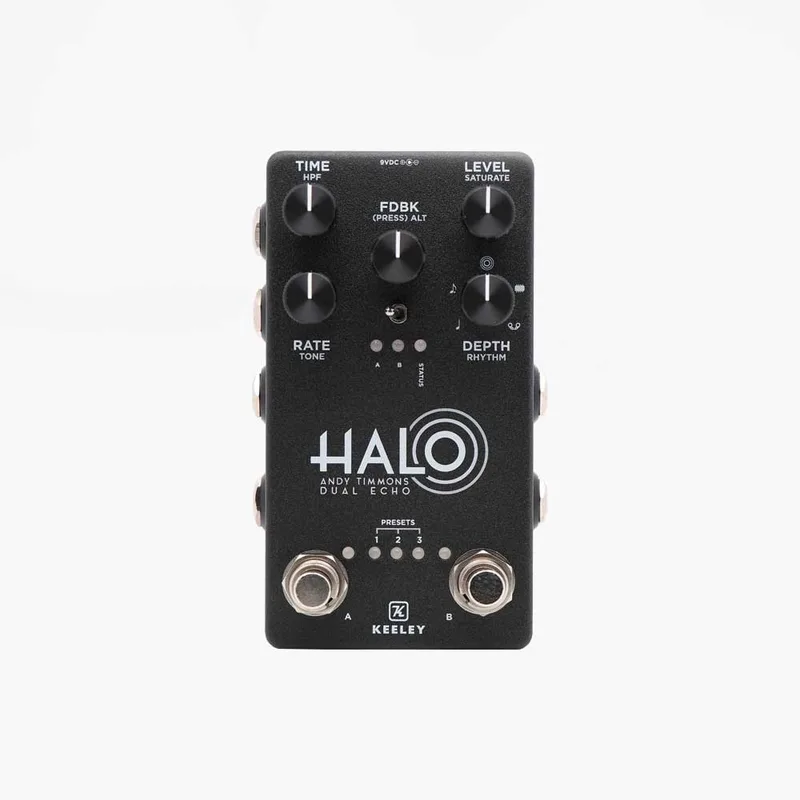
The Keeley Halo is a stereo delay pedal, while the Nocturne is a reverb pedal built from some of the same DNA2. Robert Keeley described the relationship in MusicRadar:
"The Nocturne 'sound' is essentially the beauty of what we all love about the Halo sound, but without the crosstalk of repeats of the delays."
The Nocturne occupies a similar housing to Timmons' other signature pedal and is designed on Keeley's Core platform, built for professional integration32. Where the Halo carries delay and modulation presets, the Nocturne's presets and modes are all reverb voicings24.
What reviewers said
Coverage around launch was largely descriptive. gearnews highlighted the quick access of the four controls and the pedal's US build, "made in the USA and built for the rigors of touring"6. MusicRadar's Jonathan Horsley reported Robert Keeley calling it the company's flagship reverb and noted the full-stereo design and MIDI control2. That Pedal Show demoed it alongside four other new pedals, finding that its pre-delay let it hold up with gain without getting messy5.
On That Pedal Show, the presenters also framed what the Nocturne mode does in plain terms: three algorithms, with Nocturne as Andy's reverb and plate and spring alongside it5.
Price and availability
The Nocturne was announced in December 2025 and is available now61. On price, the press reports differ: MusicRadar listed it at $269 in December 20252, while gearnews reported it available from Thomann for $361 the same month6.
Videos
Pete Thorn
Keeley Electronics
News
Questions
Is the Keeley Nocturne true bypass?
It can be. The Nocturne lets you choose between buffered bypass and true bypass, and it ships with buffered bypass as the default. You switch between the two by pressing and holding the left footswitch until the bypass LED blinks, so you can set it to suit the rest of your pedalboard.
How many presets does the Keeley Nocturne have?
In MIDI mode the Nocturne offers 23 additional preset banks, each holding one preset per reverb mode. You can also save a favorite sound directly with the preset button without going into MIDI mode.
What is the difference between the Keeley Nocturne and the Halo?
The Halo is a stereo delay pedal, while the Nocturne is a reverb pedal. The Nocturne's signature mode is adapted from Keeley's Halo algorithm, which Robert Keeley describes as the Halo sound without the crosstalk of the delay repeats. The Nocturne also adds Spring and Plate reverb modes.
Does the Keeley Nocturne have reverb trails?
Yes, and they are switchable. You can turn the reverb trails on or off, which also relates to the bypass choice: buffered bypass keeps the trails sounding when you disengage the pedal, while true bypass cuts them off immediately.
Where is the Keeley Nocturne made?
It is handbuilt in Oklahoma, USA, at Keeley's Oklahoma-based operation. Keeley describes it as built on the company's Core platform and made for professional integration and the rigors of touring.
Is the Keeley Nocturne stereo?
Yes. It is a full-stereo reverb with stereo input and output, and you can run it in stereo as wet/dry or wet-only. The jacks are on the top of the pedal.
Sources (6)
- Guitar Pedal X, Guitar Pedal X, 2025-12-13
- “I turn this thing on, I don't want to stop playing”: Keeley Electronics has made Andy Timmons fall in love with reverb with his new signature Nocturne pedal, MusicRadar, 2025-12-18
- Keeley Nocturne Reverb, Delicious Audio, 2026-02-11
- NOCTURNE INSTRUCTIONS, Keeley Electronics, 2025-12-31
- New Pedals! Keeley Nocturne, Jam Retrovibe 4, Caroline Kilo 2K, DevTech Soft Drive, Hagerman EF86, That Pedal Show (YouTube), 2026-01-30
- Keeley Nocturne Reverb: Andy Timmons Latest Secret Weapon!, gearnews.com, 2025-12-15
 Andy Timmons