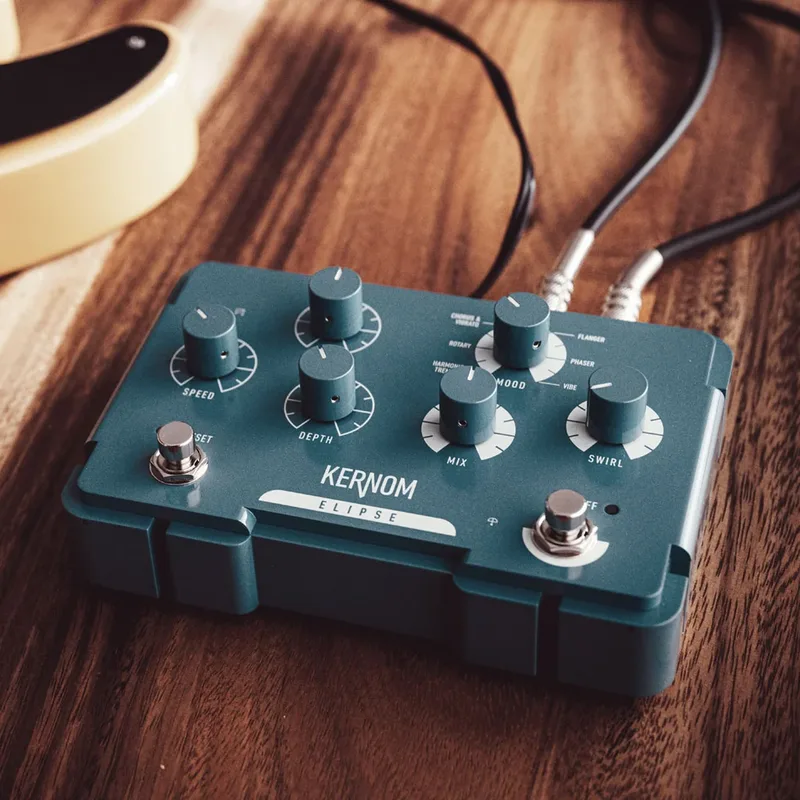



The Kernom Elipse is a multi-modulation pedal that puts the classic modulation effects in one box: chorus, flanger, phaser, tremolo, vibrato, uni-vibe and rotary speaker, plus hybrid sounds in between. Kernom describes it as an "analog modulation beast with digital brain": the audio path is analog, while a digital control layer reshapes the modulation1. It is the third pedal in Kernom's Dynamic Mood Morphing Analog Series, following the Ridge and Moho, and was launched at the NAMM show in January 20252.
The idea that sets it apart is the MOOD knob. Instead of a mode switch with fixed algorithms, MOOD is a continuous control that morphs between effects, so classic sounds sit at defined positions and the space between them holds hybrid combinations1. Pedal of the Day's reviewer called this seamless morphing the pedal's innovative core, letting you "select classic effects at specific positions or discover entirely new hybrid sounds in between"3.
An analog modulation pedal with a digital brain
Under the hood, the Elipse is not a conventional BBD, OTA or VCA design. Guitar Pedal X's Stefan Karlsson described it as a patented hybrid circuit combining an analog stage with AD and DA conversion, biasing, equalization and filtering, plus a substantial dual digital control layer, calling it "very much its own innovation"4. Kernom's own technical pages explain it as a nonlinear analog circuit combined with a digital memory stage that extends and enhances BBD-style modulation: the analog stage provides warmth and movement, while the digital control layer enables MOOD reshaping across the modulation7.
The build is solid for the price. The pedal measures 11.2 cm deep x 16.4 cm wide x 5.2 cm tall (4.4 inches deep x 6.5 inches wide x 2 inches tall) and weighs 850 g (1,8 lbs)1. Kernom's product page lists it at a regular price of £289.001.
The MOOD knob's positions, as Kernom lays them out, group the effects like this1:
| MOOD region | Effects |
|---|---|
| Tremolo end | Tremolo and Harmonic Tremolo |
| Between tremolo and chorus | Rotary Speaker |
| Middle | Chorus, Tri-Chorus and Vibrato |
| Upper middle | Flanger and Phaser |
| Top | Vibe and Psychedelic |
Guitar World's review notes the logic of the ordering: the rotary effect sits between tremolo and chorus because it shares elements of both sounds, with chorus, vibrato and flanger adjacent, and the vibe next to the phaser5. Reviewers found each region does its job: Pedal of the Day described chorus and vibrato running "from subtle warmth to massive, wide stereo-like effects," flanger and phaser modes nailing "jet-engine swooshes & rich, evolving movement," the rotary mode capturing "the iconic Leslie swirl, perfect for blues & organ-like texture," and the vibe selection giving "classic 60s warble with extra dimension"3.
One limitation worth knowing: the audio input is mono, and Guitar Pedal X flagged that "the one weakness with this device is that the Rotary Speaker is not in stereo"2.
The controls
The Elipse keeps the knob count low, with each control doing defined work1:
| Control | What it does |
|---|---|
| MOOD | Selects and morphs between all the modulation effects; classic effects at specific positions, hybrids in between |
| SPEED | Adjusts the modulation rate, from ultra slow texture to fast ringing oscillations |
| DEPTH | Controls the intensity of the modulation effect |
| SHAPE | Modifies the modulation waveform; classic triangular shape at the mid-position |
| MIX | Blends wet and dry signals; 50/50 mix at the mid-position |
| SWIRL | Adds a secondary layer to the main effect: the first part of the sweep introduces a slow phaser, the second part adds a drive effect |
The SHAPE control has more depth than a typical waveform switch. Guitar Pedal X describes it as a combination of sine and triangle waves with pulse width modulation: counter-clockwise gives a sharper, narrower pulse width, the middle is a balance of the waveforms, and clockwise is smoother and wider4.
SWIRL is the control that pushes the Elipse past stock modulation sounds. Because its second stage adds drive, the pedal can layer grit under chorus or flanger, something a pure modulation pedal cannot do. For players coming from single-effect pedals, see the flanger, phaser and tremolo pages for how those circuits work on their own1.
Presets, MIDI and expression morphing
The Elipse has one onboard preset, reachable from a dedicated footswitch, so you always have two sounds available at your feet. Beyond that, 128 presets are accessible via MIDI1.
The rear panel carries the connections: mono audio in, audio out, an expression pedal input, MIDI in and out on 1/8" jacks, and the 9V DC power socket2. Kernom specifies a type A mini jack TRS MIDI cable for MIDI connections1. MIDI gives full control over all the parameters1, which puts the pedal in the same category as other MIDI pedals for players running a programmed board.
The expression input is where the pedal gets playful. Kernom describes it as letting you "morph between two presets in real time for ultimate live expression"1. Pedal of the Day's reviewer found this the most engaging part of the pedal:
"The expression pedal morphing is soooooo fun here, and. will absolutely lead to hours of tweaking, knob-twisting, experimentation and thought-provoking musical ideas."3
For players who use one, the expression pedal becomes a live performance control here rather than a simple parameter sweep: rocking it transitions between two complete modulation settings1.
Power
The Elipse runs on a standard 9V DC center negative pedal supply, which is not included with the pedal1. Kernom's product page rates it at 150mA minimum with 200mA or more recommended1, and the maker's support documentation specifies 250mA or higher8. The pedal is protected against power supply inversion, so a polarity mistake will not damage it9.
No battery option exists: the pedal needs a 9V DC center negative supply, and the current draw rules out sharing a low-current daisy chain output with analog drives.
What reviewers said
The Elipse launched at $369 / £309 / €369, with Kernom noting that custom duties may apply outside the EU5. Since then the listed price has come down: Kernom's own product page now shows a regular price of £289.001, and guitar.com lists the Elipse at $2996. So the current asking price sits below the launch price on both sides of the Atlantic.
Videos
Kernom
Kernom
Kernom
Questions
Is the Kernom Elipse true bypass?
Yes. Kernom specifies true bypass switching using an electromechanical relay, so the pedal's circuit is out of the signal path when it is off.
Does the Kernom Elipse come with a power supply?
No, the power adaptor is not included. Kernom specifies a 9V DC center negative supply, rating the pedal at 150mA minimum with 200mA or more recommended on the product page, while its support documentation says 250mA or higher. The pedal is protected against power supply inversion.
How many presets does the Kernom Elipse hold?
It holds one onboard preset, reachable from a dedicated footswitch so you always have two sounds available, and 128 presets are accessible via MIDI.
Is the Kernom Elipse stereo?
The audio input is mono. Reviewers found wide stereo-like effects in the chorus and vibrato sounds, but Guitar Pedal X noted that the Rotary Speaker mode is not in stereo.
Where is the Kernom Elipse made?
It is made in China. Guitar.com's reviewer noted that it is made in China but does not feel cheap, with a 5mm thick aluminium casing.
Sources (9)
- KERNOM ELIPSE, Kernom
- Guitar Pedal X, Guitar Pedal X, 2025-01-21
- Kernom ELIPSE Multi Modulation Playground, Pedal of the Day, 2026-05-21
- Guitar Pedal X, Guitar Pedal X, 2025-02-21
- Kernom Elipse review, Guitar World, 2025-02-21
- Beetronics Seabee Lite, Guitar.com
- KERNOM - Analog Morphing Core® | Guitar Effects Technology, kernom.com
- Manuals - KERNOM, KERNOM
- Support - KERNOM, Kernom