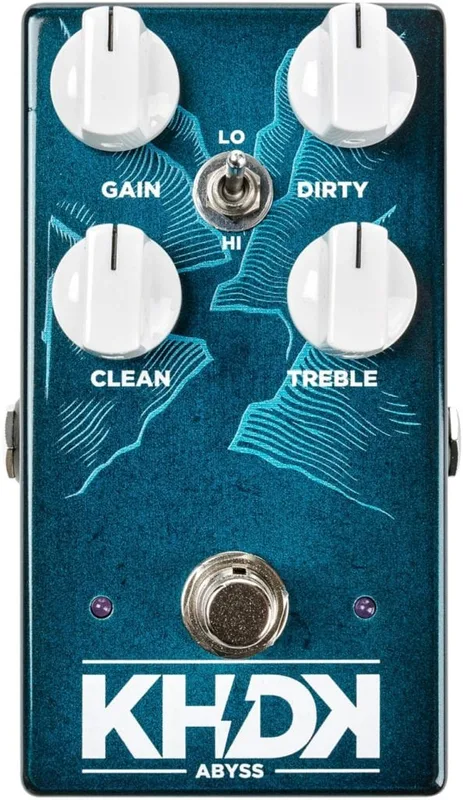


What makes it a bass tool rather than a guitar overdrive with a different label is its blend architecture. The pedal has separate dirty and clean channel volume controls, so you keep the dynamics and low end of your clean bass tone and mix in as much of the overdriven signal as you want12. KHDK's promotional material compares the result to using two amps1.
A bass overdrive with a clean blend
The Abyss is built for bass players who want full control over their sound3. Gearnews described it at launch as "a drive pedal made specifically for those four-string players who require some dirt for their tone," and noted it was the first KHDK pedal specifically aimed at bass players1. The core idea is the two-channel blend: dirty and clean channel volumes let you keep the dynamics of your bass tone and blend them with a distorted version of that tone1. KHDK says this lets bass players dial in just the right amount of overdriven signal against their clean tone2, and Guitar World repeated that framing in its review5.
For players who want more than the default character, the pedal has a Hi mode. On the Hi setting the Abyss adds saturation, sustain, low end and compression, which KHDK and Guitar World both describe as suited to more powerful rhythm playing or soloing25.
The controls and the Hi setting
The front panel has four knobs and a small lever, plus two more controls on the overdrive side. Here is what each one does:
| Control | What it does |
|---|---|
| Gain | Sets the amount of gain in the overdrive1 |
| Dirty | Controls the amount of distorted signal in your tone3 |
| Clean | Sets the clean channel volume1 |
| Treble | Sets the treble content1 |
| Hi/Lo lever | A small lever selecting Hi or Lo gain settings1 |
| Fullness | Shapes the overdrive sound1 |
| Punch | Shapes the overdrive sound1 |
The Dirty and Clean knobs are the heart of the pedal: they are the two channel volumes that set the balance between the distorted and clean paths1. Fullness and Punch then adjust the overdrive sound itself, so you can shape the dirty channel until it sits where you want it against your clean tone1. The Hi/Lo lever switches between the pedal's two gain settings, with Hi adding saturation, sustain, low end and compression for more powerful rhythm or soloing15.
Power and connections
The Abyss runs on a single 9V battery, accessed by unscrewing the bottom plate of the pedal enclosure3. Alternatively, you can plug in an external 9V DC power supply with a center negative plug, the common standard for compact effects3. Connections are simple: a standard 1/4 inch mono TS input jack and a standard 1/4 inch mono TS output jack3. The bypass is true bypass, so the pedal is out of the signal path entirely when switched off3. The enclosure measures 120 x 65 x 40 mm (width x depth x height)3.
The battery sits under the bottom plate, so reaching it means unscrewing the enclosure. Players who swap batteries often, or who run the pedal on a crowded board, will likely prefer the 9V DC center negative supply input3.
Bi-amp circuit and designer
The Abyss uses bi-amp technology with two discrete circuits, dividing your signal down two paths3. KHDK's head engineer, Antonin Salva, designed the pedal around this architecture: one path stores the dynamic and color of your tone, the other adds the overdriven sound with fullness and a powerful punch, and the two paths reconnect2. Guitar World described the same circuit in its review, explaining that the two paths are recombined into a richer and more powerful version of the original sound5. This is the circuit behind the Dirty and Clean blend: the two volume controls are effectively level controls for the two paths13.
KHDK's product page also carries a player endorsement from Frank Bello of Anthrax, quoted as saying:
"It's the best bass overdrive I've ever played."
Where it came from and what reviewers said
KHDK announced the Abyss in July 2017, with MusicRadar reporting the launch from Summer NAMM and noting at the time that the pedal would be out later that year with its price yet to be confirmed4. Gearnews likewise listed the recommended retail price as to be confirmed at announcement1. By the time Guitar World's Paul Riario reviewed it on August 7, 2017, the pedal was out at a $199.95 street price5, which matches KHDK's current list price of $199.953.
Riario's review described the Abyss as a brand-new bass overdrive providing warm, tube-like boost and subtle crunchy overdrive, and highlighted the same blend feature KHDK built the pedal around: the ability to dial just the right amount of overdriven signal into the clean tone, with the Hi setting adding saturation, sustain, low end and compression for more powerful rhythm or soloing5. Premier Guitar's launch coverage, drawn from KHDK's press release, described it as a versatile overdrive suited to rhythm playing and credited Antonin Salva's bi-amp design2.
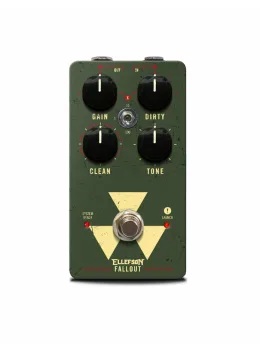
The Abyss sits in KHDK's range alongside the company's other pedals, including the No.1 overdrive and the No.2 clean boost, and a later bass-focused model, the KHDK Fallout Bass Overdrive, which KHDK associates with Dave Ellefson of Megadeth63. For bass players comparing dirt pedals, the Abyss's distinction is the clean blend built into its bi-amp circuit, rather than the single-path character of most guitar-oriented overdrive, distortion or fuzz boxes.
Videos
Premier Guitar
KHDK
BassTheWorld.com
Questions
Is the KHDK Abyss true bypass?
Yes. KHDK lists the Abyss with true bypass switching, so when the pedal is off your signal passes through without buffering. It runs on a standard 9V battery or a 9V DC center negative power supply, and connects with standard quarter inch mono TS jacks for input and output.
Where is the KHDK Abyss made?
KHDK says the Abyss is crafted and quality-tested in Kentucky, USA, like all of its pedals. KHDK Electronics is the maker, and its head engineer Antonin Salva designed the Abyss around a bi-amp circuit with two discrete signal paths, one carrying the clean dynamic and color, the other the overdriven sound.
Does the KHDK Abyss run on a battery?
Yes. The Abyss is powered by a single 9V battery, which you reach by unscrewing the bottom plate of the enclosure. Alternatively you can plug in an external 9V DC power supply with a center negative plug, the same standard arrangement as most compact effects pedals.
Is the KHDK Abyss Frank Bello's signature pedal?
No. The Abyss is a standard KHDK product, not a signature model. Frank Bello of Anthrax is quoted on KHDK's product page calling it the best bass overdrive he has ever played, but the pedal is not built as his signature model and KHDK does not present it that way.
Is the KHDK Abyss made for bass?
Yes. The Abyss is a bass overdrive, and when it launched in 2017 it was the first KHDK pedal aimed specifically at bass players. Its clean and dirty channel volume controls let you keep the dynamics of your bass tone and blend in a distorted version of it, which is the main reason it suits bass rather than guitar.
What do the Fullness and Punch knobs do on the Abyss?
Fullness and Punch shape the overdriven side of the Abyss's bi-amp circuit. KHDK describes one signal path as storing your dynamic and color while the other adds overdriven sound with fullness and a powerful punch, and the two knobs adjust that overdrive character until it sits where you want it in the mix.
Sources (6)
- KHDK shoots for bass market with Abyss overdrive pedal, gearnews.com, 2017-07-10
- KHDK Electronics Introduces the Abyss Bass Overdrive, Premier Guitar, 2017-07-07
- Abyss | KHDK Electronics, KHDK Electronics
- Summer NAMM 2017: KHDK launches “game-changing” Abyss bass overdrive pedal, MusicRadar, 2017-07-07
- Review: KHDK Electronics Abyss Pedal, Guitar World, 2017-08-07
- KHDK Introduces the Ghoul Jr. Overdrive, Premier Guitar, 2017-11-20