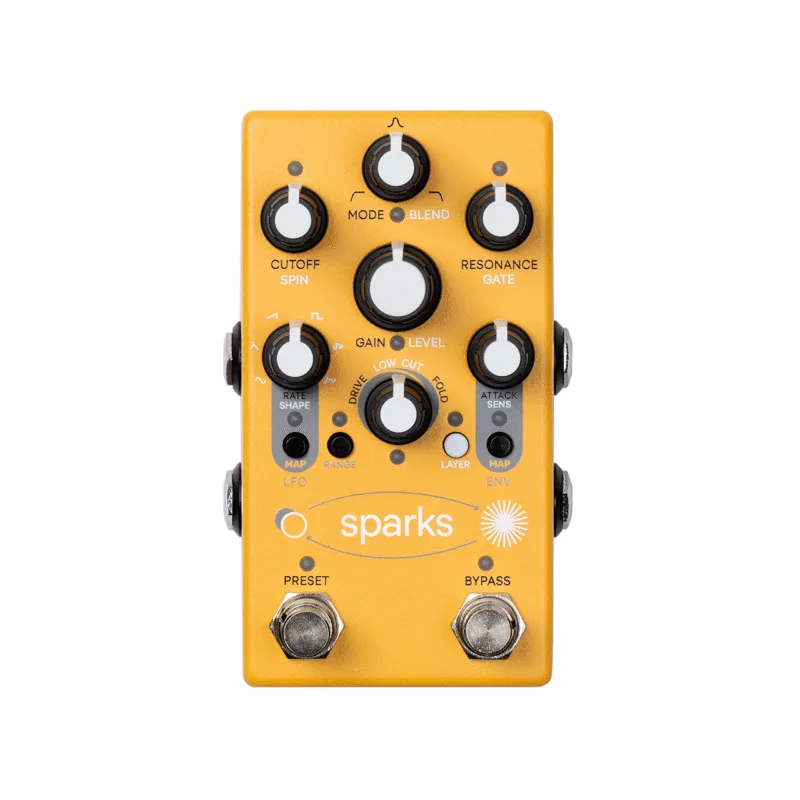


The Kinotone Sparks is a stereo analog sound design pedal: a compact box that combines two distortion circuits, a state-variable filter, a deep modulation section, and a digital synthesizer inspired by the SID chip from the Commodore 64 home computer1. Kinotone describes it as a toolkit that "can achieve many results ranging from subtle to extreme and aggressive"1, and Guitar Pedal X listed its capabilities as overdrive, fuzz, high gain, tremolo and oscillation, chip tune synth, auto-wah, volume swells, and warble2. It sells for $399 USD3.
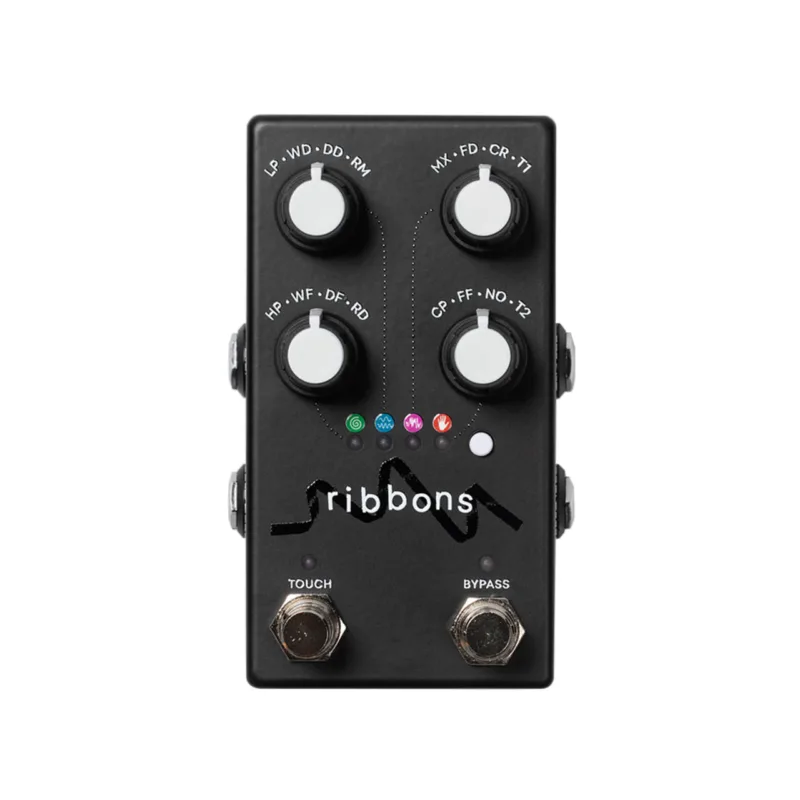
Sparks is the follow-up to Kinotone's Ribbons magnetic tape multi-FX, and Guitar Pedal X called it "a fantastically capable Wavefolder Drive, Resonant Filter, Envelope Follower and LFO hybrid Multi-FX" while noting "a hefty learning curve overall"4.
What it is and how it shapes your sound
At its core, Sparks is a filter pedal with two distortion stages feeding it. The DRIVE and FOLD control crossfades between two circuits: a unique overdrive and a west-coast-style wavefolder1. DRIVE, in Kinotone's words, "provides soft sustain and controlled, pleasant clipping," while FOLD is "a complex, liquidy effect that distorts your input signal by inverting and folding the peaks"5. The wavefolder approach puts it in different territory from conventional overdrive, distortion or fuzz pedals, which clip the signal rather than fold it back on itself.
The filter is a musical 12dB/octave multimode design, continuously variable between high-pass, band-pass, and low-pass types2. The MODE knob "lets you smoothly morph between filter types"1, so you can sweep from one response to another rather than switching between them.
The main controls
| Control | What it does |
|---|---|
| GAIN / LEVEL | One knob sets both: GAIN is the amount of distortion applied to the input, LEVEL is overall output volume1 |
| DRIVE / FOLD | Crossfades between the overdrive circuit and the west-coast-style wavefolder1 |
| LOW-CUT | Pre-distortion high-pass filter from 0 Hz to 12 kHz, controlling how much low-frequency content reaches the DRIVE and FOLD circuits1 |
| MODE | Morphs between high-pass, band-pass, and low-pass filter types1 |
| BLEND | Introduces dry signal from zero to 200%; at noon the dry signal is about as loud as bypassed, fully clockwise it is significantly boosted1 |
| GATE | Mutes all sound below a threshold you set, useful for taming background noise at high GAIN settings; does not affect the dry signal by default1 |
Two footswitches handle the rest: BYPASS engages or disengages the effect, and PRESET engages or disengages your stored preset1.
The LFO and envelope follower
The modulation section is where Sparks goes beyond a standard filter pedal. You can map the LFO to any knob control, or to several at once, with speeds ranging from super slow well into audio rate1. Guitar Pedal X gives the LFO rate range as 0.1Hz to 1kHz2. Mapped parameters act as attenuverters, so each mapping can be scaled and inverted2. The LFO offers sine, triangle, sawtooth, square, sample and hold, and random ramps waveforms, and waveforms can be synchronized to MIDI clock2. A RANGE function instantly doubles or quadruples the LFO speed, and SPIN shifts the left and right LFO channels out of phase to create stereo movement2.
The envelope follower can likewise be mapped to any knob control or to multiple controls, with adjustable attack and sensitivity2. Three envelope styles are available1:
- Classic: medium attack and release times, inspired by the envelope follower in a famous 1970s semi-modular synthesizer5
- Compressor: fast logarithmic attack and medium release times, mimicking the response of the Vinyl Sim compressor, essentially an analog version of the compressor in Ribbons with flexible timing controls5
- AR: synthesizer-style envelope1
Mapping the envelope follower to the filter gives auto-wah and dynamic filter effects; mapping it to BLEND gives volume swells; mapping the LFO to the filter gives tremolo and warble, which is how the Harmonic Tremolo and Auto-Wah factory presets are built2.
The SID-inspired synth engine
Sparks includes an internal synthesizer that Kinotone calls its "own unique take on the 6581 SID chip, the synth engine behind the Commodore 64 Home Computer," pairing digital oscillators with the analog filter1. It offers 4 voices of polyphony with an optional mono mode, plus or minus 5 semitone pitch bending, and modeling of ADSR envelope, hard sync, and ring mod2. Controls cover bit depth, pulse width modulation, pitch modulation, and glide2. Waveform choices are sine, triangle, sawtooth, pulse, and 23-bit Fibonacci LFSR noise2.
Kinotone notes that classic SID chip sounds are often gritty, crunchy, and very lo-fi1, which places this engine alongside dedicated synth pedals rather than conventional pitch effects. The whole pedal runs on a 170MHz mixed-signal ARM processor2.
Power and connections
Sparks runs on a +9VDC, 2.1 mm, negative tip power supply and draws approximately 280mA3.
At around 280mA, Sparks draws more current than a typical analog pedal, so plan for it on a power supply with an isolated or high-current 9V output rather than a battery or a shared daisy chain.
The pedal passes stereo in and stereo out by default through its TRS input and output jacks, and also supports mono in and stereo out via the mix setting menu1. The input/output level menu offers four options: instrument in / instrument out (the default), instrument in / boost out, line level in / line level out, and line level in / boost out, the last with a 6 dB boost at the output5. That line-level option means Sparks can sit in a studio or mixer path as well as on a pedalboard.
MIDI control works with any controller that has a 5-pin DIN or TRS MIDI output; Sparks defaults to MIDI channel 1 with 16 channels available1. Internal jumpers switch between TRS MIDI Type A (the factory setting), Type B, or CBA wiring2. The CV / EXP input accepts control voltages from 0 to 5 volts1, with CV control working up to 500Hz2, fast enough for audio-rate modulation from an external source. For more on this kind of control, see MIDI pedals and expression pedals.
Specifications from the press
| Specification | Value |
|---|---|
| Frequency response | 24Hz to 20kHz2 |
| Reverse polarity protection | Down to -20VDC2 |
| LFO rate range | 0.1Hz to 1kHz2 |
Presets and what reviewers said
Sparks ships with 6 factory presets3: Harmonic Reverse, Gentle Drive, Harmonic Tremolo, Auto-Wah, Crinkled Tape, and Dynamic Envelope Tremolo2. The PRESET footswitch engages or disengages your preset1.
Guitar Pedal X's Stefan Karlsson reviewed Sparks at launch and again in the site's roundup of the best new modulation and utility pedals of 2024, where he summed it up as:
"A fantastically capable Wavefolder Drive, Resonant Filter, Envelope Follower and LFO hybrid Multi-FX"
The same review flagged "a hefty learning curve overall"4, which fits a pedal where any modulation source can be routed to any control. At launch the pedal was available for pre-order from the Kinotone webstore2; the current product page lists it at $399 USD3. The circuit boards are assembled in Minneapolis, MN3.
Videos
Kinotone
Kinotone
Jorb
Questions
Is the Kinotone Sparks analog or digital?
It is a hybrid. Kinotone describes Sparks as a stereo analog sound design toolkit with a digital SID-chip-inspired synthesizer inside. The overdrive, wavefolder, and state-variable filter are analog, while the synth engine uses digital oscillators paired with the analog filter, running on a 170MHz mixed-signal ARM processor.
Does the Kinotone Sparks work in mono?
Yes. Sparks passes stereo in and stereo out by default through its TRS input and output jacks, but it also supports mono in and stereo out, which you select in the mix setting menu. A mono source can still feed both channels and take advantage of the stereo LFO movement.
What factory presets come on the Kinotone Sparks?
Six: Harmonic Reverse, Gentle Drive, Harmonic Tremolo, Auto-Wah, Crinkled Tape, and Dynamic Envelope Tremolo. You can also save up to 32 of your own presets using MIDI, and the PRESET footswitch engages or disengages your stored preset.
Can the Kinotone Sparks be controlled with MIDI?
Yes. Sparks is compatible with any MIDI controller with a 5-pin DIN or TRS MIDI output. It defaults to MIDI channel 1 with 16 channels available, internal jumpers switch between TRS MIDI Type A (the default), Type B, or CBA wiring, and LFO waveforms can be synchronized to MIDI clock.
Where is the Kinotone Sparks made?
The circuit boards are assembled in Minneapolis, Minnesota. Kinotone is the maker behind the Ribbons magnetic tape multi-FX, and Sparks followed it as the company's second major pedal release.
Sources (5)
- Sparks User Manual, Kinotone Audio, 2023-12-04
- Guitar Pedal X, Guitar Pedal X, 2024-07-03
- Sparks - Kinotone, Kinotone Audio, 2023-09-21
- Guitar Pedal X, Guitar Pedal X, 2024-12-19
- SparksPaperManual_V8_06202024, Kinotone Audio, 2024-06