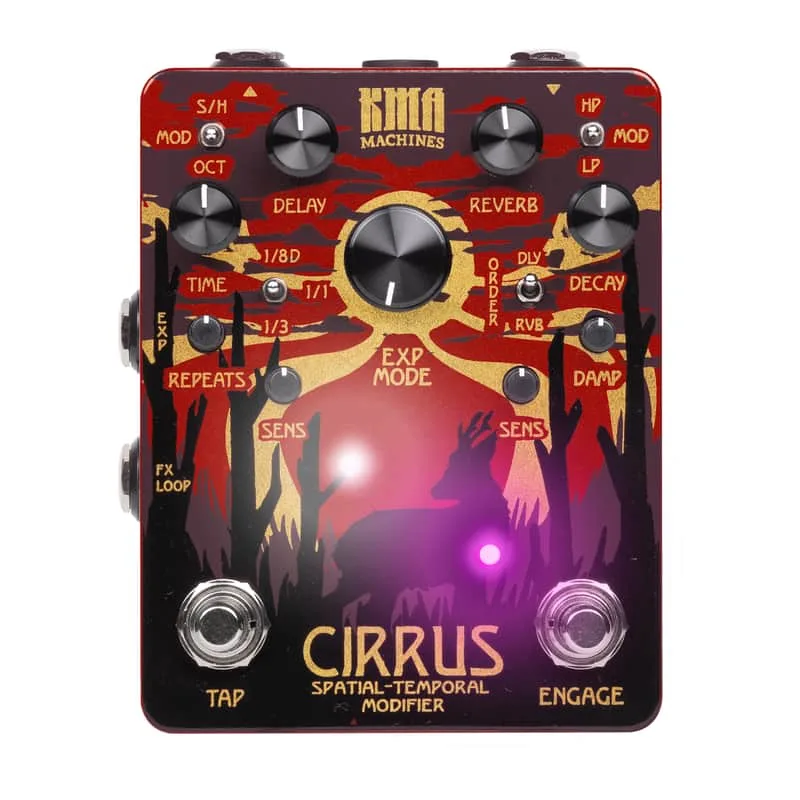


The KMA Machines Cirrus Spatial-Temporal Modifier is a delay and reverb pedal that puts both effects in one enclosure, with three modes on each side and a toggle that lets you choose which one comes first in the chain. Priced at £185 ($230, €210 approx) and shipping from mid October 20191, it runs on 9VDC power1. Guitar World called it "a soundscaper's dream" in its headline, and noted that the dual-effect unit boasts three different delay and reverb modes2.
Delay and reverb in one box
The Cirrus combines delay and reverb, with three modes for each1. On the delay side, the modes are Modulated Delay, Sample and Hold and OCT (octave)1. KMA says the Modulated Delay mode "fluctuates the Delay signal for a dynamic dancing tape echo-inspired modulation that'll deliver everything from subtle sways, to crazy pitch-bends"1. The Sample and Hold mode places a filter in front of the delay for synth-esque tones1.
On the reverb side, the Mode switch lets you pick from a closing High-Pass Filter, an opening Low-Pass Filter or Modulated reverb modes3. MusicRadar lists the reverb modes as MOD, LP and HP1.
A toggle switch changes the order of the effects, delay then reverb or reverb then delay1. Pedal of the Day describes it as "a Delay/Reverb toggle lets you choose the order of these two effects in your signal chain"3. There is also an FX loop which lets you insert any pedal or pedals before the Delay/Reverb sounds3.
Controls and footswitches
The pedal's controls split between the two sides, with a large middle knob tied to the expression input3.
| Control | Side | What it does |
|---|---|---|
| Time | Delay | Sets your delay time, up to 1.5 seconds if needed3 |
| Repeats | Delay | Sets the number of echoes, from a single slap back to infinite faux loops3 |
| Reverb | Reverb | Blend control for the reverb3 |
| Decay | Reverb | Controls the decay of the reverb, from small room to an infinite space3 |
| Delay Mode toggle | Delay | Choose from Modulated, Sample/Hold or Octave delay modes3 |
| Mode switch | Reverb | Closing High-Pass Filter, opening Low-Pass Filter or Modulated reverb3 |
| Delay/Reverb toggle | Routing | Chooses the order of the two effects in the signal chain3 |
The enclosure has two footswitches: one for tap-tempo, the other to switch the effect on or off, or, when engaged, to hold and dime the reverb decay for infinite feedback1. Pedal of the Day notes the Tap Tempo switch "will set your delay time AND will max out your delay when held down"3.
Expression control and power
The Cirrus has an input for an expression pedal so you can control parameters on the fly1. Time, Repeats, Sensitivity, Damp and Decay can all be controlled externally via an expression pedal and the large middle knob3. For players building a board around swells and ambient textures, pairing the pedal with a dedicated expression pedal turns those five parameters into hands-free controls.
The pedal takes 9VDC power1. Guitar World also listed tap tempo, the expression input, the effects loop and the routing flip among its features2.
Videos
The Pedal Zone
Sofa Jams
Pedal of the Day
News
Questions
Is the KMA Audio Machines Cirrus analog or digital?
The Cirrus is fully digital. MusicRadar's Jonathan Horsley described it as KMA's first step into fully digital effects pedals when it was announced in September 2019. The pedal combines delay and reverb, with three modes for each side, and runs them through a single digital engine rather than an analog delay or spring reverb circuit.
Can the Cirrus run reverb before the delay?
Yes. A toggle switch changes the order of the two effects, so you can run delay into reverb or reverb into delay. Pedal of the Day notes that the Delay/Reverb toggle lets you choose the order of the two effects in your signal chain, and Guitar World highlighted the ability to flip the routing as one of the pedal's features.
Does the Cirrus have tap tempo?
Yes. Guitar World listed tap tempo among the pedal's features. The Tap Tempo switch sets your delay time, and Pedal of the Day adds that holding the switch down maxes out the delay, which is useful for swells and soundscaping.
Can I connect an expression pedal to the Cirrus?
Yes. The Cirrus has an input for an expression pedal so you can control parameters on the fly. According to Pedal of the Day, Time, Repeats, Sensitivity, Damp and Decay can all be controlled externally through an expression pedal and the large middle knob.
What voltage does the Cirrus use?
The Cirrus runs on 9VDC power, as reported by MusicRadar at the pedal's announcement in 2019. Like most modern digital pedals, it needs its own power supply rather than a battery.
Sources (3)
- KMA will leave your head in the clouds with the Cirrus delay and reverb, MusicRadar, 2019-09-23
- The KMA Audio Machines Cirrus delay and reverb is a soundscaper's dream, Guitar World, 2019-09-20
- KMA Machines Cirrus Spatial-Temporal Modifier, Pedal of the Day (www.pedal-of-the-day.com), 2020-06-02