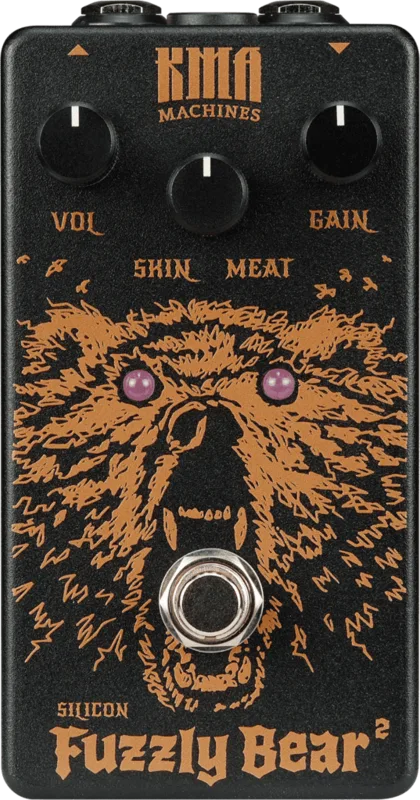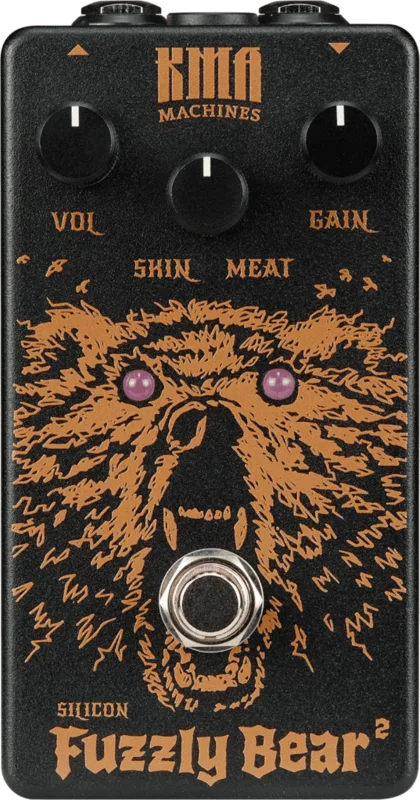


The KMA Machines Fuzzly Bear is a silicon fuzz pedal that takes its circuit from the Jordan Bosstone, an obscure vintage fuzz box that KMA describes as "old, obscure and highly underrated"1. Released in 2013, it was KMA Machines' first ever production pedal1. The company kept the fuzzy character of the Bosstone but reworked the circuit to bring back low end the original lost, and added a bias control the Bosstone never had12.
For a player, that means a '60s and '70s style silicon fuzz with three knobs and a bias sweep that moves the tone from thin and cutting to thick and saturated. Pedal of the Day's reviewer called it "definitely a plug-and-play pedal, as it is not too hard to get a good sound out of it just by looking at it"341.
A silicon fuzz built on the Jordan Bosstone
The Jordan Bosstone is a vintage fuzz circuit that General Guitar Gadgets, which sells a DIY clone kit, describes as "a great little fuzztone that can be built with silicon transistors and still has an awesome fuzz sound"5. That silicon design is what separates the Bosstone family from the germanium fuzzes of the same era: silicon transistors are less temperature-sensitive and behave more consistently, and they push a sharper, more aggressive fuzz character.
KMA Machines built its take on the Bosstone aiming, as Pedal of the Day put it, "to get that classic sound with some modern twists"3. In a 2019 guitar.com interview, KMA's Enrico Preuss described the starting point of the project as "building a Jordan Boss Tone clone with a bias control and a wider frequency range"6. The wider frequency range matters for guitar players: the original Bosstone circuit thins out the low end, and the Fuzzly Bear's reworked circuit was designed to keep it1.
The pedal uses silicon transistors throughout, with a BC109C in the first position and a 2N3906 in the second, according to the build documentation for the circuit2.
The controls: Gain, Skin/Meat and Volume
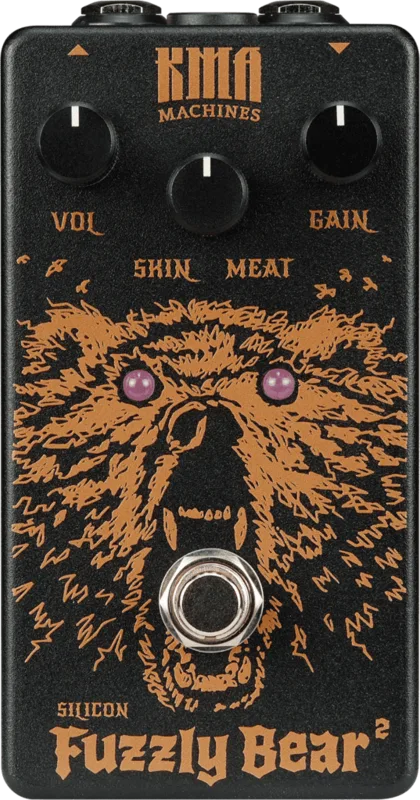
The Fuzzly Bear keeps the control set simple: three knobs, labeled Gain, Skin/Meat and Vol4.
| Control | What it does |
|---|---|
| Gain | Delivers a whole range of different fuzz shapes, from deep low-end drive to classic-rock fuzz tones13 |
| Skin/Meat | A bias control for the fuzz circuit, from sharp and thin to thick and meaty13 |
| Vol | Sets the output level, with plenty of loudness on tap3 |
The Skin/Meat knob is the distinctive one. It adjusts the bias of the circuit, and Pedal of the Day's reviewer called it "the true star of this pedal," describing how it "goes from a sharper, finer, SKIN-ier fuzz sound to a big, fat, thick, MEAT-y tone in a flash"3. Delicious Audio describes the same sweep on the Fuzzly Bear 2 as running "from a sharp drive tone to a thick and meaty wall of fuzzy fur"7.
Bias controls on fuzz pedals let a player deliberately starve or overfeed the transistors, which changes how hard they clip and how the sustain decays. On a silicon fuzz like this one, that sweep is the main tool for dialing in anything from a spitty, gated drive to a saturated wall.
"The Skin/Meat knob is the true star of this pedal, as it controls the bias of the fuzz circuit."
From the Bosstone circuit to the Fuzzly Bear 2
The Fuzzly Bear 2 returns KMA Machines' first-ever production line pedal, the original Fuzzly Bear of 2013, in a more pedalboard-friendly format1. Like the original, its circuit is based on the Jordan Bosstone fuzz1.
Original Fuzzly Bear vs Fuzzly Bear 2
What reviewers said
Reviewers have been positive about both versions. Pedal of the Day found the original made "some incredible fuzz tones" and praised its ease of use3. Of the Fuzzly Bear 2, gearnews.com's reviewer wrote:
"I quite like it, and it certainly has that '60s style silicon fuzz thing going on."
Delicious Audio notes that the Fuzzly Bear "is a silicon fuzz that delivers a more present low end than the original" Jordan Boss Tone7, which is the practical difference a player will hear against a straight Bosstone clone.
Videos
KMA Machines
The Pedal Zone
Iga Massardi
Questions
What circuit is the KMA Machines Fuzzly Bear based on?
The Fuzzly Bear is based on the Jordan Bosstone, an old and obscure silicon fuzz box that KMA Machines describes as highly underrated. KMA's take on the circuit adds a bias control and a wider frequency range, with more low end than the original.
What does the Skin/Meat knob do on the Fuzzly Bear?
Skin/Meat is a bias control for the fuzz circuit. Turned toward Skin it gives a sharper, finer fuzz sound; turned toward Meat it biases the transistors for a big, fat, thick tone. Reviewers have called it the true star of the pedal.
Is the Fuzzly Bear a silicon or germanium fuzz?
It is a silicon fuzz. KMA lists the Fuzzly Bear 2 as an analog silicon fuzz, and the original circuit used silicon transistors, with a BC109C in the first position and a 2N3906 in the second.
Where is the KMA Machines Fuzzly Bear made?
It is handmade in Berlin, Germany. KMA Machines is based in Berlin, and the Fuzzly Bear 2 was designed there as well.
Sources (7)
- FUZZLY BEAR 2, KMA Machines, 2013
- FuzzyBritches.pdf, madbeanpedals.com, 2021
- KMA Machines Fuzzly Bear Silicium Fuzz, Pedal of the Day, 2015-06-14
- Fuzzly Bear 2: KMA Machines updated take of Jordan Bosstone silicon fuzz, gearnews.com, 2022-04-21
- Jordan™ Bosstone™ Clone: DIY Fuzz Kit, PCB & Schematic, General Guitar Gadgets, 2014-05-14
- Interview: Enrico Preuss of KMA Audio Machines, guitar.com, 2019-03-11
- Updated Pedal: KMA Machines Fuzzly Bear 2, Delicious Audio, 2022-04-21