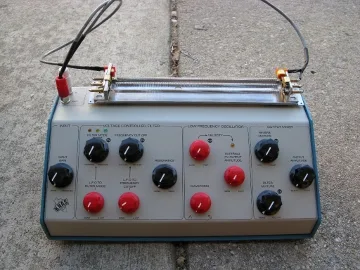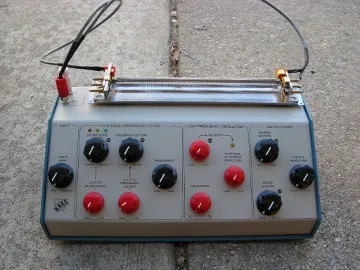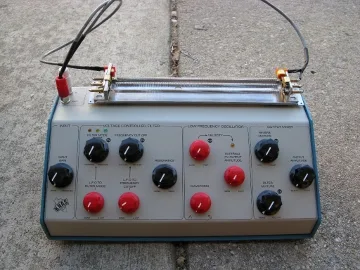
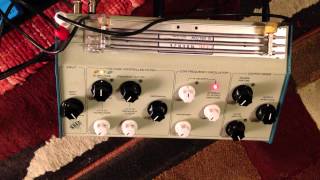


The Ekdahl Moisturizer is a spring reverb, multimode filter and LFO combo unit made by Knas1. What sets it apart from a typical reverb pedal is that its spring reverb tank sits exposed on the outside of the unit, so the player can use the Moisturizer as an instrument as well as an effects unit: the springs can be played, hit and fiddled with directly12. It is a mono unit, and it incorporates an LFO that is internally routable to the filter, with external routing options as well2.
The Moisturizer was developed with the help of Jason Willett (Half Japanese, Leperchaun Catering), Martin Schmidt (Matmos, Instant Coffee), Joshua Atkins (Polygons, Major Powers) and many others2. A later version, the Ekdahl Moisturizer 2, carries the design forward.
What it does: spring reverb with filter and LFO
The signal path combines three blocks: a spring reverb with exposed, playable springs, an analog multimode filter, and an LFO that can be routed to the filter internally or externally12. The filter is a state variable type with a resonance control that has no resonance limiter, so it can be pushed into self-oscillation territory2.
The main controls, as listed by Knas, are:
| Control | What it does |
|---|---|
| Reverb / Preamp wet/dry crossfader | Blends between wet and dry, controllable by knob, CV or expression pedal2 |
| Filter / No filter wet/dry crossfader | Blends the filtered and unfiltered signal, also knob, CV or expression pedal controllable2 |
| State variable filter: Resonance | Sets filter resonance, with no resonance limiter in place2 |
| LFO: Square / Triangle crossover | Switches the LFO waveform between square and triangle2 |
Because the springs are exposed, the tank works as a sound source in its own right: striking, pressing or dragging the springs feeds physical sound into the reverb path. The maker describes the unit as something the player can use as an instrument as well as an effects unit1.
One documented user is Jason Glover, featured in a Strymon pedalboard piece, who runs the Moisturizer after all of his dirt pedals. In his words5:
"Since it runs after all of the dirt, I use it to sculpt my overall sound before things start running in stereo5."
He also tweaks the Frequency Cut Off and Resonance controls to thicken everything up5.
Power: AC supply, 12V minimum
Power requirements differ between revisions, and this is a common source of trouble with the unit46.
R4 and later units are flexible: the power input accepts either AC or DC supplies of any polarity, through a standard 2.1mm barrel connector. The unit requires a minimum of 12V, can theoretically handle DC up to 20V (18V maximum for AC), but Knas advises not going above 15V DC (12V AC) in practice. The current should be at least 0.33A4.
R3 and earlier units require an AC output supply at 12V @ 0.33A, which Knas notes are unfortunately not that easy to find4.
A DC output supply will not work on an R3 or earlier Moisturizer. Whether the supply's label says "AC ADAPTOR" does not matter; what matters is whether the output is AC or DC. An AC output supply has no polarity, so there is no plus or minus marking to go by6.
The classic symptom of feeding an older unit the wrong supply is that all the lights are on all the time, whatever you do6. Knas historically shipped American power supplies described as super common: 12 VAC 500mA with a 2.1mm plug7.
The unit runs on an external wall-wart rather than an internal supply. Knas wanted an internal supply but abandoned it because of mains liability issues and differences between countries2.
Revisions: R3 and earlier, R4 and after
Knas divides the Moisturizer into two families by revision:
| Revision | Board construction | Power | Modification guide |
|---|---|---|---|
| R3 and earlier | Through hole | AC supply at 12V @ 0.33A4 | R3 modification page8 |
| R4 and later | SMD | AC or DC of any polarity, minimum 12V, at least 0.33A4 | R4 modification page9 |
The R4 board has all the mod points broken out as one header on the board, which is the main practical difference for anyone modifying the unit9. All of the mods themselves are the same as for the R3; the R4 page covers the same ground for the newer board9.
Owner modifications
Knas publishes detailed modification guides for both revisions, written for owners with a soldering iron. The maker describes the mods as designed to be as non-intrusive as possible, with no circuit board modification necessary, and beginner-friendly if the instructions are followed carefully8. Most of the modifications are, in the maker's words, "scientific", planned with a certain outcome in mind, though some are circuit-bent and were stumbled upon by accident9.
The six documented mods for the R3 and earlier are:
| Mod | What it does | Difficulty | Time |
|---|---|---|---|
| 1. Filter-Reverb chain switcheroo | Adds a switch to put the filter in front of the reverb instead of the reverse | Hard | 20 to 40 minutes8 |
| 2. More filter bubble | Adds a switch that gives more resonance "bubble" by overdriving one of the filter stages | Easy | 5 minutes8 |
| 3. Resonance limiter | Removes the resonance "bubble" using two 1N4148 diodes | (not rated) | (not stated) |
| 4. Input overdrive | Adds more gain to the input stage, optionally switchable for flicking in distortion while playing | (not rated) | (not stated) |
| 5. Internal feedback | Makes the Moisturizer squeal, for creating what the maker calls noise-hell | Medium | 10 minutes8 |
| 6. LFO speed modification | Changes the maximum and minimum speed of the LFO | Easy / Medium | (not stated) |
A few details worth knowing before starting:
- The original input stage of the Moisturizer (Rev. 3 and 4) allows for 10 times gain. Replacing the 10K resistor R5 with a 1K resistor gives up to 100 times theoretical gain, and lower values give even more8.
- The LFO speed is set by capacitor C1, originally 2.2uF. A higher value gives slower speeds, a lower value faster; the mod suggests 1nF for really high speeds or 10uF for slow speeds, on a three-way switch. The replacement capacitors must be bipolar polyester or polystyrene, not electrolytics8.
- The resonance limiter mod wires two 1N4148 diodes to RV8 and the resonance potentiometer's outer tabs, with the diodes twined together so their lines point in different directions8.
- Rev. 1 or 2 owners do not need the input overdrive mod8.
All of the mods require a soldering iron, snippers, 26 gauge stranded wire, a power drill, wire stripper, solder-sucking device, fine tweezers, lead-free solder, tape and pliers8. Knas strongly suggests a decent but cheap temperature-regulated iron such as the Hakko FX-888d or Weller WES-51, set to 350C / 650F, or 250C / 500F when soldering switches, and never heating an area for more than 5 seconds89.
Knas takes no responsibility if you damage the Moisturizer during the mods. On the R4, the procedure involves cutting all the marked traces (reconnectable by solder-bridging the pads), adding the marked components and moving one cable as shown9.
Buying one from Knas
The Moisturizer is bought directly from Knas. The price is 350 EUR (and VAT if you are in the EU) plus shipping, and the maker takes a deposit of US$90 to buy parts and secure the purchase4. Lead time depends on stock: if units are in stock it can be a few days; if a new batch has to be built it can take weeks4. Sales questions go through the sales page on the Knas site4.
What you get in the package:
- One Ekdahl Moisturizer
- One detachable spring reverb tank in a hard cardboard tube
- One optional American power supply4
The hard cardboard tube replaced an earlier padded bag for better protection while transporting the reverb tank7. The tank itself is fastened to the unit with self-adhesive velcro, so it detaches for transport2. On power supplies, Knas notes that for now they most likely only have American supplies in stock, along with the common EU supplies4.
Videos
hiwattbob
Perfect Circuit
once upon a synth
Questions
Can the Ekdahl Moisturizer run on a DC pedal power supply?
It depends on the revision. R4 and later units accept either AC or DC supplies of any polarity, needing a minimum of 12V with a current of at least 0.33A through a standard 2.1mm barrel connector. R3 and earlier units require an AC output supply at 12V, and a DC supply will not work in them.
Why are all the lights on my Moisturizer on all the time?
Knas identifies this symptom as a power supply problem: you are most probably using a DC output supply instead of an AC output supply, which will not work on older units. An AC output supply has no polarity, so there is no plus or minus marking to check; the output rating on the label is what matters.
Does the Moisturizer accept CV?
Yes. The wet/dry crossfaders are controllable by CV or expression pedal, and the LFO has external routing options. Knas says the unit should work with anything within the normal 0 to 10V range of CV and may withstand up to 20V, but the maker does not guarantee operation above the normal range.
Is the spring reverb tank on the Moisturizer detachable?
Yes. The spring reverb tank is fastened to the unit with self-adhesive velcro, so it detaches for transport protection, and it ships in a hard cardboard tube. The tank is exposed on the outside of the unit so the springs can be played, hit and fiddled with directly.
How long does it take to get a Knas Moisturizer?
According to Knas, if units are in stock it can be a few days; if a new batch has to be built it can take weeks. The maker takes a deposit of US$90 to buy parts and secure the purchase, and sales questions are handled through the sales page on the Knas site.
Sources (9)
- Knas, Knas, 2026-05-29
- Knas, Knas (knasmusic.com), 2024-09-12
- Knaster, knasmusic.com, 2015-12-19
- Knas, Knas (knasmusic.com), 2026-05-29
- Pedalboard Feature: Jason Glover, Strymon, 2015-09-16
- Knaster, Knaster (knasmusic.com), 2015-12-19
- Knaster, knasmusic.com, 2015-12-19
- Knas, Knas, 2024-09-12
- Knas, Knas, 2024-09-12