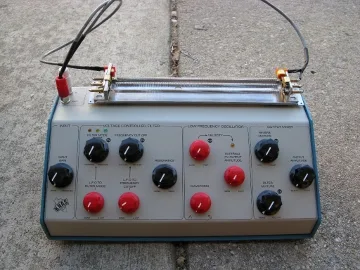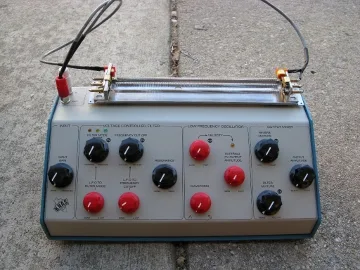
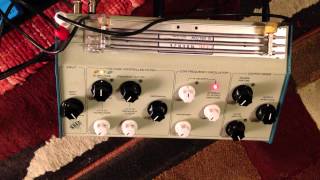


The Ekdahl Moisturizer is a spring reverb, multimode filter and LFO combo unit from Knas, the company of builder Karl Ekdahl, released in the summer of 2009 and produced continuously since12. What sets it apart from every conventional reverb pedal is that its spring reverb tank is exposed on the outside of the unit, so the player can use the Moisturizer as an instrument as well as an effects unit1. You can hit, pluck and fiddle with the springs directly, and because the tank runs at normal reverb signal gain, hitting the springs hard makes them distort while hitting them softly keeps the sound undistorted3.
The filter side is an analog state variable filter with a seamless crossover between lowpass, bandpass and highpass modes, plus resonance that Knas deliberately left without a resonance limiter, so it will self-oscillate and scream if pushed3. An LFO with a square/triangle crossover can sweep the filter, and nearly every parameter is patchable by control voltage or expression pedal3.
A spring reverb tank you can play
The core idea is simple: instead of hiding the springs inside a steel box, the Moisturizer leaves them out where your hands can reach them. Knas describes the unit as "a spring reverb where the springs are exposed so they can be played/hit/fiddled with"3. The tank is fastened to the unit with self-adhesive velcro, so it detaches for transport protection, and it ships in a hard cardboard tube rather than the padded bag used earlier35.
The gain staging of the tank is what makes it expressive as an instrument34:
- Hit the springs hard and they distort, in Knas's words, "like crap which is real nice"3
- Hit them softly and the sound stays undistorted3
- The tank is otherwise a normal spring reverb tank, so it also colors whatever audio you send through it3
In a Strymon rig rundown, guitarist Jason Glover explained how he uses it in a board context: since it runs after all of his dirt pedals, he uses it to sculpt his overall sound before things run in stereo, tweaking the Frequency Cut Off and Resonance to thicken everything up7.
"Since it runs after all of the dirt, I use it to sculpt my overall sound before things start running in stereo."
Filter, LFO and CV inputs
The filter section is a state variable design, which is what allows the seamless morph between modes rather than switching between separate circuits3.
| Control | What it does |
|---|---|
| Lowpass / Bandpass / Highpass | Seamless crossover between filter modes, set by knob, CV/expression pedal or LFO3 |
| Resonance | Sets filter emphasis, with no resonance limiter, so it can run to self-oscillation3 |
| LFO shape | Square / triangle crossover for modulating the filter3 |
| Reverb Mixture | Blends the reverb signal, controllable by knob or CV/expression pedal3 |
The rear panel carries a set of jacks that accept either control voltage or an expression pedal: Reverb Mixture, VCF Cutoff, VCF Filter Mode (LP/BP/HP), Filter Mixture and LFO Speed3. Knas says the unit should work with anything within the normal 0 to 10V range of CV and should probably withstand up to 20V, though that is not guaranteed5. It has been tested with a Moogerfooger, an Arp 2600, the Ekdahl Polygamist and several other units5.
Power and connections
Power is where the revisions really matter, and getting it wrong is the most common problem Knas documents68.
R3 and earlier Moisturizers require an AC output supply at 12V and 0.33A. A DC output supply will not work on these units, and Knas notes these AC supplies are unfortunately not that easy to find68. R4 and later units accept AC or DC of any polarity through a standard 2.1mm barrel connector6.
For R4 and later units, the Moisturizer requires a minimum of 12V and can theoretically handle DC up to 20V (18V max for AC), but Knas recommends not going above 15V DC or 12V AC, with a current of at least 0.33A6. An AC supply has no polarity, since there is no plus and minus, and whether the wall wart says "AC ADAPTOR" on it does not matter; what matters is whether the output is AC or DC8. Knas originally wanted to build an internal power supply and skip the wall wart entirely, but abandoned that due to mains liability and differences between countries' mains systems3.
The package contains one Ekdahl Moisturizer, one detachable spring reverb tank in a hard cardboard tube, and one optional American power supply6. Knas's American supplies are 12 VAC 500mA with a 2.1mm plug5.
Versions and where it is made
Knas splits the product line into two families: R3 and earlier, built with through-hole components, and R4 and later, built with surface-mount (SMD) parts910. The fourth revision also breaks all the modification points out as a single header on the board, which makes the documented mods far easier to reach10.
| Version | Construction | Mod access |
|---|---|---|
| R3 and earlier | Through hole | Mod points scattered on the board10 |
| R4 and later | SMD | All mod points broken out as one header10 |
The Moisturizer was developed with the help of Jason Willett (Half Japanese, Leperchaun Catering), Martin Schmidt (Matmos, Instant Coffee), Joshua Atkins (Polygons, Major Powers) and, in the earlier telling, mom and dad3. Jason Glover's rig rundown places the builder in Baltimore: "My friend Karl makes them here Baltimore"7.
Modifications
Knas publishes extensive modification guides for both revisions, and the mods themselves are the same across versions, with the R4 page referring back to the R3 page for the overview10. Most of the modifications are, in Knas's words, "scientific", planned with a certain outcome in mind, while some are circuit-bent and were stumbled upon by accident10.
Documented mods include:
- Filter-Reverb chain switcheroo (difficulty: Hard): reroutes the order of the filter and reverb using a 3PDT switch, six 100K resistors, four 27K resistors, and removal of resistor networks RN10, RN21 and RN199
- More filter bubble (difficulty: Easy): a DPDT switch soldered to RN10 and U49
- Resonance limiter: two 1N4148 diodes wired to RV8 and the resonance potentiometer's outer tabs, twined together with the lines pointing in different directions9
- Input overdrive: replacing the 10K resistor R5 with a 1K resistor, with an optional switch9
- Internal feedback (difficulty: Easy/Medium): a potentiometer and two 20K resistors9
- LFO speed modification (difficulty: Easy/Medium): swapping the original 2.2uF capacitor for a 1nF (really high speeds), 10nF, 100nF or 10uF (slow speeds) via a three-way switch; the capacitors must be bipolar polyester or polystyrene, never electrolytics9
Knas takes no responsibility if a unit is damaged during modification, and warns never to heat up an area for more than 5 seconds. R4 boards use lead free solder only, and Knas suggests you do the same910.
The mods require a soldering iron, snippers, 26 gauge stranded wire, a power drill, wire stripper, solder-sucking device, fine tweezers, lead free solder, tape and pliers; Knas strongly suggests a decent but cheap iron like the Hakko FX-888d or Weller WES-51910. On the R4, modifying means cutting the marked traces (reconnectable by solder-bridging the pads), adding the marked components and moving one cable10.
Buying and lead time
The list price was $400 plus shipping as of December 2015, with a deposit of US$90 to buy parts and secure the order5. Lead time depends on stock: if units are on hand it can be a few days, and if a new batch has to be built it can take weeks6.
Videos
hiwattbob
Perfect Circuit
once upon a synth
Questions
Is the Ekdahl Moisturizer mono or stereo?
It is a mono unit, according to Knas's own product page. It has a single audio path through the spring reverb tank and the analog multimode filter, so it is not a stereo reverb. Players who want stereo width typically place it before a stereo section of their rig.
Can the spring tank be removed from the Moisturizer?
Yes. The spring reverb tank is fastened to the unit with self-adhesive velcro, so it detaches for transport protection. The tank ships in a hard cardboard tube rather than a padded bag, which Knas adopted to protect the springs while moving the unit.
What power supply does the Ekdahl Moisturizer use?
It depends on the revision. R3 and earlier units require an AC supply at 12V and 0.33A, which Knas notes are not easy to find. R4 and later units use a standard 2.1mm barrel connector, accept AC or DC of any polarity, need at least 12V, and draw at least 0.33A.
Can you control the Moisturizer with an expression pedal?
Yes. The rear jacks take either control voltage or an expression pedal for Reverb Mixture, VCF Cutoff, VCF Filter Mode (lowpass, bandpass or highpass), Filter Mixture and LFO Speed. Knas says the unit works with anything in the normal 0 to 10V CV range.
Who makes the Ekdahl Moisturizer?
Knas, the company of builder Karl Ekdahl. The Moisturizer was Knas's first product, released in the summer of 2009, and the company has produced it continuously since. Jason Glover's rig rundown places the builder in Baltimore.
Sources (10)
- Knas, Knas, 2026-05-29
- Knaster, knasmusic.com, 2015-12-19
- Knas, Knas (knasmusic.com), 2024-09-12
- Knaster, knasmusic.com, 2015-12-19
- Knaster, knasmusic.com, 2015-12-19
- Knas, Knas (knasmusic.com), 2026-05-29
- Pedalboard Feature: Jason Glover, Strymon, 2015-09-16
- Knaster, Knaster (knasmusic.com), 2015-12-19
- Knas, Knas, 2024-09-12
- Knas, Knas, 2024-09-12