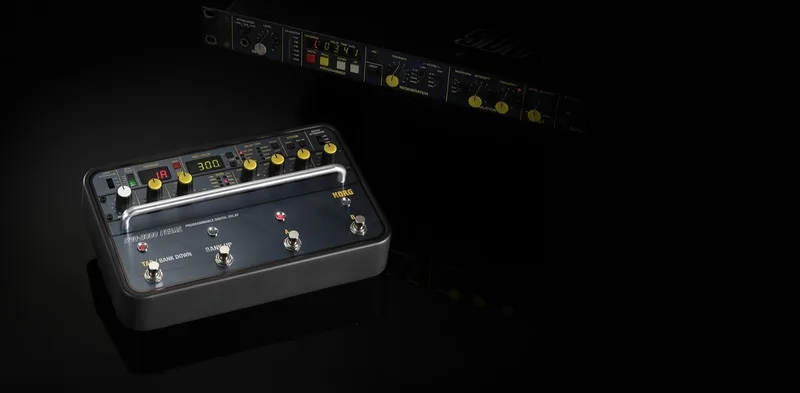


The Korg SDD-3000 Programmable Digital Delay is a stompbox reissue of Korg's rack-mounted SDD-3000 digital delay, a unit that first appeared in 1982123. The original found its way into the signal chains of many guitarists, including Daniel Lanois, Johnny Marr and, most famously, The Edge of U2, who still collects and uses them45. The pedal packs the rack unit's functionality into a large, stage-ready enclosure, adding modern features along the way67.
The pedal was developed in collaboration with veteran U2 guitar tech Dallas Schoo, who needed a solution for his ageing, failing rack units24. It was announced in July 2014 with a US street price of $399.992, and Premier Guitar's review lists it at a $399 street price1.
What it is and what it does
Korg describes the pedal as "the classic sound of the SDD-3000 digital delay, reborn as a pedal"6. It is a digital delay with eight delay types, a modulation section, a feedback control with a 6-band filter, and a mix control1. Korg says it covers all of the rack unit's important elements, featuring a pre-amp with ample headroom, a filter circuit that modifies the feedback sound, and modulation waveforms that allow a diverse array of delay effects6.
The enclosure is robustly stage-ready, with a raised metal bar protecting the knobs7. At 10.24 inches in length it is a big footprint on a pedalboard5. A comprehensive manual detailing complete function and operation is included in the box5, and an optional expression pedal can control multiple effect parameters simultaneously6.
The controls
The top of the pedal carries the sound-shaping knobs, and the lower third holds a four-footswitch array1.
| Control | What it does |
|---|---|
| Delay time knob | Dials in delay time, any value from 1ms to 4000ms7 |
| Feedback knob | Sets the number of repeats7 |
| Blend / mix knob | Sets the blend of dry and effected sound71 |
| Input level knob | Controls signal clipping, indicated by the headroom meter1 |
| Input attenuator | Switchable to -30dB or -10dB1 |
| Output attenuator | Switchable to -20dB or +4dB1 |
| Modulation intensity and frequency knobs | Set modulation depth and speed7 |
| Waveform knob | Continuously variable, dials in modulation waveforms and allows blends7 |
| L/C/R switch | Creates multi-tap delays that output to the left, center and right7 |
The modulation section is one of the features carried over from the original rack unit. MusicRadar's Trevor Curwen called the original's modulation section "one of the great assets of the original machine," and noted it is reproduced here with intensity and frequency knobs plus a choice of five basic modulation waveforms: sine wave, triangle, square, random and envelope7.
The four footswitches handle navigation and performance duties1:
- Bank up and bank down switches move through the program banks8
- The bank down switch doubles as a tap tempo control when hit twice1
- A and B switches select the two preset channels within each bank8
- A MIDI/SYS button accesses specific MIDI settings8
There is also a ducking function that applies delay only when the input is at a low level7. The output attenuator's +4 setting offers an opportunity to drive your amp harder, something players of the original rack unit have taken advantage of over the years7. MusicRadar's reviewer found the +4dB option works like a good boost pedal into an amp, and that the pedal makes a valid contribution to tone even when bypassed7.
Delay types and presets
The pedal offers eight delay types: SDD-3000, Analog, Tape, Modern, Kosmic, Reverse, Pitch and Panning6. One represents the original SDD-3000 sound, while the others cover tape and BBD emulations, reverse and more7.
| Delay type | What reviewers found |
|---|---|
| SDD-3000 | An accurate take on the original vintage unit's sound; a series of filter cuts in the highs, more apparent with every repeat75 |
| Modern | A typically cleaner digital delay; the most transparent delay of all the modes75 |
| Analog | Bucket Brigade-style degradation in the repeats; the same kind of filter cut without signal degradation75 |
| Tape | A smoother decaying vibe; filter cuts with warble and flutter, an extremely accurate representation of true tape delay75 |
| Kosmic | A mix of delay, a touch of reverb and some light pitch shifting5 |
Premier Guitar's reviewer found the pedal "excels at replicating the classic SDD-3000 delay voice," and that the kosmic delay with sine-wave modulation has an expansive, crystalline chime1.
"the new SDD-3000 excels at replicating the classic SDD-3000 delay voice."
A total of 80 programs can be saved, organized as 40 banks x 2 channels6. Premier Guitar describes this as two sound banks holding up to 40 presets each1. Tap tempo works from the bank down footswitch, and engaging the synch function allows tap-tempo divisions as short as 32nd notes1. In sync mode you can specify the delay time as a note value, which MusicRadar's reviewer notes suits "a little bit of rhythmic dotted eighth-note action"7.
MIDI connectors are provided, allowing you to trigger program changes from an external device, or to transmit program data as a bulk dump to and from other units6.
Where it came from
The rack-mounted SDD-3000 appeared in 1982, and Korg calls it "a classic digital delay that dominated the world thanks to its peerless sonic character"6. It became a much-used effect, not just by The Edge but by Daniel Lanois and other bands, both live and in recording studios, where an SDD-3000 was often an essential item in the effects rack4. The Edge has been using original units since their inception and owns a stockpile of both working and non-working rack units5. Today the original is a sought-after vintage piece, selling used for over $2,0009.
The pedal came about following an approach from Dallas Schoo, who needed a solution for his ageing, failing rack units4. Designer Dave Clarke says the pedal has "seriously upgraded hardware" able to recreate the unmistakable tone with modern-day reliability47. The pedal arrived earlier in 20144, announced in July of that year with a US street price of $399.99 and a predicted UK RRP of around £395210.
What reviewers made of it
Premier Guitar's review listed the pedal's strengths as "Hugely versatile. Vast storage. Stereo capability. Authentic SDD-3000 sounds," against the criticisms "Expensive. Going deep involves a learning curve"1. The reviewer found it relatively easy to use and navigate live, with seemingly limitless configurations for post-rock and ambient environments, and concluded that U2 fanatics will love it, while it should also appeal to experimentally minded players eager to explore the extreme ends of the pedal's capabilities1. On value: "The $399 price tag is steep at first glance, but this is a highly capable delay that can take on many, many personalities"1.
MusicRadar's verdict was similarly positive on sound, listing "Delay sounds excellent. Comprehensive modulation section. Preamp/boost is great. Seamless changeover between settings. Wide variety of delay effects," against the criticisms that it "Requires proper programming (and, ideally, two amps) to get the most from it" plus price7. The reviewer found the user interface may be a bit fiddly onstage, so it needs programming in advance, but the footswitching is well implemented7. MusicRadar's summary line: "A classic name revived with modern options"7.
"This pedal sounds awesome in mono, but a stereo setup is really a must to squeeze all of the potential out of this beast."
MusicPlayers.com's Bruce Sokolovic gave it 3.6 stars overall, earning a WIHO Award5. He noted the warranty covers 1 year parts and labor, with the power supply and footswitches covered for only ninety days, though registering online extends things an extra year5.
The pedal draws 600mA at 9V DC8, far more than a typical analog pedal. It uses a 9V barrel-type connector and includes a power supply5, but a standard low-current daisy chain is unlikely to feed it alongside much else.
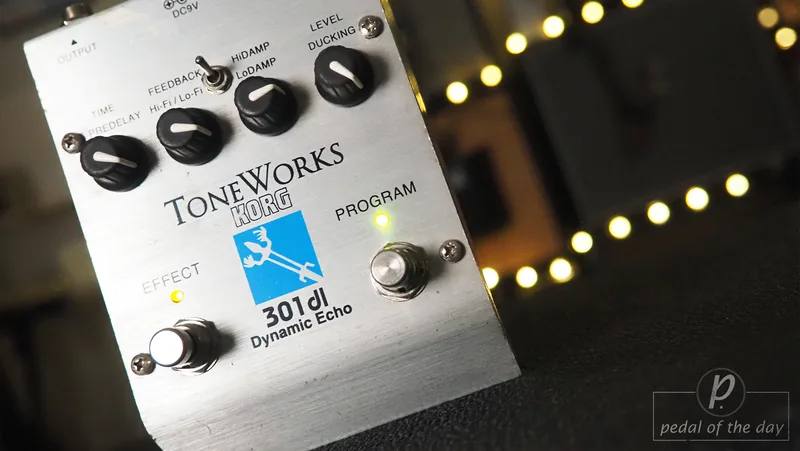
For players comparing Korg delays, the SDD-3000 pedal sits alongside the original Korg SDD-3000 rack unit it reproduces, and elsewhere in the brand's line the Korg ToneWorks 301 dl Dynamic Lo-Fi Echo also offers a ducking feature among its eight parameters. More broadly, it is one option among many delay pedals, distinguished by its rack-unit lineage, MIDI implementation and stereo multi-tap routing.
Videos
ProGuitarShopDemos
Sweetwater
Premier Guitar
Questions
How long is the delay time on the Korg SDD-3000 pedal?
Delay time runs from 1 to 4,000 milliseconds, adjustable in 1 millisecond steps with full bandwidth. You can dial it in with the delay time knob, or use the tap tempo function on the bank down footswitch to set the time directly in milliseconds or as a note value in sync mode.
Does the SDD-3000 pedal have tap tempo?
Yes. The bank down footswitch doubles as a tap tempo control when you hit it twice, and engaging the synch function lets you select tap-tempo divisions as short as 32nd notes. In sync mode you can specify the delay time as a note value, handy for rhythmic parts like dotted eighth notes.
Is the Korg SDD-3000 pedal stereo?
Yes, it has stereo inputs and outputs. Reviewers found the stereo delay sounds especially rewarding, and MusicRadar's reviewer said the pedal really comes alive with a pair of amps or in stereo recording, since you can set different but related delay times for each side. It works fine in mono too.
How much power does the SDD-3000 pedal draw?
It runs on a DC 9V AC adapter with a current consumption of 600mA, and a 9V/600mA adapter is included in the box. The pedal uses a 9V barrel-type connector aimed at pedalboard power supplies. That draw is high for a daisy chain, so plan power accordingly.
Does the SDD-3000 pedal sound like the original rack unit?
The SDD-3000 delay type is intended as an accurate take on the original vintage unit's sound, and Premier Guitar's reviewer found the pedal excels at replicating the classic SDD-3000 delay voice. It was developed with input from The Edge's guitar tech, Dallas Schoo, specifically to reclaim the original unit's tone.
Does the SDD-3000 pedal have MIDI?
Yes. MIDI connectors let you trigger program changes from an external device and transmit program data as a bulk dump to and from other units. There is also a MIDI/SYS button for specific MIDI settings, which makes it workable as part of a larger MIDI-controlled rig.
Sources (10)
- Korg SDD-3000 Programmable Digital Delay Review, Premier Guitar, 2015-09-18
- Korg Introduces the SDD-3000 Delay Pedal, Premier Guitar, 2014-07-10
- Korg Introduces New SDD-3000 Delay Pedal, Guitar Interactive Magazine, 2014-07-11
- Korg SDD-3000, MusicRadar, 2014-08-27
- Korg SDD-3000 Programmable Digital Delay Pedal, MusicPlayers.com, 2016-05-16
- SDD-3000 PEDAL, KORG (USA)
- Korg SDD-3000 Pedal review, MusicRadar, 2014-08-05
- Korg SDD-3000 Digital Delay, Pedal of the Day, 2016-03-03
- Mr. Black JDD-3000+ Digital Delay, Delicious Audio, 2023-10-02
- Korg unveils SDD-3000 delay pedal, MusicRadar, 2014-07-10