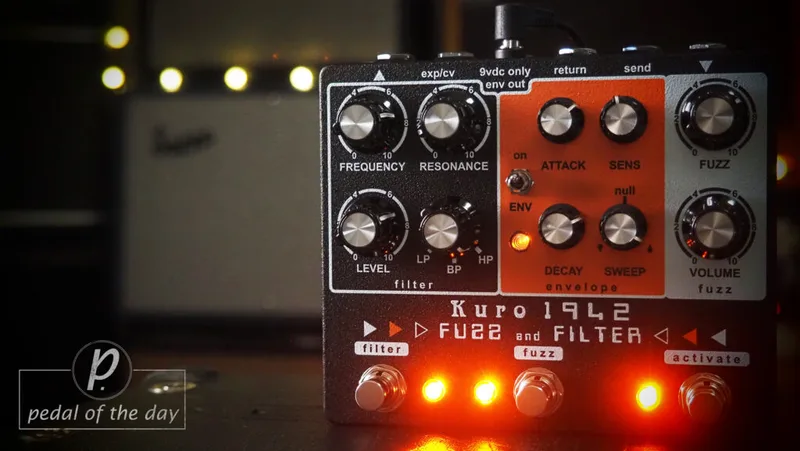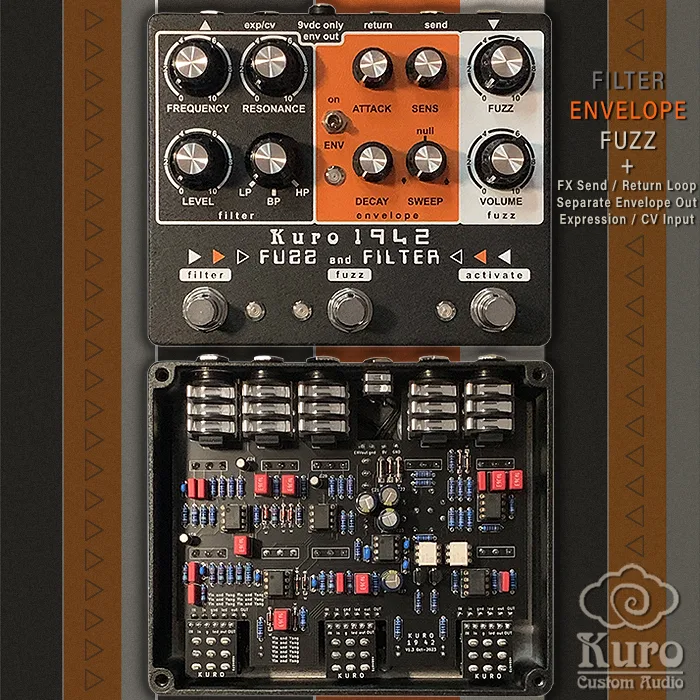


The Kuro Custom Audio 19 42 is an analog fuzz and filter pedal that packs four functions into one box: a gated square-wave fuzz, a resonant filter, an envelope follower, and an FX loop. Guitar Pedal X calls it a "4-in-1 Fuzz-Filter-Envelope-FX Loop" pedal, designed by Giulio as "an analog Filter Fuzz with independently usable functions and warbly swell textures"1. Pedal of the Day frames it as the union of two effects that work well together: "a square wave gated fuzz and a classic filter, like the ones found on '70s synthesizers"2.
The gated fuzz side produces the hard, on/off character of a square wave, where notes cut off abruptly rather than decaying smoothly. The filter side is a resonant filter in the mold of vintage synth filters, and the two sections can be run individually or together, which Pedal of the Day says gives "a broad spectrum of sounds to explore"2. The pedal is made in Italy and carries a lifetime warranty1.
What it is and what it does
The 19 42 is built around two main sections. The fuzz section generates a gated square wave, the clipped waveform shape associated with synth-like, splatty fuzz tones where the gate shuts the signal off when it falls below a threshold. The filter section is a resonant filter with three modes, and an envelope follower makes the filter respond to how hard you play, the way an envelope filter or auto-wah does. Guitar Pedal X describes the envelope follower as "highly sensitive / controllable"1.
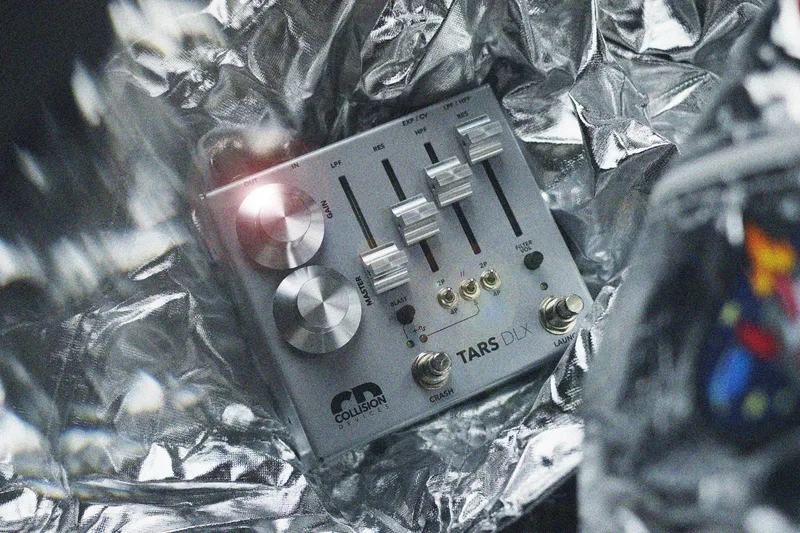
Pedal of the Day's reviewer found the fuzz side to be "a powerful fuzz that will rip through any amp"2. In Guitar Pedal X's 2024 roundup of the year's new fuzz pedals, Stefan Karlsson went further, calling it "so much the better filter fuzz with vastly extended feature set" compared to the Collision Devices TARS, and counting 11 controls overall3.
"19 42 is the union of two distinct effects that work really well together, a square wave gated fuzz and a classic filter."
The controls
The controls are grouped by section, with footswitches for the fuzz, the filter, and a master Activate switch13.
| Section | Control | What it does |
|---|---|---|
| Fuzz | Fuzz (Gain) | Sets the fuzz amount |
| Fuzz | Volume | Sets the fuzz section's output level |
| Fuzz | Fuzz footswitch | Switches the fuzz section on and off |
| Envelope | ENV On/Off | Enables or disables the envelope follower |
| Envelope | Attack | Sets the rate of onset, how fast the envelope sweeps begin |
| Envelope | Send | Sensitivity / trigger threshold for the envelope |
| Envelope | Decay | Sets how the envelope falls |
| Envelope | Sweep | Sets how far the envelope moves the filter |
| Filter | Frequency | Sets the filter's center operating point |
| Filter | Resonance | Sets the filter's emphasis at its cutoff point |
| Filter | Level | Sets the filter section's output level |
| Filter | Mode toggle | Selects Low-Pass, Band-Pass or High-Pass |
| Filter | Filter footswitch | Switches the filter section on and off |
| FX Loop | Activate footswitch | Engages the pedal and the FX loop together |
The filter's three modes cover the standard shapes: low-pass rolls off highs above the cutoff, high-pass rolls off lows below it, and band-pass passes a narrow band around it1. Because the fuzz and filter each have their own footswitch, either can be brought in and out independently while the pedal is active1.
Power and connections
The 19 42 runs on a 9V DC center-negative supply with a 140mA current draw1. That draw is well above what a typical analog fuzz needs, so it expects a proper pedalboard power supply rather than a battery.
The rear panel carries a full set of jacks1:
- Mono TS In: instrument input, >1Meg ohm input impedance
- Send and Return: the FX loop, engaged by the Activate footswitch
- Envelope Out: 3.5mm mono jack carrying the envelope signal
- Expression / CV In: for an expression pedal, CV or LFO
- Mono TS Out: main output, <1K ohm output impedance
Expression and CV control
The Exp/CV jack accepts an expression pedal, or a CV or LFO signal, to control the filter frequency12. Kuro tested it with classic 10k linear taper expression pedals, naming M-Audio and Roland models as examples1. An LFO from a synthesizer or modular source can sweep the filter automatically, turning the 19 42 into something closer to a synth-style filter with moving sweeps.
The Envelope Out jack
The Envelope Out is a 3.5mm mono jack that carries the envelope signal out of the pedal. It can control other devices that have a CV or envelope input, such as compatible pedals or synth gear. The Activate footswitch has to be on for the Envelope Out to work1.
The FX loop
The Send and Return jacks form an effects loop that can host other pedals, and the Activate footswitch engages the pedal and the loop together1. Pedal of the Day notes the loop as part of the pedal's feature set2.
Where it came from
The 19 42 is made in Italy by Kuro Custom Audio and carries a lifetime warranty1. It is available for order from the Kuro Kustom Audio webstore, listed at €349 / $36513.
The name "19 42" is not a reference to a year or date. According to Guitar Pedal X, it signifies the immaculate interaction of two highly complementary elements, a reference to the pedal's principal fuzz and filter abilities1.
Videos
collector//emitter
ToneMorph Dan
We As A Company
Questions
Does the Kuro Custom Audio 19 42 have an effects loop?
Yes. The 19 42 has a Send and Return on the rear panel, and an Activate footswitch that engages the pedal and the FX loop together. Other effects patched into the loop can be brought in and out with the pedal itself.
Can I use an expression pedal with the Kuro 19 42?
Yes. The Exp/CV jack accepts an expression pedal, or a CV or LFO signal, to control the filter frequency. Kuro tested it with classic 10k linear taper expression pedals such as M-Audio and Roland models.
What does the name 19 42 mean?
According to Guitar Pedal X, the name is not a reference to a year or date. It signifies the interaction of two complementary elements, referring to the pedal's principal fuzz and filter abilities.
Is the Kuro 19 42 analog?
Yes. Guitar Pedal X describes it as an analog filter fuzz, designed by Giulio with independently usable functions and warbly swell textures. It combines gated square-wave fuzz, a resonant filter, an envelope follower and an FX loop.
What filter modes does the Kuro 19 42 have?
A toggle switch selects low-pass, band-pass or high-pass operation for the filter section. Frequency, Resonance and Level knobs shape the chosen mode, and the filter can be switched on and off with its own footswitch.
What can the Envelope Out jack control?
The Envelope Out is a 3.5mm mono jack that carries the envelope signal, so it can control other devices that have a CV or envelope input, such as synthesizer modules or compatible pedals. The Activate footswitch has to be on for it to work.
Sources (3)
- Guitar Pedal X, Guitar Pedal X, 2024-01-31
- Kuro Custom Audio 19 42 Fuzz and Filter, Pedal of the Day, 2024-03-09
- Guitar Pedal X, Guitar Pedal X, 2024-12-18