

The Line 6 POD Go is a compact floor unit that puts Line 6's HX-family amp, cab and effects modeling into a lightweight, plug-and-play package. Line 6 describes it as an "ultra-portable and lightweight amp and effects processor" with a simple interface and "professional-quality amp, cab, and effect models drawn from the celebrated HX family of effects processors"12. Where a full Helix lets you route a signal chain however you like, the POD Go uses a semi-fixed serial signal path, trading routing freedom for speed and ease of use1.
Guitar World's Chris Gill framed the unit's place in the lineup plainly: "Now Line 6 has boldly resurrected the POD series with the debut of the POD Go"3. It is a digital modeler, housed in a compact floor controller unit measuring approximately 14 by 9 inches and weighing about 5 1/2 pounds3.
What the POD Go does
The POD Go is built around models taken from the HX family of processors, the same lineage as the Line 6 Helix. Premier Guitar's reviewer noted of the platform that "It shares a lot of digital DNA with company's newer flagship Helix processors"6. In practice that means amp and cab models plus a range of effects blocks, arranged along a fixed-order signal path rather than a freely routable grid.
Each preset holds nine simultaneous blocks4. That is fewer moving parts than a Helix preset, and it is the core of the design intent: Line 6's Eric Klein, Chief Product Design Architect, was quoted at launch on the design, and the company positions the unit as getting players "on the road to ultimate tone" quickly rather than offering deep routing14.
The unit also carries features that round it out as a live tool:
- 256 presets on the Wireless version (128 user plus 128 factory), a tuner, tap tempo, and a looper with 40 seconds of mono or 20 seconds of stereo sampling7
- Snapshots for switching sounds within a preset1
- Pedal Edit mode, which Guitar.com reported "allows users to tweak amp and effect parameters with their feet"8
- USB audio interface capability7
The controls
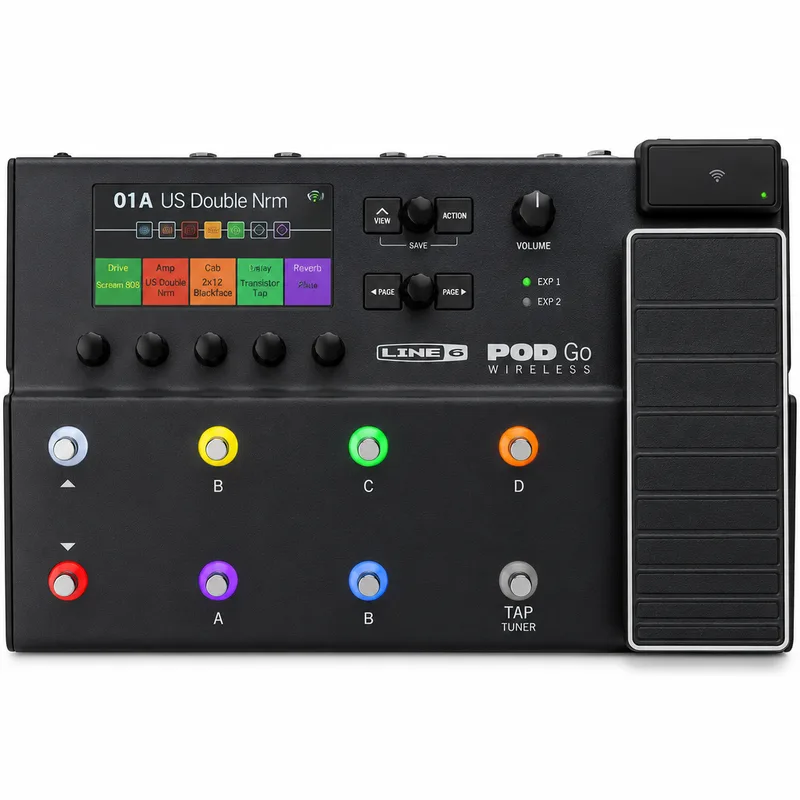
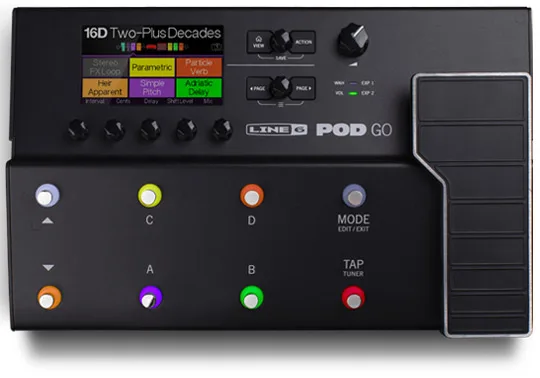
The front panel is built around a 4.3" color LCD for viewing edits, five soft knobs, four buttons, and eight footswitches with colored LED rings149. The top knob changes jobs with the view: in Play view it selects presets (press to open the preset list), and in Edit view it selects blocks, with a press bypassing the selected block1.
| Control | What it does |
|---|---|
| Upper Knob (Play view) | Turn to select presets; press to open preset list1 |
| Upper Knob (Edit view) | Turn to select blocks; press to bypass selected block1 |
| Knobs 1-5 | Turn to adjust parameters for the selected block; press to reset the value; press and turn to assign the parameter to snapshot control1 |
| MODE footswitch | Toggles between PRESET and STOMP footswitch modes1 |
| Footswitches A-D | Select presets within a bank in Preset mode7 |
| Up/Down footswitches | Change banks7 |
The unit powers up in Preset mode, with each bank assigning presets to footswitches A, B, C and D7. Stepping on MODE switches the footswitches to Stomp mode for turning individual blocks on and off mid-song1.
The expression pedal is a rugged cast-aluminum, multi-function unit. Moving it controls volume, wah, or any combination of amp and effects parameters, and a toe switch toggles between Wah (EXP 1) and Volume (EXP 2)19. Two external footswitches or a second expression pedal can be connected as well4.
Snapshots
Snapshots let one preset do several jobs. Line 6 explains that they "enable you to create up to four variations within a preset and seamlessly transition between them without audio dropouts or disrupting delay and reverb trails"1. For a player, that means switching from a clean verse sound to a driven chorus sound without the gap or the cut-off delays a full preset change can cause.
The knob behavior ties into this: press and turn any of Knobs 1-5 and that parameter becomes part of snapshot control, so each of the four snapshots can recall its own value1.
Power and connections
The POD Go runs from a DC input, and Line 6 "strongly recommends using only the supplied DC-3 power supply"1. The Wireless version ships with a 9V DC DC-3h adaptor rated at 2500 mA7, a draw that rules out battery power and makes daisy-chaining with ordinary pedalboard supplies impractical.
Connection options cover the main ways a player might use it:
- Guitar In: Line 6's manual says to "connect your guitar, bass, or synth here"1
- Signal path: a semi-fixed serial signal path designed for fast tone creation and plug-and-play operation1
- Display: a 4.3" (11cm) color LCD for viewing edits1
The duplicate amp output can be tapped before the Cab/IR block, so the speaker simulation can be left out of the feed going to a real amp4.
History and versions
The POD Go was announced for release worldwide in spring 2020, with a US MSRP of $629.994. Eric Klein, Chief Product Design Architect at Line 6, was quoted on the design intent at the announcement4. The POD name itself has since been retired; Line 6's legacy page states simply that "POD is no longer made"10.
In 2021 Line 6 followed it with the POD Go Wireless, announced at $579 against the original's $479, available in spring 20215. MusicRadar's review describes it as "the same compact compendium of amp models and effects, the same enclosure to the regular POD Go, only there is an in-built Relay G10 unit added"7. It also adds MIDI In and MIDI Out/Thru, which the standard POD Go lacks47. Guitar Player's news piece noted its 4.3" LCD screen and reported Line 6 saying it would be available that spring11.
How it compares
Against the Helix line, the trade-offs are clear. Guitar Player's reviewer framed the standard POD Go's limits as features you give up: "If you don't need dual signal chain, MIDI I/O, Variax control and the like," the POD Go covers the essentials9. MusicRadar's review of the Wireless version made the same point from the other direction, listing "other Line 6 modellers offer more flexible signal chains" among its reasons to look elsewhere, and noting the regular POD Go is the exact same unit and cheaper if you do not need wireless7.
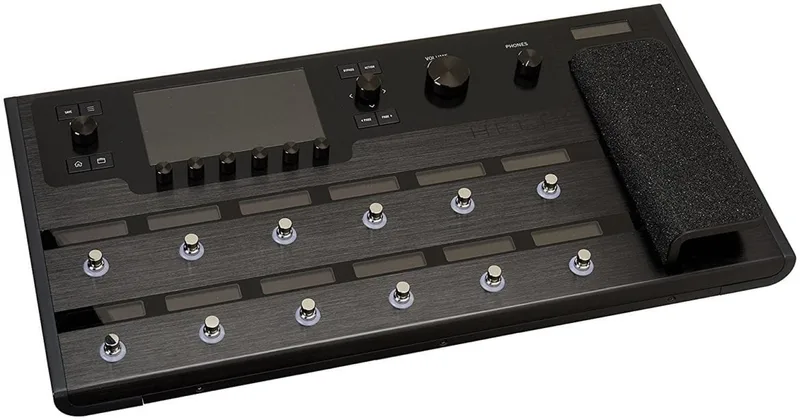
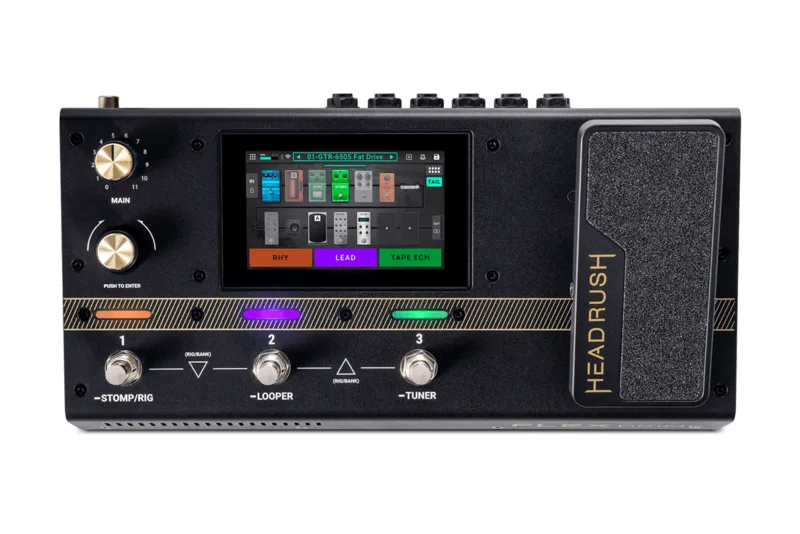
In a 2026 Guitar World review of the HeadRush Flex Prime, Matt McCracken compared the two directly, listing the POD Go at $499 and finding that "it's slightly cheaper than the HeadRush Flex Prime and for my money, sounds slightly better," while conceding "It doesn't have quite as many features as the Flex Prime"12.
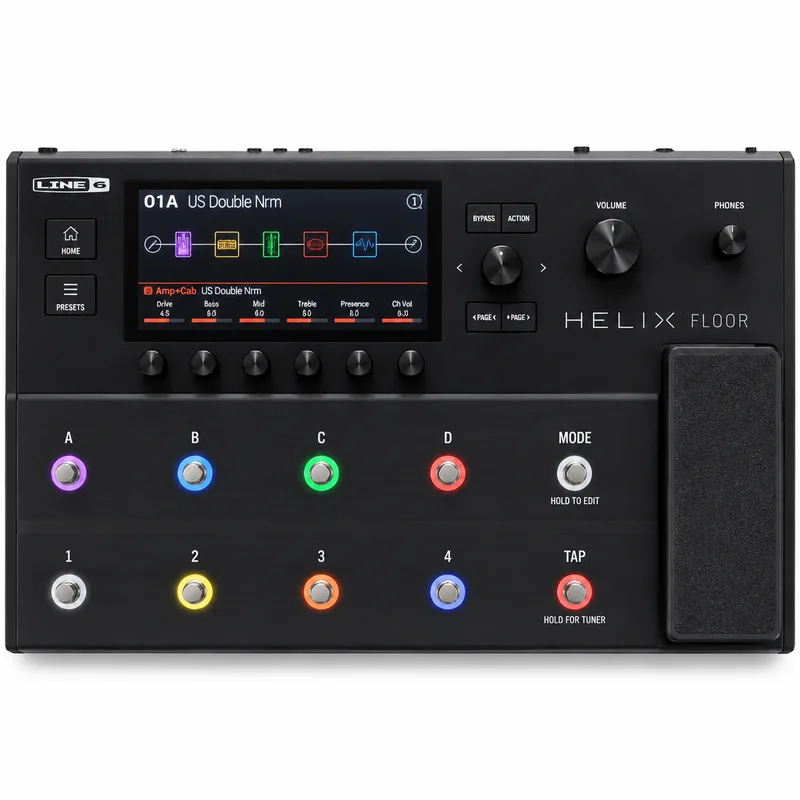
Pete Thorn's video review from 2020 walked through the unit for players coming from the bigger Line 6 flagship, saying "if you're used to using a helix it's really similar as far as programming and the layout and everything"13.
Videos
Andertons Music Co
Guitar World
News
Questions
Does the Line 6 POD Go have MIDI?
No. The standard POD Go has no MIDI I/O, which is one of the features Guitar Player's reviewer pointed to as a reason some players would step up to a bigger Line 6 modeler. The POD Go Wireless, however, adds MIDI In and MIDI Out/Thru alongside its built-in wireless system.
How many blocks can a POD Go preset run at once?
Each preset runs nine simultaneous blocks, arranged on a semi-fixed serial signal path. That path is what makes the unit fast to program: you pick blocks in order rather than routing a flexible signal chain yourself, as you would on a Helix.
What are snapshots on the POD Go?
Snapshots are up to four variations within a single preset. Switching between them is seamless, with no audio dropouts and without disrupting delay and reverb trails. You can assign individual knob parameters to snapshot control by pressing and turning the knob.
Can I use the POD Go with the 4-cable method?
Yes. Line 6 states that POD Go processors may be connected to a traditional amplifier using the Amp Out jack or the 4-Cable Method. The unit also has a mono/stereo effects loop with Send and Return connections to support this.
How much does the Line 6 POD Go weigh?
Guitar World's review puts it at about 5 1/2 pounds, in an enclosure measuring approximately 14 by 9 inches. That light weight is part of what makes it a practical grab-and-go floor unit compared with larger modelers.
Is the POD Go the same as a Helix?
No, but they are related. The POD Go draws its amp, cab and effects models from the HX family used in the Helix line, and Pete Thorn noted its programming and layout feel very similar to a Helix. The differences are in flexibility: no dual signal chain, no MIDI I/O on the standard model, and a semi-fixed rather than fully routable signal path.
Sources (13)
- Line 6 | POD Go | Ultra-Portable Amps & Effects Processor, Line 6
- Line 6 | POD Express | Ultra-Portable Amp and Effects Processor, Line 6
- Line 6 POD Go review, Guitar World, 2020-06-30
- Line 6 Debuts POD Go Guitar Processor The Best-Sounding POD Ever, MusicPlayers.com, 2020-01-18
- Line 6 unveils new-and-improved POD Go Wireless amp and effects processor, Guitar World, 2021-03-09
- Line 6 POD Go Wireless Review, Premier Guitar, 2021-07-06
- Line 6 Pod Go Wireless review, MusicRadar, 2021-10-11
- Nine best effects pedals of NAMM 2020, Guitar.com, 2020-01-21
- Line 6 POD Go Review, GuitarPlayer, 2020-07-17
- Line 6 | Legacy Products, Line 6
- Line 6 Unveils New POD Go Wireless Amp Modeler, Multi-Effects Pedal, GuitarPlayer, 2021-03-09
- HeadRush Flex Prime review, Guitar World, 2024-12-13
- IS IT... A BABY HELIX? Line 6 POD GO, youtube.com, 2020-08-01