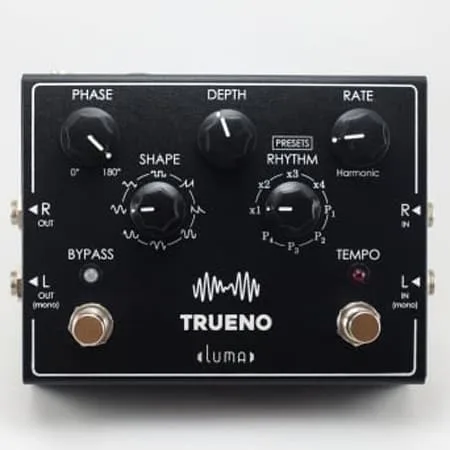



Controls, modes and presets
The Trueno's feature set is built around shaping both the tremolo wave and its rhythm1:
- Eight waveforms, three of which recreate soft valvular clipping sound, a softer, tube-like shape of gain rounding off the wave peaks1
- Four rhythm patterns to choose from1
- Four subdivisions: quarter, eighth, triplets and sixteenths notes1
- Tap tempo switch, described as super accurate1
- Eight presets for favorite settings1
- Dissastro mode, an oscillator mode (ring modulator)1
- Stereo In / Stereo Out, with phase control of right and left channel oscillator, sync and pan1
- Expression pedal input, assignable to Phase, Depth or Rate parameters1
The waveform selection is where the Trueno's classic side lives: with three of the eight shapes recreating soft valvular clipping, the pedal can lean toward the rounded, tube-flavored swell players associate with vintage amp tremolo, while the remaining shapes cover sharper, more squared-off modulation1. The rhythm patterns and subdivisions then let you place those swells in time, from straight quarter notes to sixteenth-note stutter1.
Stereo operation and Dissastro mode
The Trueno's stereo inputs and outputs are central to what it does. Phase control of the right and left channel oscillator, along with sync and pan, means the two channels can move together or against each other, which is the basis of its harmonic tremolo style of movement1. Players running a stereo rig, or feeding two amps, get the most from this; a mono setup still works, but the panning and channel phase features have nowhere to go.
Dissastro mode takes the pedal outside tremolo altogether. As an oscillator mode (ring modulator), it mixes the guitar signal with an internal oscillator, producing the metallic, bell-like tones ring modulation is known for1. It sits alongside the tremolo modes as a creative option rather than a replacement for them, which is why Delicious Audio described the pedal as "a very creative tremolo that combines classic and harmonic tremolo with a ring modulator"1.
"a very creative tremolo that combines classic and harmonic tremolo with a ring modulator"
Expression control
An expression pedal input can be assigned to the Phase, Depth or Rate parameters1. In practice that means a player can sweep the speed of the tremolo, its depth, or the channel phase relationship by foot, which suits the pedal's time-based features: riding the Rate against a drummer, or fading the effect in and out mid-song. Any standard expression pedal connected to this input handles the sweeping.
Videos
Luma Sonido
Luma Sonido
Luma Sonido
Questions
Does the Luma Trueno have tap tempo?
Yes. The Trueno has a tap tempo switch, which Delicious Audio described as super accurate. Alongside tap tempo, the pedal offers four subdivisions (quarter, eighth, triplet and sixteenth notes) and four rhythm patterns to choose from, so you can lock the tremolo to the song or set it by ear.
Is the Luma Trueno Tremolo stereo?
Yes. The Trueno has stereo inputs and stereo outputs, with phase control of the right and left channel oscillator, plus sync and pan. That stereo movement is also what makes its harmonic tremolo and panning effects possible.
What does Dissastro mode do on the Trueno?
Dissastro is the Trueno's oscillator mode, a ring modulator. Ring modulation produces clangorous, bell-like tones by mixing the input with an internal oscillator, so this mode takes the pedal well beyond standard volume-based tremolo into more experimental territory.
Where is the Luma Trueno made?
The Trueno is made in Argentina. It was the first pedal by its maker, Luma Sonido, when Delicious Audio covered its release in February 2021.
Can you use an expression pedal with the Luma Trueno?
Yes. The Trueno has an expression pedal input that can be assigned to the Phase, Depth or Rate parameters, so you can sweep any of those three controls by foot while you play.
Sources (1)
- Luma Trueno Tremolo, Delicious Audio, 2021-02-04