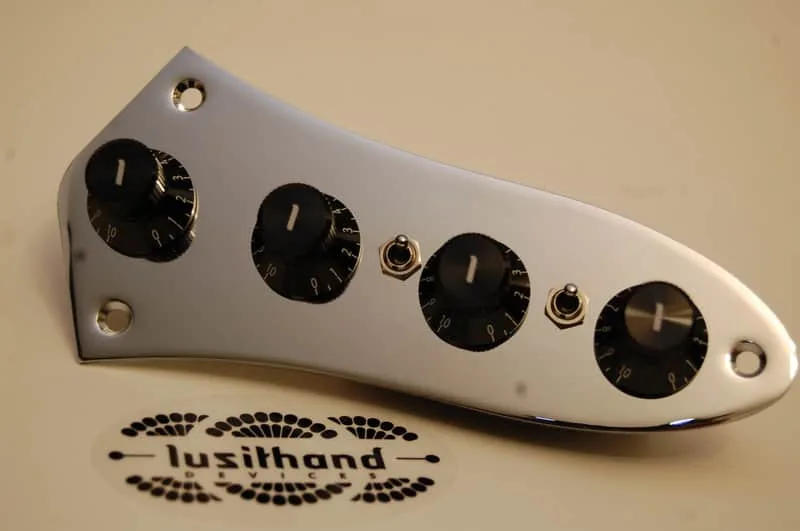


The Lusithand Devices NFP Preamp is an onboard filter preamp for bass, described by the maker as "a filter preamp alike the ones seen on basses like the Alembic or Wal"1. It is a resonant low pass filter: it lets all bass frequencies pass through up to 4 kHz, where it forms a resonant peak and then rolls off the frequencies above that point1. In practice, that gives a bass player the kind of sweepable tone shaping built into certain high-end basses, added to an instrument that does not have it.
Controls and how it works
The single potentiometer does two jobs at once. Rotating it left and right sweeps the cutoff frequency, meaning the resonant peak, within a range of 150 Hz to 4 kHz1. Pulling up on the potentiometer's switch, the push-pull function, selects between two levels of gain at the resonant peak and boosts the cutoff point1. That is the core of the NFP: one knob that moves the peak across the bass range, and a switch that adds more emphasis at the peak.
The trim potentiometer is a set-and-forget control. If your pickups are too hot, causing clipping and unwanted distortion, the trim attenuates them. It ships set for zero attenuation, so it does nothing until you adjust it1.
| Control | What it does |
|---|---|
| Potentiometer (rotated) | Sweeps the cutoff frequency, the resonant peak, from 150 Hz to 4 kHz1 |
| Potentiometer (push-pull, pulled up) | Selects between two levels of gain at the resonant peak and boosts the cutoff point1 |
| Trim potentiometer | Attenuates hot pickups that cause clipping and unwanted distortion; ships at zero attenuation1 |
Installation and wiring
The NFP is designed to be wired into a bass rather than used as a floor pedal. The board measures 3.1 cm wide, 2.3 cm high and 1.7 cm deep, and the potentiometer needs a 6.35 mm hole with a 10 mm bush height1. The manual's wiring points include:
- Terminal 2, GND: ground for the pickup1
- Terminals 2 and 6: two ground connectors to tie all grounds together, including shielding and bridge ground wires, plus ground to the jack's sleeve connector1
- Terminal 4: the potentiometer, which doubles as the ring connection of the jack1
- Terminal 5, Out: to the jack tip or a volume potentiometer of 10kA to 50kA1
Lusithand's manual advises creating a solid base for the potentiometers to sit on, for example by using another washer between the pot's base and the wood, to prevent the pots from sinking into the body1.
Power
The NFP was designed to run between 9 and 27 volts, and its power consumption is about 2 mAh at 9V1. That light draw suits an onboard battery arrangement in a bass.
Warranty
Lusithand states that any of its products that are defective will be replaced or fixed with all expenses covered, once it has been verified that the problem is not a result of bad handling or negligence. Damage due to negligence or wrong handling loses the warranty, a repair cost can occur, and shipping costs are not covered1.
Where it sits in Lusithand's range
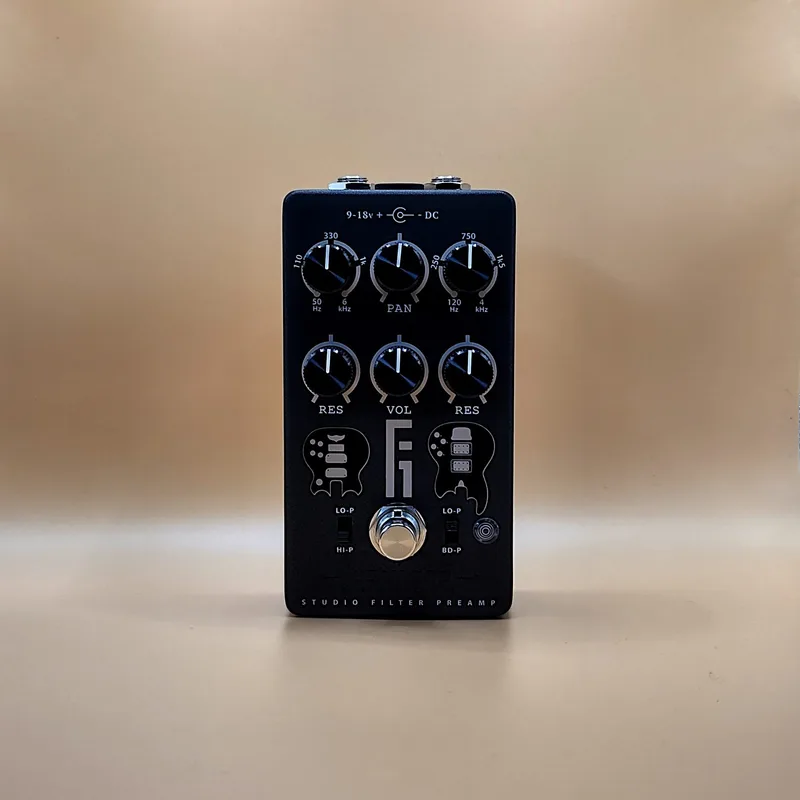
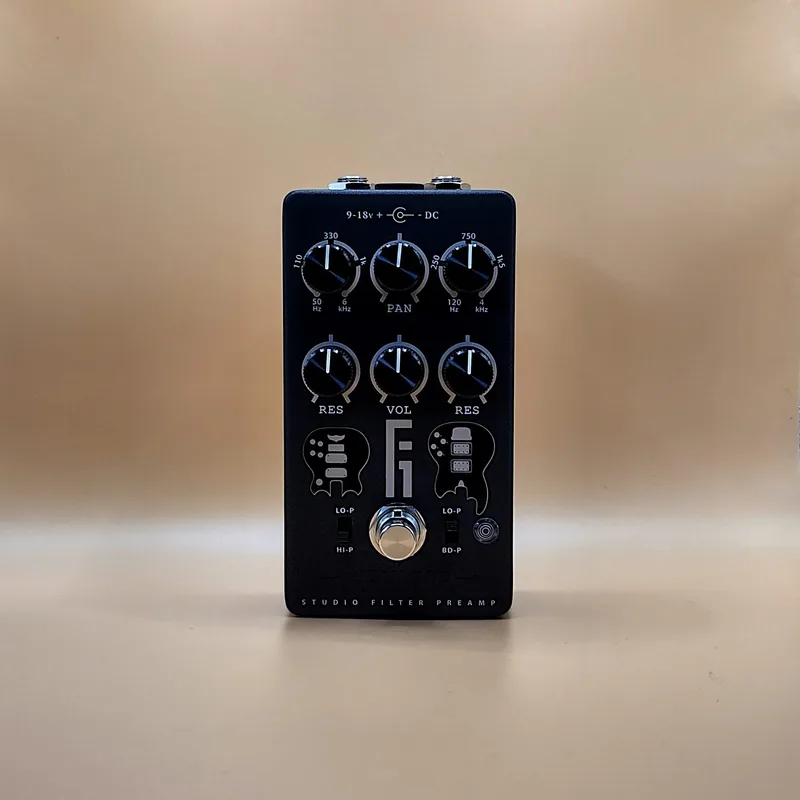
The NFP is the onboard version of Lusithand's filter approach. Players who want the same resonant filter idea in pedal form can look at the Lusithand Devices F1 and the Lusithand F1 Studio Filter Preamp, and filter effects generally are covered on the Filter Pedals page.
Videos
LusitHand Devices
LusitHand Devices
LusitHand Devices
Questions
What frequency range does the NFP Preamp sweep?
The potentiometer sweeps the cutoff frequency, where the resonant peak sits, within a range of 150 Hz to 4 kHz, rotating left and right. Being a low pass filter, it lets all bass frequencies pass through up to the cutoff point, where it forms a resonant peak and then rolls off the frequencies above it.
What voltage does the Lusithand NFP Preamp run on?
Lusithand designed the NFP to run between 9 and 27 volts, so it works with a standard 9V supply as well as higher-voltage power. Current draw is about 2 mAh at 9V, which is light enough for most onboard battery setups.
What does the push-pull switch do?
Pulling up on the potentiometer's switch selects between two levels of gain at the resonant peak and boosts the cutoff point. The same potentiometer doubles as the sweepable cutoff frequency control when rotated left and right.
What is the trim potentiometer for?
If your pickups are too hot and cause clipping and unwanted distortion, the trim potentiometer attenuates them. It ships set for zero attenuation, so it has no effect until you turn it down.
What does the Lusithand warranty cover?
Lusithand states that any of its products that are defective will be replaced or fixed with all expenses covered, once the problem is verified not to be the result of bad handling or negligence. Damage from negligence or wrong handling loses the warranty, a repair cost can occur, and shipping costs are not covered.
Sources (1)
- NFP-push-pull-manual.pdf, Lusithand Devices, 2025-04