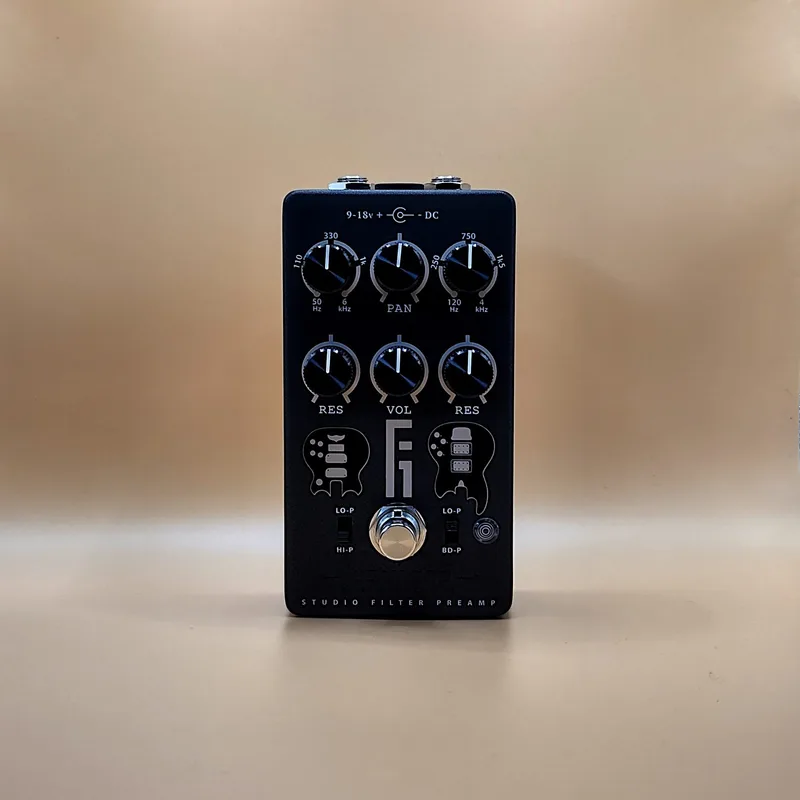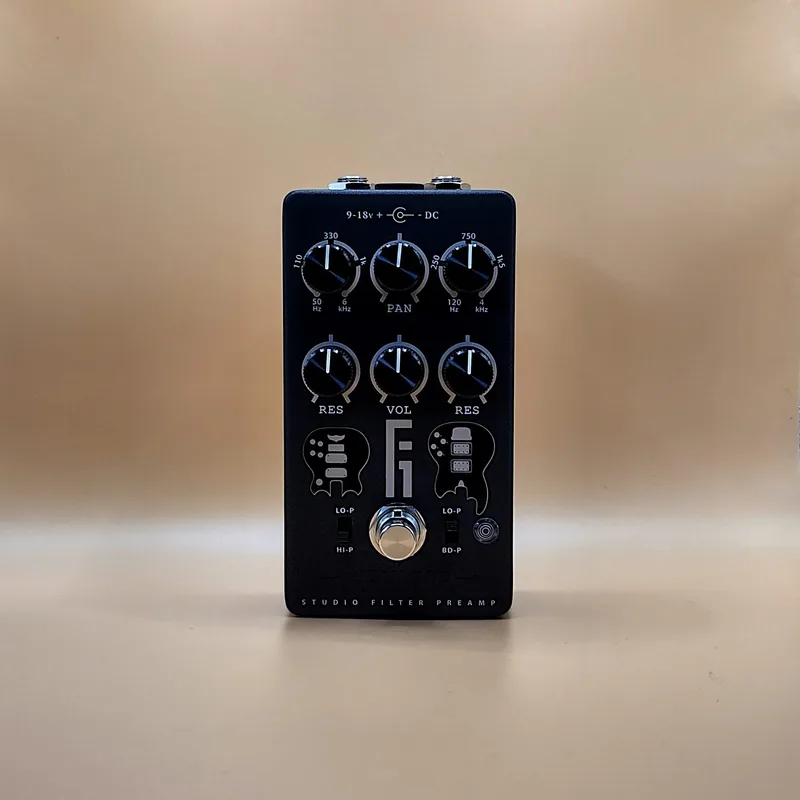


The Lusithand Devices F1 Studio Filter Preamp is an analog preamp pedal built around two independent, blendable filters. Lusithand designed it to replicate the resonant peak characteristics of iconic basses such as Alembic and Wal, and describes it as useful both as an effect and as a utility tool with bass and guitar, in the studio or performing live1. RockBoard's PedalPedia classifies it as a preamp and lists the circuit type as analog2.
What the two filters do
The F1 consists of two separate filters, one blending PAN control and a Master Volume1. The two filters cover different ranges and offer different filter types, which is what lets the pedal shape a broad sweep of the spectrum or zero in on one band:
| Filter | Sweep range | Filter type options |
|---|---|---|
| Filter 1 (left) | 50Hz to 6kHz | Low-Pass or High-Pass |
| Filter 2 (right) | 120Hz to 4kHz | Low-Pass or Band-Pass |
Filter 1 sweeps from 50Hz to 6kHz with selectable Low-Pass or High-Pass modes, while the second sweeps from 120Hz to 4kHz with Low-Pass or Band-Pass options2. The left filter's narrower range covers the low fundamentals and upper mids most players sweep on bass, while the right filter's band-pass mode isolates a single band of frequencies.
Controls
The maker lists the panel as follows1:
- Filter Sweep (left): sweep from 50Hz to 6kHz
- Filter Sweep (right): sweep from 120Hz to 4kHz
- PAN: blend between both filters
- RES (right): increase or decrease the Resonance for this filter
- LO-P and HI-P switch: select between Low Pass or High Pass for the left filter
- LO-P and BD-P switch: select between Low Pass or Band Pass for the right filter
Each filter includes a dedicated Resonance (RES) control that adjusts the sharpness of the frequency peak, from flat to highly boosted2. That resonance is the heart of the pedal's design intent: a flat setting behaves like a gentle tone filter, while a boosted peak emphasizes the swept frequency, reproducing the resonant hump that Alembic and Wal basses are known for2. The PAN control then sets how much of each filter's output reaches the blend, and the Master Volume sets overall level1.
Where the circuit comes from
The F1 uses the same filter topology that Lusithand uses on its NFP filter preamps, according to the maker's product page1. RockBoard's PedalPedia entry describes the pedal as based on the filter topology of the company's NFP (New Filter Preamp) series2. Players who want to trace the design can read it as a studio-oriented take on the Lusithand Devices NFP Preamp, and as one entry in the wider field of filter pedals and preamp pedals.
AMT Electronics also sells a pedal called the F1, a guitar preamp with hi/low pass filters plus Presence and cabinet simulation. It is a different product from a different maker, and the two should not be confused when reading reviews or listings3.
Videos
the wetter bass
Theo And His Pedals
Paul Del Bello and LusitHand Devices
Questions
Is the Lusithand F1 analog or digital?
The F1 Studio Filter Preamp is an analog circuit, according to the RockBoard PedalPedia listing for the pedal. That matters for players who want their filtering and preamp stage to behave like a traditional analog front end rather than a digital model, and it means the pedal sits in a signal chain the same way other analog preamps and filters do.
What power supply does the Lusithand F1 need?
The F1 runs on 9V DC with a center-negative plug, the same standard used by most modern pedals. RockBoard's PedalPedia listing gives the voltage as 9V DC, center negative. As with any pedal, a clean, isolated supply is the safe choice on a shared board.
Can the Lusithand F1 be used with guitar as well as bass?
Yes. Lusithand describes the F1 as useful both as an effect and as a utility tool with bass and guitar, whether in the studio or performing live. Although its filters were designed around the resonant peaks of iconic basses, the maker positions it as a general-purpose filter preamp for either instrument.
What does the RES control do on the Lusithand F1?
Each of the F1's two filters has a dedicated RES (Resonance) control. It adjusts the sharpness of the frequency peak, from flat to highly boosted. At low settings the filter rolls off gently; turned up, it emphasizes the sweep frequency, which is how the pedal recreates the resonant peak character of basses like Alembic and Wal.
What is the Lusithand NFP series?
The NFP (New Filter Preamp) series is Lusithand Devices' line of filter preamps. The F1 uses the same filter topology as those pedals, according to both the maker and RockBoard's PedalPedia listing, so the F1 can be read as a studio-oriented expression of the company's existing filter preamp design.
Sources (3)
- F1 (Studio Filter Preamp), Lusithand Devices
- F1 Studio FiltePreamp by Lusithand, RockBoard PedalPedia, 2026
- AMT Electronics: F1 preamp, Media center of AMT Electronics