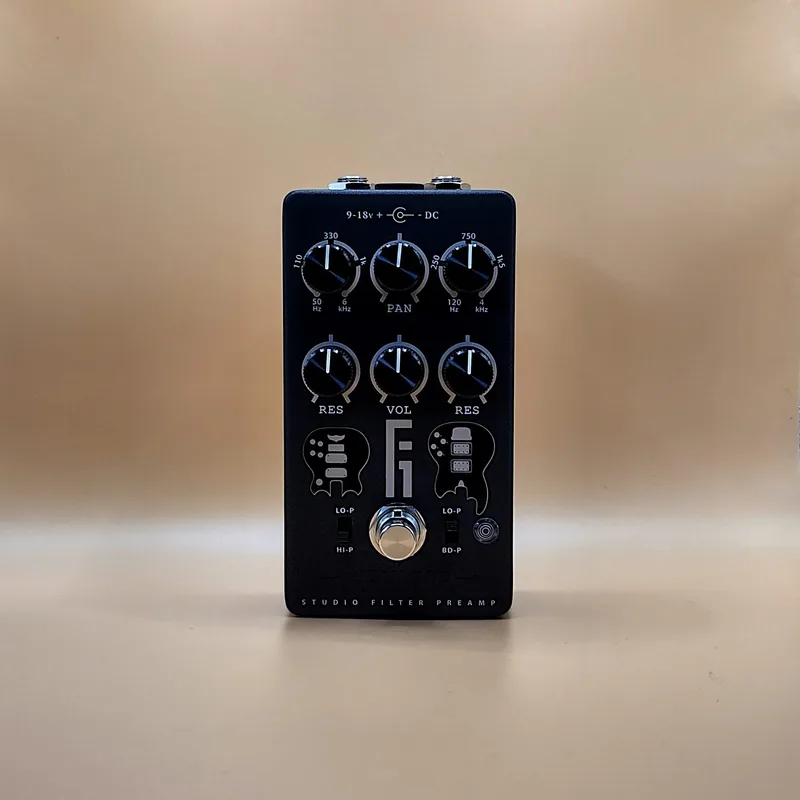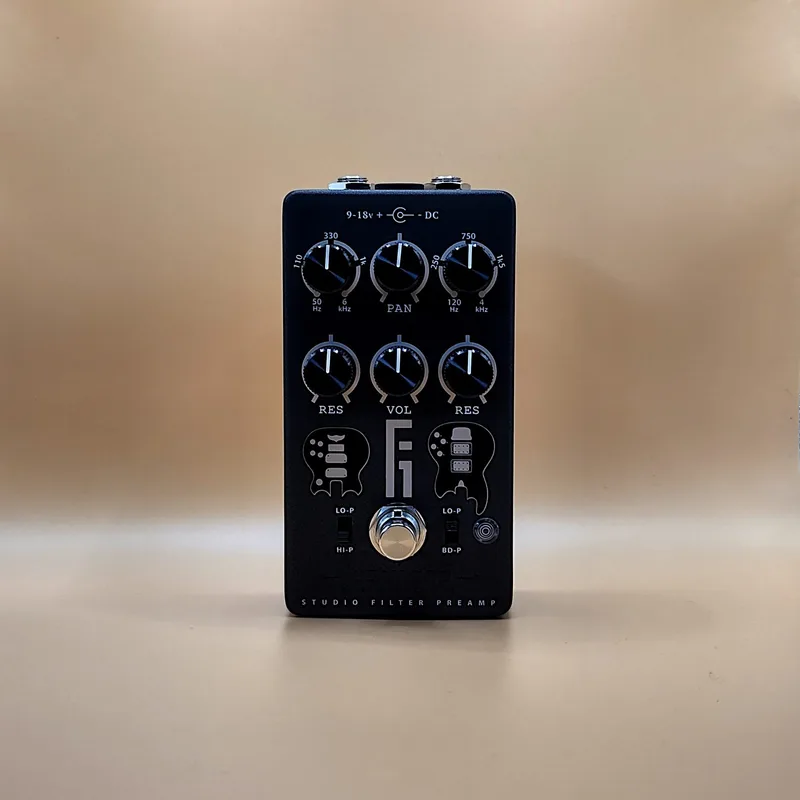


The Lusithand Devices F1 is a Studio Filter Preamp pedal: two separate filters in one box, with a PAN control that blends between them and a VOL master volume for the active signal1. Lusithand Devices positions it as useful "both as an effect or as an utility tool whether you are in the studio, or performing live" with bass and guitar1. It belongs to the filter family of pedals, but unlike a wah or an envelope filter it is a set-and-sculpt tone tool rather than a swept, expressive effect.
Two filters and a blend
The F1's core idea is two independent filters that you can blend. RockBoard's PedalPedia entry describes it as featuring "two independent, blendable filters designed to replicate the resonant peak characteristics of iconic basses like Alembic and Wal"2. Each filter has its own sweep range and its own resonance control:
| Control | What it does |
|---|---|
| Filter Sweep (left) | Sweep from 50Hz to 6kHz1 |
| Filter Sweep (right) | Sweep from 120Hz to 4kHz1 |
| RES (each filter) | Adjusts the sharpness of the frequency peak, from flat to highly boosted2 |
| PAN | Blend between both filters1 |
| VOL | Master volume for the active signal1 |
The mode switches set what each filter does:
- LO-P and HI-P switch: selects between Low Pass or High Pass for the left filter1
- LO-P and BD-P switch: selects between Low Pass or Band Pass for the right filter1
In practice, the left filter covers the wider sweep range and can work as a high pass, while the right filter sits in a midrange-to-treble window and can work as a band pass. Blending the two with PAN lets a player shape a low-end peak and a mid or high peak at the same time, which is the resonant-peak character the maker and RockBoard describe12.
Related to the NFP filter preamps
The F1 is not a one-off design. Lusithand Devices states plainly that "The F1 uses the same filter typology that we use on our NFP filter preamps"1, and RockBoard likewise describes it as based on the filter topology of the company's NFP (New Filter Preamp) series2. Players who know the Lusithand Devices NFP Preamp will find the same filtering approach here, in a two-filter, blendable format.
Power
The pedal can be run from 9V to 18V (max)1, and RockBoard lists the voltage as 9V DC, center negative2. There is an internal twist worth knowing:
A voltage doubler circuit inside the pedal doubles the voltage being fed to it. Lusithand Devices says this makes it possible to have 36V of internal running operation from an 18V supply1.
Warranty
Lusithand Devices states that any of its products will be replaced or fixed with all expenses covered once it has been verified that the problem does not result from bad handling or negligence on the owner's part1.
Videos
the wetter bass
Theo And His Pedals
Paul Del Bello and LusitHand Devices
Questions
What is the difference between low pass, high pass and band pass on the Lusithand F1?
The F1 carries two filters with switchable modes. The left filter is selected between Low Pass and High Pass with the LO-P and HI-P switch, while the right filter is selected between Low Pass and Band Pass with the LO-P and BD-P switch. A low pass filter lets frequencies below its sweep point through, a high pass lets frequencies above it through, and a band pass passes a band around the sweep point. The two filters are then blended with the PAN control.
Does the Lusithand Devices F1 have resonance?
Yes. According to RockBoard's PedalPedia entry, each of the two filters includes a dedicated Resonance (RES) control that adjusts the sharpness of the frequency peak, from flat to highly boosted. Resonance is what gives the filters their pronounced resonant peak character.
What power supply does the Lusithand Devices F1 need?
Lusithand Devices states the pedal can be run from 9V to 18V (max) DC. RockBoard lists the voltage as 9V DC, center negative. The pedal also contains an internal voltage doubler circuit that doubles the voltage fed to it, so an 18V supply gives 36V of internal running operation.
Can the Lusithand Devices F1 be used with bass?
Yes. Lusithand Devices describes the F1 as useful both as an effect and as a utility tool with bass and guitar, in the studio or performing live. RockBoard notes the two blendable filters were designed to replicate the resonant peak characteristics of iconic basses like Alembic and Wal.
What does the PAN knob do on the Lusithand F1?
The PAN knob blends between the two filters. The F1 consists of two separate filters, and PAN sets the balance between them, from one filter to the other, before the signal passes to the VOL master volume control.
What warranty does Lusithand Devices give on the F1?
Lusithand Devices states that any of its products will be replaced or fixed with all expenses covered once it has been verified that the problem does not result from bad handling or negligence on the owner's part.
Sources (2)
- F1 (Studio Filter Preamp), Lusithand Devices
- F1 Studio FiltePreamp by Lusithand, RockBoard PedalPedia, 2026