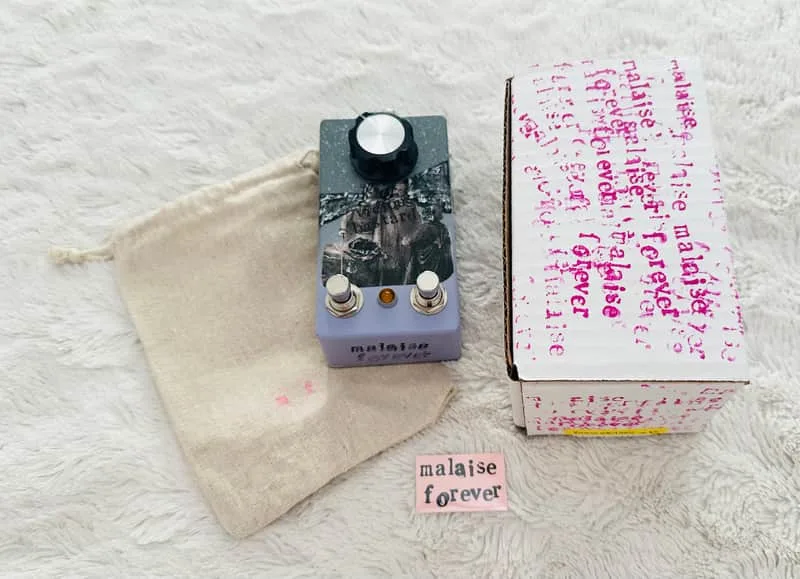


The Malaise Forever Vicious Bastard is a loud, angry one-knob fuzz pedal, described by Delicious Audio as "an unforgivingly loud and angry two-stage fuzz"1. It is based on the classic D*A*M* Meathead circuit and adds a built-in gate, engaged by a second footswitch, on top of the usual effect on/off switch. The tone is described as "heavy in the mid-low frequencies with a light mid-scoop, and enough high-end to cut through the mix"1.
How the circuit works
The Vicious Bastard is hard clipped in two stages: first with asymmetrical silicon/Schottky diodes, then with blue LEDs after a final dirty boost stage1. Hard clipping is a fuzz design in which diodes chop the signal's peaks sharply, producing the compressed, aggressive sustain fuzzes are known for. Stacking two clipping stages with a dirty boost between them gives the pedal its described heaviness in the mid-low frequencies1.
Controls
The layout is minimal: "One knob. Two switches. Three good."1
A secondary gate footswitch engages a heavy gate, which matters because the circuit produces noise and feedback when it is not gated1. Unity volume is around noon on the knob1.
Version 1.5 changes
Version 1.5 is a slight tweaking of the specs for the circuit, which Delicious Audio's Paolo De Gregorio feels optimizes it1. Compared with V1, the V1.5 changes are:
- Update to BC550C transistors, from BC550B1
- Changed clipping diodes in stage one to asymmetrical silicon/Schottky diodes1
- Adjusted bias and impedance of the second stage to reduce noise and feedback when not gated1
That second-stage adjustment also slightly improves the low end response of the circuit, "further optimizing it for bass or baritone"1. Players running lower-tuned instruments may also want to look at the Malaise Forever Clubber Lang, the maker's harmonic percolator fuzz, or browse other fuzz pedals for comparison.
Power and connections
The Vicious Bastard accepts a 2.1 mm center negative 9VDC power supply, the standard connector used by most pedalboard power supplies1. Audio connections are via top-mounted Lumberg jacks, which keep the cable runs at the ends of the pedal rather than the sides1.
Videos
ambienttrash
Eric Merrow
ambienttrash
Questions
What circuit is the Malaise Forever Vicious Bastard based on?
The Vicious Bastard is based on the classic D*A*M* Meathead circuit. Malaise Forever builds it as a two-stage hard clipping fuzz: the first stage clips with asymmetrical silicon/Schottky diodes, and the second clips with blue LEDs after a final dirty boost stage. Version 1.5 updates the transistors to BC550C and reworks the bias and impedance of the second stage.
Does the Vicious Bastard work with bass?
Yes. Version 1.5 adjusts the bias and impedance of the second stage, which improves the low end response of the circuit. Delicious Audio notes that this change further optimizes the pedal for bass or baritone guitar. The pedal's tone is described as heavy in the mid-low frequencies with a light mid-scoop, which also suits lower-tuned instruments.
What does the gate switch do on the Vicious Bastard?
The left switch turns the gate on and off. A secondary gate footswitch engages a heavy gate, which tames the noise and feedback the circuit produces when it is not gated. The right switch is the effect on/off footswitch, so the pedal has two switches and a single volume knob in total.
Where is unity volume on the Vicious Bastard?
Unity volume, where the pedal's output matches your clean signal, is around noon on the single knob. Since the knob controls output volume only, there is no gain or tone control to balance against it.
What power does the Vicious Bastard take?
The Vicious Bastard accepts a 2.1 mm center negative 9VDC power supply, the standard format used by most pedalboard power supplies. The pedal has top-mounted Lumberg audio jacks for its input and output connections.
Sources (1)
- Malaise Forever Vicious Bastard Fuzz V1.5, Delicious Audio, 2022-02-28