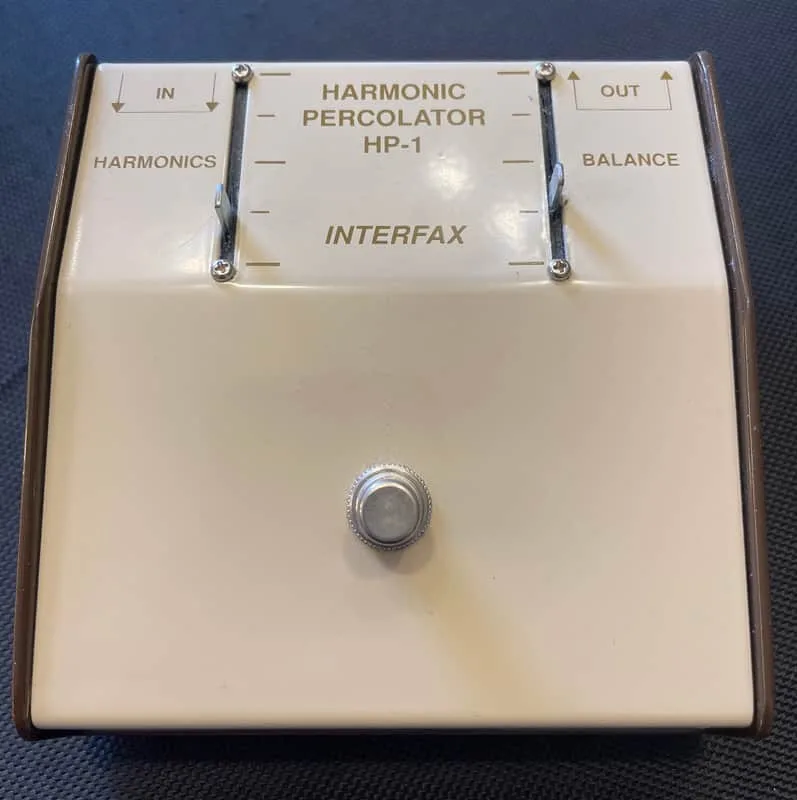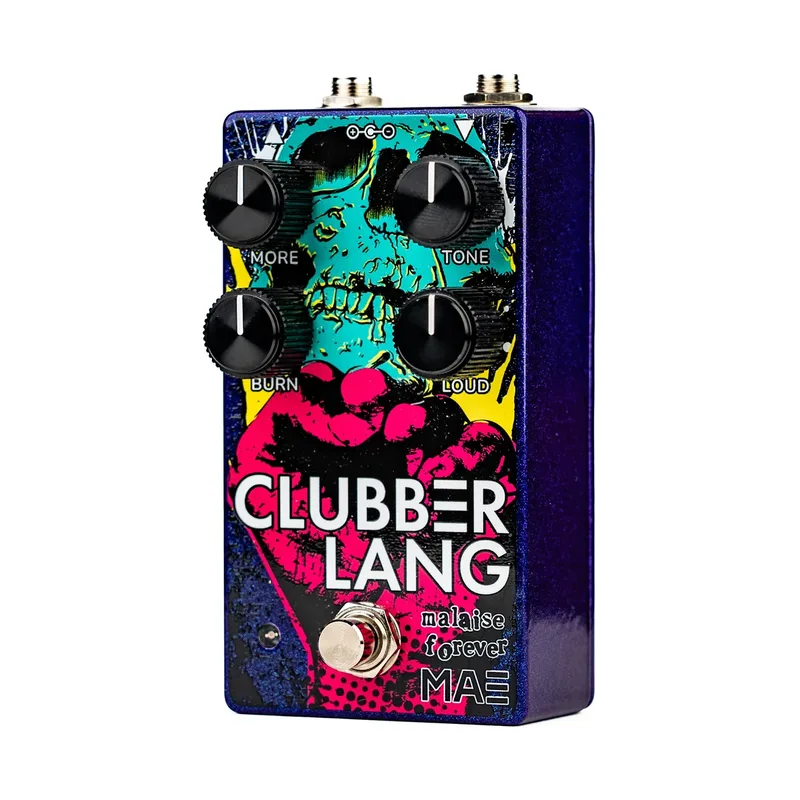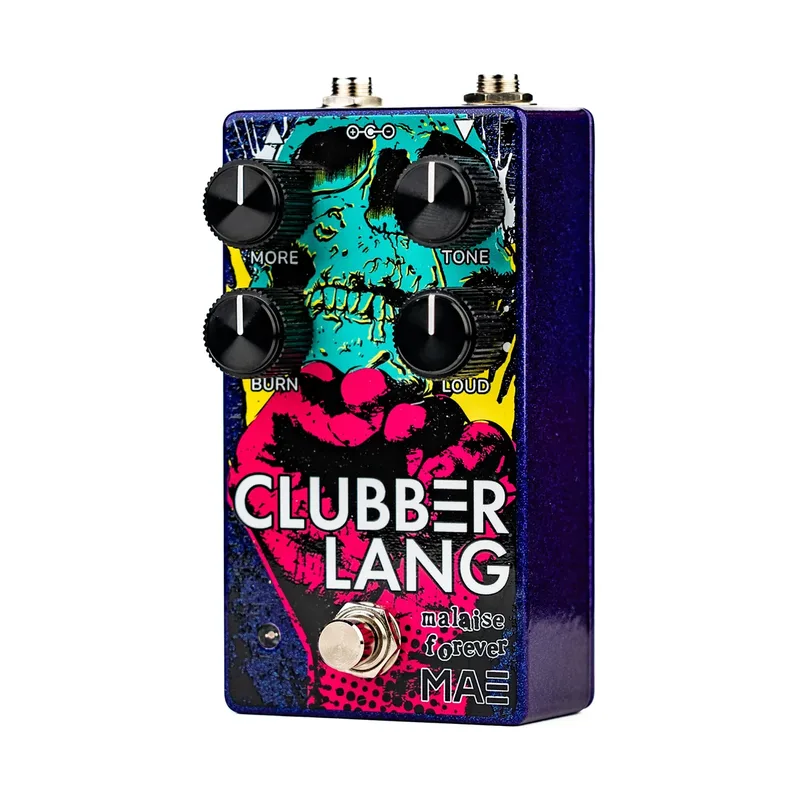


The Malaise Forever Clubber Lang is a fuzz pedal built around the circuit ideas of the Interfax HP-1 Harmonic Percolator, the oddball 1970s fuzz that Steve Albini made famous. It is not a copy: Malaise Forever's builder describes it as a love letter to the Percolator with several changes, including a MOSFET input stage, asymmetrical germanium soft clipping, increased low end output, and a Tone control the original never had1.
What you get is a fuzz that reacts strongly to how you play it. Reviewers describe a lot of interactivity between the two gain controls and the tone controls, with the pedal responding to pickup selection, your instrument's tone knob, input dynamics, and stacking with other dirt pedals12. Pedal of the Day named it one of its Top Pedals of 20212.
A Harmonic Percolator-style fuzz
The original Interfax Harmonic Percolator used a very particular circuit with a mix of now rare germanium and silicon transistors1. The Clubber Lang keeps that germanium and silicon mix: the clipping is asymmetrical germanium soft clipping, and the output comes from a silicon transistor whose stability is set by an internal trimmer2.
The big circuit difference is up front. The Clubber Lang features a MOSFET input stage that pushes wild texture out of the circuit1. On top of that come increased low end output and a widely effective tone control, two things players often want from a Percolator-style build that the original did not deliver in the same way1.
"CLUBBER LANG is my love letter to the Interfax Harmonic Percolator, with some changes."
The controls: Burn, Harm, Tone and Level
The V1 carries four knobs plus one trimmer inside. The V2 made with Mask Audio Electronics renames Level and Harm as LOUD and MORE, but the jobs are the same4.
| Control (V1) | Control (V2) | What it does |
|---|---|---|
| Burn | BURN | MOSFET stage gain control (crackles when turned)14 |
| Harm | MORE | Fuzz stage gain control14 |
| Tone | Tone | Counter-clockwise for more low end, clockwise for more treble1 |
| Level | LOUD | Controls output volume14 |
| Whud (internal) | Whud (internal) | Sets feedback resistance, see below1 |
Burn and Harm are where the character lives: Burn drives the MOSFET input stage and Harm drives the fuzz stage, and reviewers found excellent interaction between the two2. The Tone sweep is wide, producing the amount of low or high end your rig needs2. One quirk worth knowing before you buy: Burn crackles when you turn it1.
The Whud trimmer
Inside the pedal is an internal trimmer called Whud. It controls feedback resistance, which is the stability of the output from the silicon transistor12:
- Lower it and the pedal sounds wilder and more interactive, but the volume can drop below unity1.
- Raise it and the output signal strengthens and the volume slightly increases, but some of the interactivity goes away1.
- Midpoint is the stock setting1.
History and the V2 with Mask Audio Electronics
The Clubber Lang was reviewed by Pedal of the Day in October 2021 in its original form, and it made that site's Top Pedals of 2021 list2. In June 2026, Delicious Audio reported that the circuit's V2 had been reworked in collaboration with Mask Audio Electronics, adding a MOSFET input stage to push the pedal further in the wild texture department1.
Mask Audio Electronics now sells its own version, partnering with the builder it calls "fellow Midwest dirt farmer Zac at Malaise Forever Customs" to bring the Clubber Lang to its lineup4. That version is described as a fuzz pedal with a MOSFET input stage and asymmetrical soft clipping, a love letter to the harmonic percolator with improvements for the modern player4. Details are on the Mask Audio Electronics Clubber Lang page.
"There is a lot of interactivity between all of the knobs on the pedal and all of the knobs on your instrument. Clubber Lang rewards the detailed tweakers and pedal stackers."
How it differs from an Interfax Harmonic Percolator
Comparing the Clubber Lang to the original is complicated by the fact that the original was never one fixed circuit. The Percolator does not seem to have had one "stock" design; slight changes were made in component values over its life cycle5. Aion FX traces at least two known versions, "stock" and "Albini," with Albini's unit using several different component values from every other traced copy6. Pedal of the Day puts it more bluntly: of all the Percolator-inspired builds, "each is its own beast, with no two being alike, and none being a precise recreation of the original"7.
Against that backdrop, the Clubber Lang's changes are concrete:
- An additional Tone control, which Guitar Pedal X's Stefan Karlsson called "handy for sure" against the original's fixed voicing3
- A MOSFET input stage for wild texture1
- Asymmetrical germanium soft clipping1
- Increased low end output1
- A wide variety of colourways, and a price advantage at $150 over some other Percolator-inspired pedals3
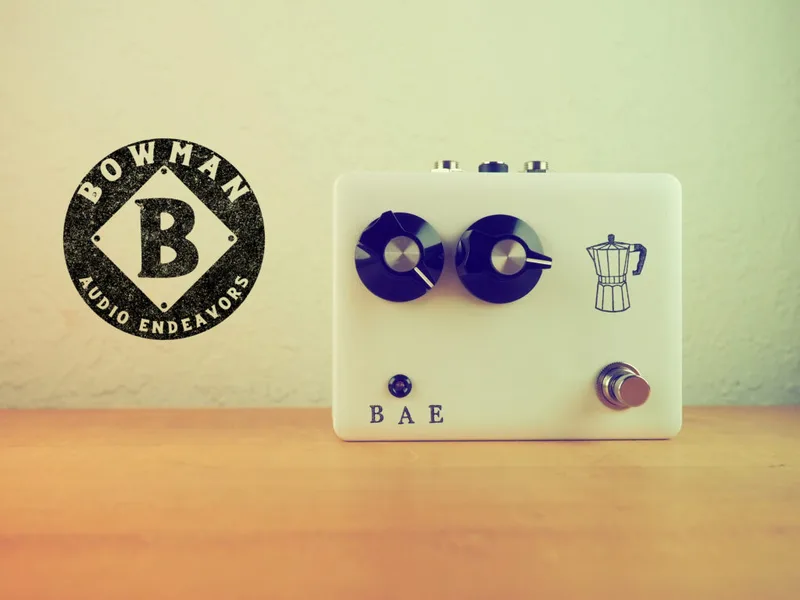
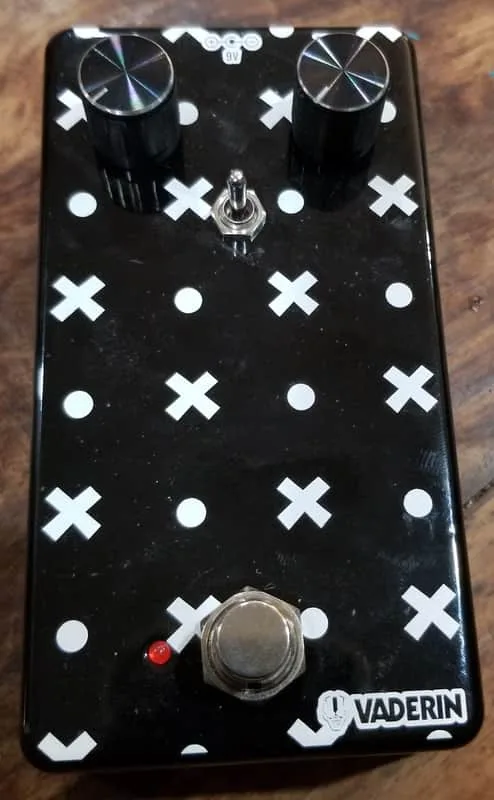
The Clubber Lang is far from the only Percolator-inspired build. Pedal of the Day has also counted the Nine of Swords Headache, Bowman Audio Endeavors' Harmonic Percolator, and the Vaderin Pedals HP-X among the clones it has seen8, and Fredric Effects makes a version with a switch offering three clipping options9. What sets the Clubber Lang apart in that crowd is the MOSFET front end and the interactive two-gain-control layout.
What reviewers said
The Malaise Forever Clubber Lang is built by Malaise Forever and carries a list price of $150 USD3.
Videos
SpiralCasterPlaysPedals
collector//emitter
Pedal of the Day
Questions
What does the Whud trimmer do on the Clubber Lang?
Whud is an internal trimmer that controls feedback resistance, which sets the stability of the output from the silicon transistor. Lowering it makes the pedal sound wilder and more interactive but can drop below unity volume; raising it strengthens the output and slightly increases volume but removes some interactivity. The midpoint is the stock setting.
Is the Clubber Lang true bypass?
Yes. The Clubber Lang uses pro soft-click true bypass switching, so with the pedal off your signal passes through without active buffering.
How is the Clubber Lang different from an Interfax Harmonic Percolator?
It is not a faithful recreation. The Clubber Lang adds a MOSFET input stage, asymmetrical germanium soft clipping, increased low end output, and a Tone control the original Percolator did not have. It also comes in a wide variety of colourways and, at $150, has a price advantage over some other Percolator-inspired builds.
Does the Clubber Lang use germanium transistors?
It uses a mix of germanium and silicon, like the original Percolator circuit. The clipping is asymmetrical germanium soft clipping, and the output stage is a silicon transistor whose stability is set by the internal Whud trimmer.
Sources (9)
- Malaise Forever/Mask Audio Clubber Lang Fuzz V2, Delicious Audio, 2026-06-02
- Malaise Forever Clubber Lang Harmonic Percolator Fuzz, Pedal of the Day, 2021-10-16
- Guitar Pedal X, Guitar Pedal X, 2024-05-13
- CLUBBER LANG, Mask Audio Electronics
- PepperSpray.pdf, madbeanpedals.com, 2024-06-07
- Particle Vintage Fuzz / Interfax Harmonic Percolator, Aion FX, 2021-02-19
- Land Devices HP-2 Distortion, Pedal of the Day, 2018-12-21
- Paperboy Pedals Harmonic Percolator Clone, Pedal of the Day, 2024-02-08
- Interfax Spec Harmonic Percolator, Fredric Effects