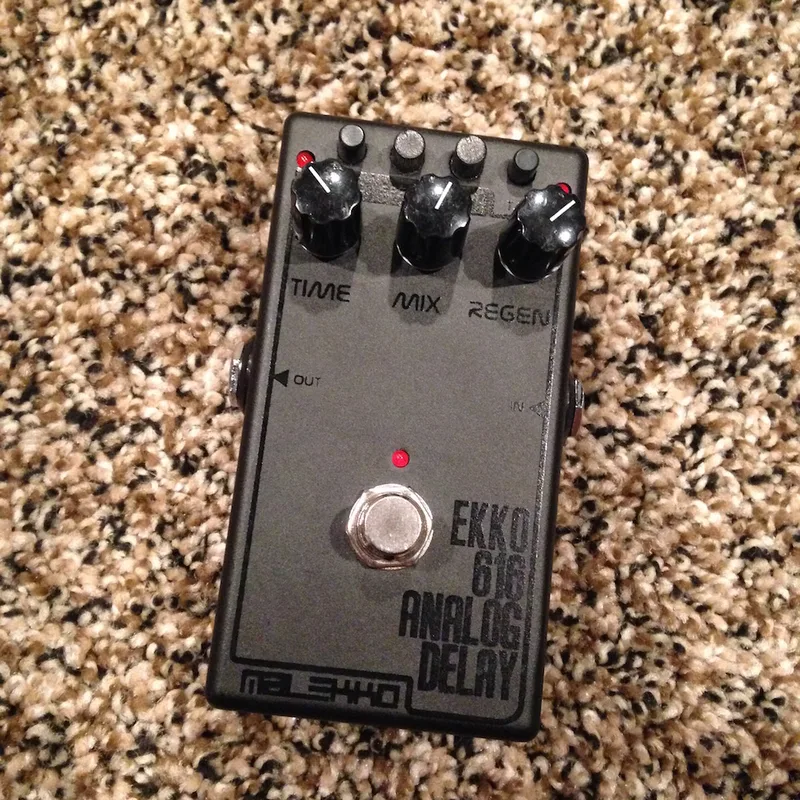


The Malekko Ekko 616 is an analog delay pedal from Malekko, built on classic Bucket Brigade Delay (BBD) chips1. BBD chips pass your signal down a chain of capacitors a step at a time, which gives analog delay its characteristic repeats that soften and darken as they decay. RockBoard's PedalPedia says the MKII's specially voiced repeats "allow a larger bandwidth to pass than most traditional analog delays," meaning the echoes stay fuller in the treble than the BBD norm2.
The pedal's regeneration control is a big part of its character. RockBoard's PedalPedia describes it as running from "a simple slapback to a nice gentle decay of a few repeats then all the way to" self-oscillation, the point where the repeats feed back on themselves and keep going2. On top of the delay itself, the Ekko 616 carries a modulation section, so the repeats can wobble and flutter like a worn tape echo.
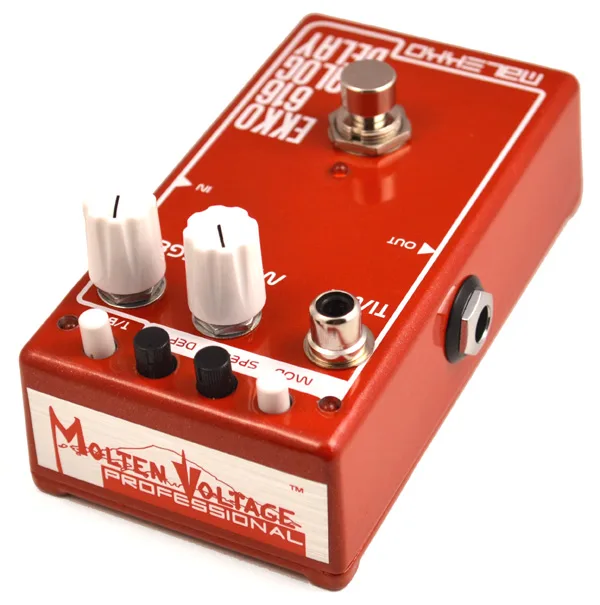
The controls and bypass options
The control set splits into main knobs for the delay and smaller trimmers for the modulation. Pedal of the Day's 2015 review of the MkII Dark laid out what each one does3:
| Control | What it does |
|---|---|
| Time | Sets the delay time, maxing out at 650ms |
| Regeneration | From slapback through a few repeats to self-oscillation |
| Mod | Mixes in the level of modulation affecting the delays, from minor and subtle to raging flutter and twist |
| Speed | Measures how fast the modulation comes across |
| Depth | Controls the intensity of the modulation |
| T/B push button | Selects between the pedal being true bypass or a buffer |
| Internal pot | Adjusts the overall gain output to fit your setup |
The bypass choice is worth a note. True bypass leaves your signal untouched when the pedal is off, while the buffer mode keeps a low-impedance signal driving down long cable runs. RockBoard's PedalPedia says the MKII's "revised buffer circuit is smooth and transparent, even with many pedals on your board"2, so the buffered setting is a real option rather than a fallback. Pedal of the Day's 2017 re-review of the same pedal described the smaller Mod, Speed and Depth controls as "the 616's secret weapons," creating "beautiful, random and intriguing sounds" in the modulation section4.
The MkII Dark's modulation section gives you direct control over the effect: the Speed knob measures how fast the modulation comes across3. The MkII modification also adds a wider control range for modulation with easy access controls567, and the original Ekko 616's Delaytion mod likewise widened the modulation speed and depth control ranges567. Malekko says the Ekko 616 MKII's revised buffer circuit is smooth and transparent, even with many pedals on your board2.
The MKII and the Delaytion modification
The Ekko 616 has gone through a MKII revision, and the version most reviewers covered is the Ekko 616 MkII Dark, a darker-voiced variant sold as a guitar effects pedal by Malekko Heavy Industries38. In its 2017 video demo of the 616 MkII Ekko Dark Delay, Pedal of the Day called 650ms "a great length for this brooding analog delay"43.
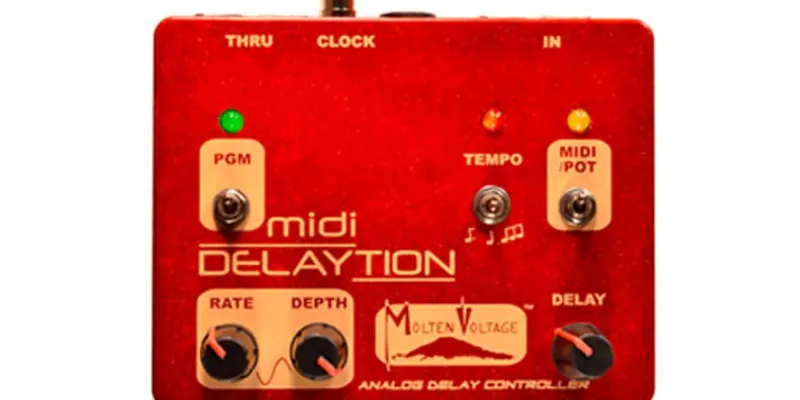
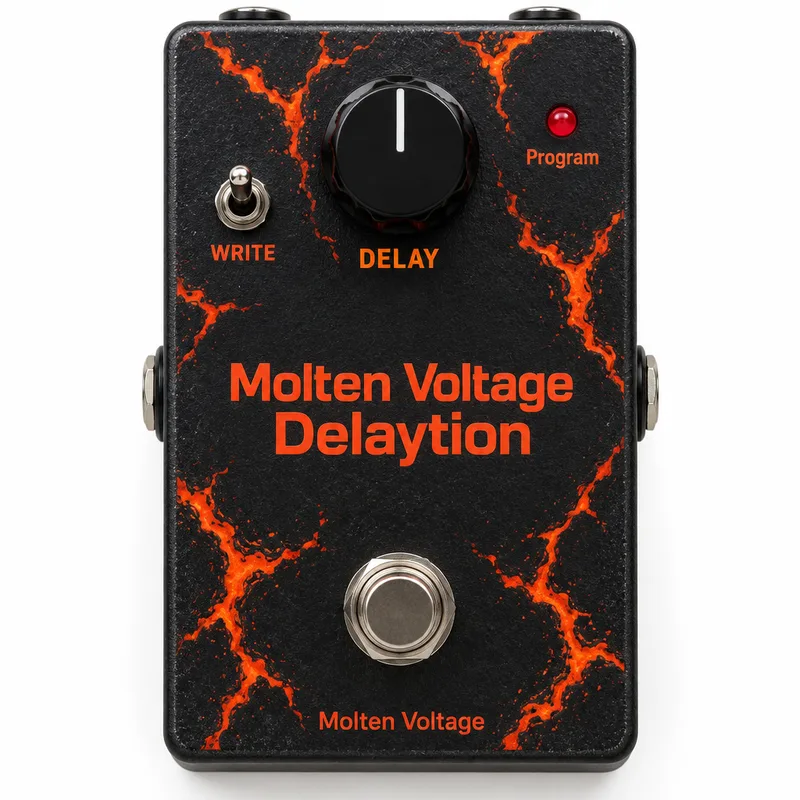
The stock pedal has no tap tempo; delay time is set by hand with the Time knob. That changed for players willing to open the box. Molten Voltage, which also modifies the Ekko 616 Analog Delay, offers its Delaytion clocking for the pedal, and describes the modified Ekko 616 as sounding great and a little brighter and grittier than the Carbon Copy97. The modification is invasive: it replaces the pedal's delay-time control with external clocking5.
According to Molten Voltage's Delaytion documentation, the modified pedal gains7:
- Tap tempo timing with 3 delay ratios
- The ability to create and recall four presets
- A wider control range for modulation, with easier access to the controls
Molten Voltage also modifies the Ekko 616 Analog Delay itself, and characterizes it against a well-known rival: the company says the Ekko "sounds great and is a little brighter and grittier than the Carbon Copy"9. That comparison is Molten Voltage's own view as the modifier, not an independent review, but it lines up with Malekko's claim of wider bandwidth in the MKII's repeats.
The Delaytion modification is a third-party DIY project by Molten Voltage, not a Malekko product. It involves permanently removing the original Time pot, so it is a one-way change for players comfortable with soldering and pedal surgery.
For players comparing analog delays, the Ekko 616's selectable true or buffered bypass sets it apart from simpler BBD pedals that offer only time, feedback and mix. Its sibling in the Malekko lineup, the Malekko Charlie Foxtrot, takes a granular approach to delay instead of the Ekko's bucket brigade repeats21.
Videos
ProGuitarShopDemos
ProGuitarShopDemos
Malekko HeavyIndustry
Questions
Is the Malekko Ekko 616 analog or digital?
It is an analog delay. The Ekko 616 uses classic Bucket Brigade Delay (BBD) chips to create its repeats, and Malekko describes the MKII's specially voiced repeats as allowing a larger bandwidth to pass than most traditional analog delays. Reviewers of the MkII Dark version also describe it as an analog delay.
Can the Ekko 616 run in true bypass or buffered bypass?
Yes, and you can choose. A T/B push button on the pedal selects between true bypass and buffered bypass. Malekko says the MKII's revised buffer circuit is smooth and transparent, even with many pedals on your board, so the buffered mode is a practical option for long signal chains.
What power does the Ekko 616 need?
The Ekko 616 runs on 9V DC with a center negative plug, the standard arrangement for most modern pedal power supplies. It draws 50mA, which is modest enough that it can share a typical isolated or daisy-chain supply with other 9V pedals without straining the unit.
How much current does the Ekko 616 draw?
The Ekko 616 draws 50mA at 9V DC. That is a fairly light draw for an analog delay with modulation, and it leaves plenty of headroom on a multi-output power supply alongside drives and other small pedals.
Does the Ekko 616 have tap tempo?
Not as standard. The stock pedal sets delay time with its Time knob. However, Molten Voltage published a DIY modification called Delaytion for the Ekko 616 MK II that adds tap tempo timing with three delay ratios, plus four presets and a wider control range for modulation.
What does the regeneration control do on the Ekko 616?
Regeneration sets how many repeats you hear. Malekko says the pot takes you from a simple slapback, to a gentle decay of a few repeats, then all the way to self-oscillation, where the delay feeds back on itself and generates its own sound.
Sources (9)
- PedalSync®, Molten Voltage, 2014
- Ekko 616 by Malekko, RockBoard PedalPedia, 2026
- Malekko Heavy Industries Ekko 616 MkII Dark Analog Delay, Pedal of the Day, 2015-02-10
- Malekko Heavy Industry Ekko 616 MkII Dark Delay, Pedal of the Day, 2017-07-10
- Malekko Ekko 616 Modification for Delaytion PedalSync MV-64 Analog Delay Control Station .:. by Molten Voltage, Molten Voltage
- Molten Voltage™ .:. Analog Delay Modifications for Delaytion .:. MXR Carbon Copy Hack, Malekko Ekko 616 Mods, DIY Stompbox Pedal Footswitch Controller with Presets, Modulation, and Ratios, Molten Voltage
- Delaytion Tutorial, Molten Voltage
- Malekko Heavy Industries Ekko 616 MKII Dark Analog Delay, Pedal of the Day, 2015-01-26
- Molten Voltage™ presents Starship Kaom .:. the Modern MIDI PedalBoard, Molten Voltage