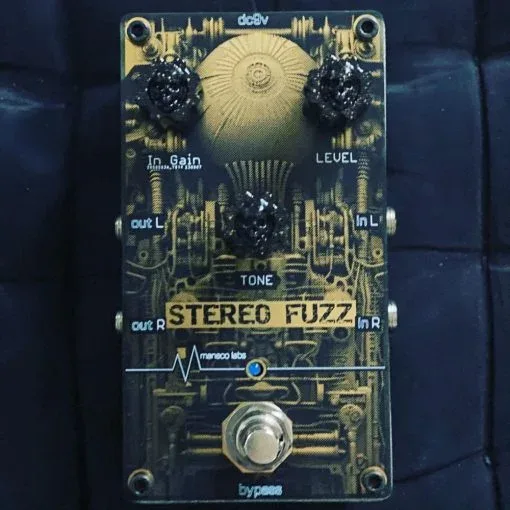
The Manecolabs Stereo Fuzz is a fuzz pedal with true stereo operation, built around what the maker calls a "Big Muff tone stack" and a silicon transistor gain stage. Manecolabs describes it as "a versatile fuzz device, true stereo and with powerful tone shaping capabilities"1.
How it works and what it does
The pedal takes the tone-shaping approach of the Big Muff, the fuzz circuit many players know from its scooped, thick midrange, and applies it in a stereo format. The gain stage uses silicon transistors, the standard modern alternative to the rarer germanium parts in vintage fuzz designs1.
A dedicated input gain control is included "for fine tuning distortion quality, also adapting for wide range of input signals"1. That matters on a pedalboard: it lets you match the fuzz to whatever is feeding it, from a quiet single-coil guitar to a hot active signal, without changing the pedal's own character.
Bypass and power
The Stereo Fuzz uses buffered clickless bypass rather than true bypass. The clickless part is aimed at eliminating the switch pop some pedals produce, and the buffer holds the signal steady when the pedal is off1.
Power comes from a 9v standard power supply with center tip negative polarity, the common pedal-supply format1.
Because the pedal runs in true stereo, plan your patching accordingly: to keep both channels separate it needs stereo inputs and outputs rather than a single mono cable path.
Where it sits among fuzz pedals
Most fuzz pedals are mono, single-output designs. The Stereo Fuzz's true stereo operation sets it apart for players running stereo rigs, and its Big Muff-derived tone stack places it in the sustained, thick-ended family of fuzz rather than the splattery or octave-fuzz styles. For comparison, the Dunable Splatterblaster, reviewed by Pedal of the Day, is another stereo fuzz-distortion design, where "Splatter controls your gain" alongside Level and Boost controls2.
Questions
Is the Manecolabs Stereo Fuzz true stereo?
Yes. Manecolabs describes the Stereo Fuzz as having true stereo operation, so it can process left and right channels independently rather than summing them to mono. That makes it usable at the end of a stereo pedalboard or in a stereo effects loop, where the fuzz character is applied to each side of the signal.
Does the Manecolabs Stereo Fuzz use true bypass?
No. The pedal uses buffered clickless bypass rather than true bypass. A buffer holds the signal path constant when the pedal is off, and the clickless design is aimed at avoiding the popping sound some pedals make when their switch is pressed.
What power supply does the Manecolabs Stereo Fuzz need?
Manecolabs specifies a 9v standard power supply with center tip negative polarity. That is the common center-negative pedal supply format, so a standard isolated pedal power supply output should suit it.
What does the input gain control do on the Manecolabs Stereo Fuzz?
The input gain is for fine tuning the distortion quality and for adapting the pedal to a wide range of input signals. In practice it lets you set how hard the fuzz circuit is driven by whatever feeds it, whether that is a low-output or high-output instrument or another pedal in front.
Sources (2)
- Manecolabs Stereo Fuzz, Manecolabs
- Dunable Splatterblaster Stereo Fuzz Distortion, Pedal of the Day, 2020-10-09