

The Mattoverse TremStortion is a full-featured analog optical tremolo pedal with a distortion circuit built into the same box, released by Mattoverse Electronics in September 20191. Mattoverse says it can be run super-clean or fully distorted2, which makes it two pedals in one: a tremolo that works on its own, and a tremolo that interacts with dirt in ways a separate overdrive or fuzz into a clean tremolo cannot.
The modulation itself is a traditional optical tremolo, where an LED flashes rhythmically against an LDR (light-dependent resistor)3. An Electric Druid STOMPFLO microprocessor generates the eight available waveforms3. The pedal is no longer in production: Mattoverse built two final units from its remaining boards and components in 2024, and both sold out4.
An optical tremolo with distortion built in
The TremStortion combines analog tremolo and distortion in a single unit1. The tremolo side uses the classic optical arrangement of an LED flashing against a light-dependent resistor3, the same approach as vintage photo-cell tremolos, while an Electric Druid STOMPFLO microprocessor generates the eight waveforms that drive it3.
The gain side is controlled by a single knob and, as Guitar.com described it at launch, "ranges from completely clean to a transparent yet palpable crunch"1. That means the pedal covers clean amplitude modulation at one end of the gain knob and modulated dirt at the other. gearnews.com's writer called the combination "a nice twisted little analogue tremolo effect"7.
What sets it apart from running a tremolo and a distortion separately is the routing toggle: the tremolo can sit before the distortion, after it, or in a third "inverted" configuration that links different parts of the signal chain together1.
The controls: eight waveforms, tap tempo and a pre/post toggle
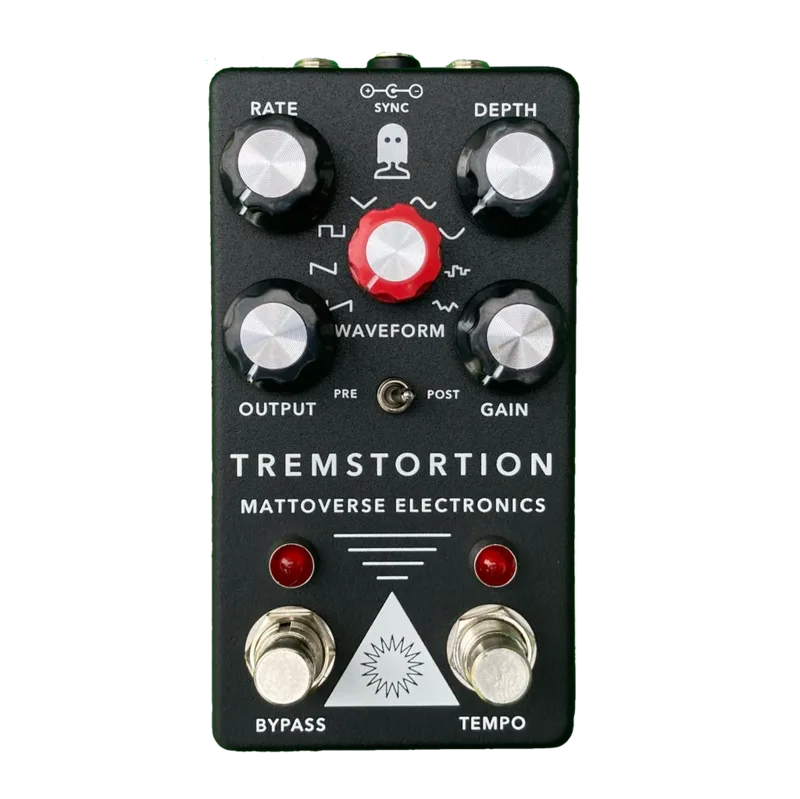
The TremStortion is, in Guitar Pedal X's words, "a really simple pedal to operate"4. It has five knobs, one three-position toggle, and two footswitches: bypass and tap tempo4.
| Control | What it does |
|---|---|
| Rate | Sets the tremolo frequency7 |
| Depth | Manages the intensity of the chosen wave1 |
| Waveform | Selects one of the eight waveforms5 |
| Gain | Sets the distortion amount, from completely clean to crunch1 |
| Output | Standard level control1 |
| 3-position toggle | Tremolo pre-gain, post-gain, or the mystery inversion option (center)6 |
| Bypass footswitch | Switches the pedal on and off4 |
| Tap-tempo footswitch | Sets the tremolo frequency by tapping7 |
The eight waveforms are ramp up, ramp down, square, triangle, sine, sweep, random pulse, and random slopes5. The two random waveforms give the effect a less predictable, choppy character than a standard sine or square tremolo.
The frequency can be set either by the rate knob or by the tap-tempo footswitch for more precise control1. A secondary LED above the tap-tempo footswitch pulses in time with the effect1.
The three-position toggle is the pedal's distinctive feature. In the pre-gain position the tremolo modulates the signal before it hits the distortion; in post-gain the tremolo comes after the dirt, the more conventional order. Guitar.com described the center position this way: "The centre position links different parts of the signal chain together for a more unique 'inverted' sound"1. Mattoverse's own page calls it the mystery inversion option6.
Guitar Pedal X's Stefan Karlsson, who kept one of the final units in his reference collection, wrote: "I generally mostly tend to live on the Ramp Down, Square, Triangle, and Lumps Waveforms", applied equally as pre- and post-gain at various rates4.
Syncing to a synth or external clock
The top panel also includes a 1/8" control-voltage input for tempo-syncing synthesizers and such3. It is a 0-5V rate sync input, and when something is plugged into it, it overrides the other tempo controls1. That makes the TremStortion usable alongside modular synths or any gear that outputs a clock voltage.
Power, size and pedalboard use
The TremStortion runs on a standard center-pin negative 9V DC power supply only, which is not included, and there is no battery option6. Current draw is approximately 30mA6, light enough for any isolated pedalboard supply.
No battery: the TremStortion accepts 9V DC power only, so it cannot run on a 9V battery and needs a power supply from the start6.
The enclosure is compact, at 4.77" x 2.6" x 1.39", with heavy-duty off-board top-mounted jacks that make it easier to fit into a busy pedalboard61. It is true bypass6.
Final editions and discontinuation
In May 2024, Guitar Pedal X reported that Matt of Mattoverse had some final boards and components, "which turned out were enough to create two more" units4. Those two final editions were a wood-facia edition with white knobs and an acrylic edition with silver knobs4. The acrylic edition, with red LEDs, joined Guitar Pedal X's reference collection4.
The maker's product page now shows the pedal as sold out6, so the TremStortion is effectively discontinued and available only on the second-hand market. Karlsson paid $39.21 in shipping for his unit to reach the UK4.
What reviewers said
Coverage at launch in September 2019 was consistent across outlets. Guitar.com noted the $179 list price and the eight waveforms1; MusicRadar reported the UK price of £149.97 plus shipping on Reverb2; gearnews.com highlighted the eight waveform options and the 0-5V rate sync input7. Premier Guitar reviewed it in December 2022 at a $179 street price, explaining the optical LDR circuit and the STOMPFLO-generated waveforms3.
Guitar Pedal X's 2024 retrospective was the warmest verdict, calling it "Mattoverse's excellent TremStortion" and noting how simple it is to operate despite its range4.
Videos
mattoverse
mattoverse
Noise Generator
Questions
Does the Mattoverse TremStortion take a battery?
No. The TremStortion runs on a standard center-pin negative 9V DC power supply only, and the supply is not included with the pedal. There is no battery option, so you will need a 9V power supply or a pedalboard power brick to run it.
Is the TremStortion true bypass?
Yes. Mattoverse lists the TremStortion as true bypass, so when the effect is switched off the signal passes through without buffering. It has two footswitches, one for bypass and one for tap tempo.
Can the TremStortion sync to a synth or external clock?
Yes. The top panel has a 1/8 inch control-voltage input, listed as a 0-5V rate sync input, for tempo-syncing synthesizers and similar gear. When something is plugged into it, the external signal overrides the rate knob and the tap-tempo footswitch.
How much current does the TremStortion draw?
Mattoverse lists the current draw at approximately 30mA at 9V DC. That is modest by modern pedal standards, so a typical pedalboard power supply will run it without difficulty.
Is the Mattoverse TremStortion still made?
No. In 2024 Mattoverse built two final units from its remaining boards and components, a wood-facia edition with white knobs and an acrylic edition with silver knobs, and those sold out. The maker's product page now shows the pedal as sold out.
Sources (7)
- Mattoverse Electronics unveils the Tremstortion, Guitar.com, 2019-09-18
- Analogue tremolo meets gritty gain in Mattoverse Electronics' TremStortion, MusicRadar, 2019-09-18
- Mattoverse TremStortion Review, Premier Guitar, 2020-01-09
- Guitar Pedal X, Guitar Pedal X, 2024-05-21
- Mattoverse AirTremTrashStortion, Mattoverse Electronics
- Mattoverse TremStortion, Mattoverse Electronics
- Mattoverse Electronics TremStortion, gearnews.com, 2019-09-18