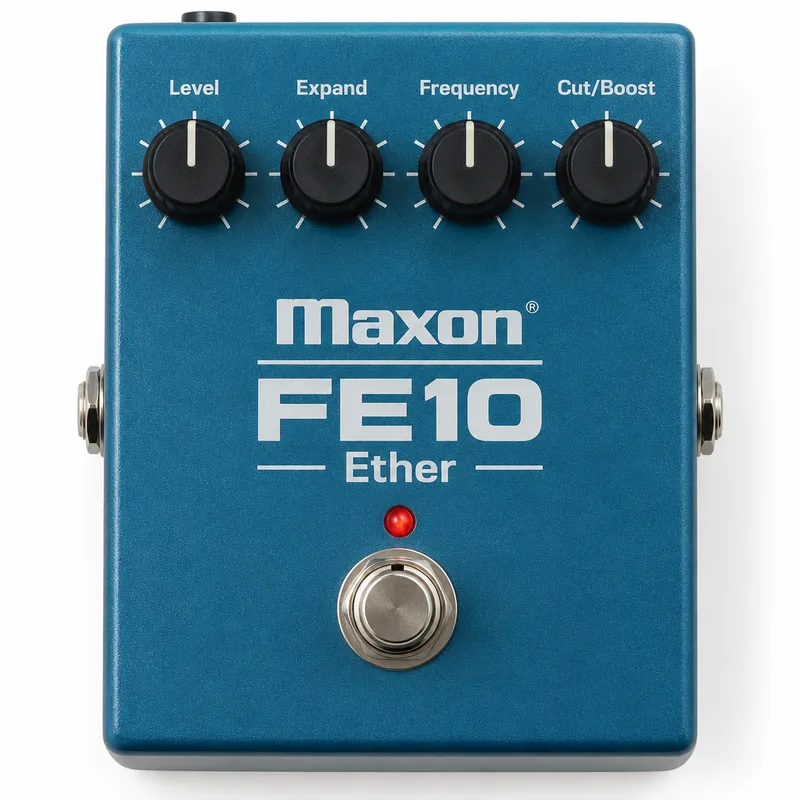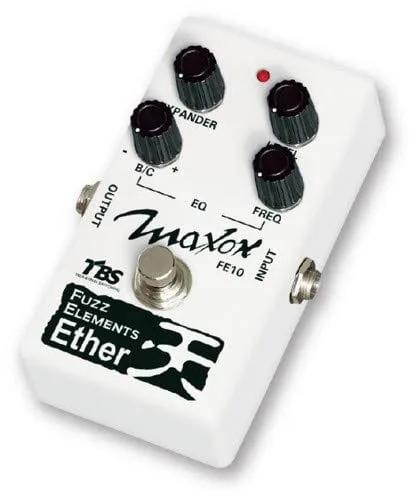


The Maxon Fuzz Elements Ether, model number FE10, is a fuzz pedal from Maxon built around the vintage Shin-Ei / Univox Super Fuzz circuit. Its fuzz engine produces square wave clipping with an upper octave harmonic, the sound the original Super Fuzz was known for, and it adds something the vintage pedal never had: a parametric EQ that lets you select a frequency and cut or boost it1.
Maxon describes the design plainly: the FE10 takes the Fat channel of the FA10 Air, another Fuzz Elements model, and combines it with a parametric equalizer to create variations on the classic Super Fuzz sound1. Pedal of the Day's launch coverage put it the same way, calling the Ether an FA10 circuit with a parametric tone section added2.
The pedal is sold out on Maxon's product page, so it is no longer readily available new1.
A Super Fuzz with a parametric EQ
The FE10's fuzz engine is based on the vintage Shin-Ei / Univox Super Fuzz, a circuit known for square wave clipping and upper octave harmonics1. That octave-up character is what gives the Super Fuzz family its aggressive, synth-like edge, and the Ether reproduces it.
What separates the Ether from a straight Super Fuzz clone is the parametric EQ. Where a fixed tone control only tilts the whole spectrum brighter or darker, a parametric circuit lets you pick one frequency band and then cut or boost it. Maxon says the EQ covers a wide range, from 100 Hz to 5 kHz1, which spans from the low end of a guitar's fundamentals up past the presence region. Godlyke, Maxon's US distributor, describes the result as the ability to cut or boost specific frequencies to create a variety of new fuzz and Octavia tones4.
The controls
The FE10 keeps the control set of the FA10 Air and adds the EQ section on top of it15.
| Control | What it does |
|---|---|
| Level | Sets the output volume1 |
| Expand | Shapes the fuzz character, carried over from the FA10 Air15 |
| Frequency | Selects the center frequency of the parametric EQ, 100 Hz to 5 kHz1 |
| Cut/Boost | Cuts or boosts the selected frequency1 |
The Level and Expand controls are the same pair used on the Fuzz Elements Air, the FA10 that the Ether is built from15. Frequency and Cut/Boost together form what Maxon calls the Parametric Tone circuit1.
History: from the FA10 Air to the Ether
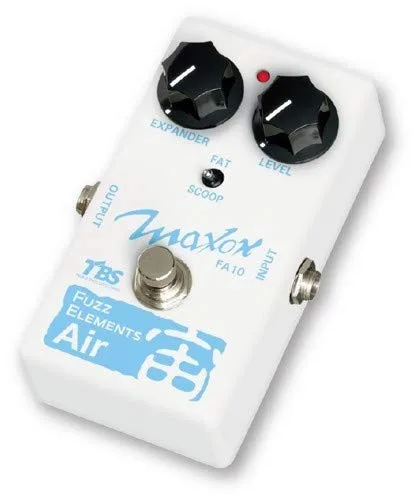
The Fuzz Elements series took its circuits from vintage fuzz history. The FA10 Fuzz Elements Air, a fuzz pedal, was built around a fuzz engine designed to emulate the vintage Shin-Ei / Univox Super Fuzz, recreating its square wave clipping and octave harmonics41. The FE10 Fuzz Elements Ether then took the FA10 circuit and added a parametric tone section, letting a player cut or boost specific frequencies to create a variety of new fuzz and Octavia tones42.
Within that series, the FA10 Air was the straight Super Fuzz recreation. Godlyke says its fuzz engine was designed to emulate the vintage Shin-Ei / Univox Super Fuzz, recreating its square wave clipping and octave harmonics, and claims the FA10 "sounds identical to the vintage Univox Super Fuzz at a fraction of the cost of an original"5. The Ether took the FA10's Fat channel and added the parametric tone section, creating a more flexible variation on the same circuit12.
The Ether also drew attention from the bass press. Bass Player Magazine's Jonathan Herrera heaped praise on the pedal, and suggested that it would be even cooler if the EQ frequency could be swept via an expression pedal3.
What reviewers said
Writing at Delicious Audio, Paolo De Gregorio noted that Bass Player Magazine's Jonathan Herrera heaped praise on the Ether, and that Herrera suggested the pedal would be even cooler if the EQ frequency could be swept with an expression pedal3.
"One writer who heaped praise on the Ether was Bass Player Magazine's Jonathan Herrera. Jon suggested that the pedal would be even cooler if the EQ frequency could be swept via an expression pedal."3
That wish points at the one limit of the design: the Frequency control is a knob, not a sweepable input, so the EQ stays where you set it during a performance3.
Videos
Dennis Kayzer
Godlyke Inc.
Godlyke Inc.
Questions
Is the Maxon Fuzz Elements Ether true bypass?
Yes. Maxon specifies mechanical true bypass switching for the FE10 Ether, along with an effect LED indicator. The pedal runs on a 9-volt DC battery or an external adaptor, so it can sit on a board or work standalone.
What frequency range does the Ether's EQ cover?
The parametric EQ sweeps from 100 Hz to 5 kHz. The Frequency control selects the center frequency and the Cut/Boost control cuts or boosts it, letting you carve out or push a specific band of the fuzz signal.
Is the Maxon FE10 still made?
The FE10 Ether shows as sold out on Maxon's product page, and the related FA10 Air is also listed as sold out at Godlyke. The Fuzz Elements series dates to 2013, so the Ether is best treated as a discontinued or unavailable model on the used market.
Can the Maxon Ether get Octavia sounds?
Yes. The FE10 uses square wave clipping with an upper octave harmonic, the signature Super Fuzz behavior, and Maxon's launch material says the parametric EQ can cut or boost specific frequencies to create a variety of new fuzz and Octavia tones.
How much did the Maxon FE10 cost?
At the Fuzz Elements launch in March 2014, the FE10 Ether carried a US street price of $199. Maxon's product page later listed it at £138.00 GBP in the UK. It now shows as sold out.
Sources (5)
- Maxon Fuzz Elements Ether (FE10), Maxon (maxonfx.com)
- Maxon Fuzz Elements, Pedal of the Day, 2014-04-24
- TWA Wahxidizer Envelope Controlled Fuzz, Delicious Audio, 2025-12-02
- Maxon Fuzz Elements models, Guitar Interactive Magazine, 2014-03-28
- AIR (FA10), Godlyke Distributing, Inc.