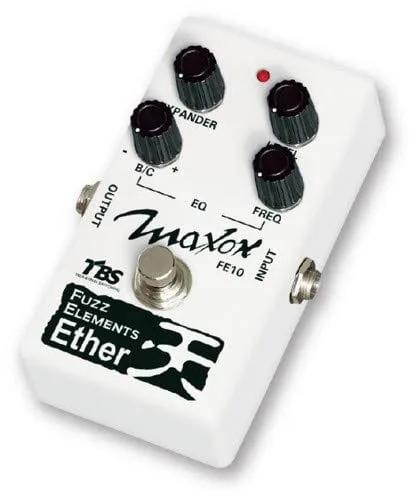

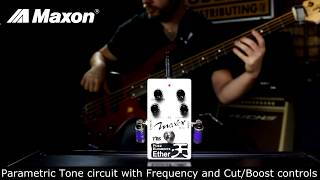
The Maxon FE10 Ether is a fuzz pedal from Maxon's Fuzz Elements series. Its circuit uses square wave clipping with an upper octave harmonic1, and it can produce what Maxon describes as "sizzling, scorching highs that accentuate the upper octave harmonic" or "big, beefy bottom that's perfect for Bass Gu"itar1. It sold for £138.00 GBP1.
What sets the Ether apart from a straight Super Fuzz replica is its parametric equalizer. Maxon describes the design plainly: the FE10 takes the Fat channel of the Fuzz Elements Air and combines it with a parametric EQ, which the maker says creates unlimited variations on the classic Super Fuzz sound2. Guitar Interactive Magazine's launch coverage put it in practical terms: the parametric tone section lets you "Cut or Boost specific frequencies to create a variety of new fuzz/Octavia tones"3.
The FE10 Ether is shown as sold out on both Maxon's and Godlyke's product pages, as of October 2026. The FA10 Air it derives from is also sold out14. Godlyke's listing carries a price of £138.00 GBP1.
A Super Fuzz with a parametric EQ
The Super Fuzz circuit the Ether replicates is known for square wave clipping with an upper octave harmonic riding on top of the fuzz1. On a stock replica, that character is fixed. The Ether's parametric EQ makes it adjustable: instead of a tone switch with two preset voices, you choose a frequency and decide how much to cut or boost it.
Maxon says the range of tones runs from "Sizzling, scorching highs that accentuate the upper octave harmonic to big, beefy bottom that's perfect for Bass Guitar"1. That low end matters for bass players, who often lose fundamental through octave fuzz circuits; here the EQ can push the 100 Hz region back up rather than leaving the pedal voiced only for guitar.
The controls
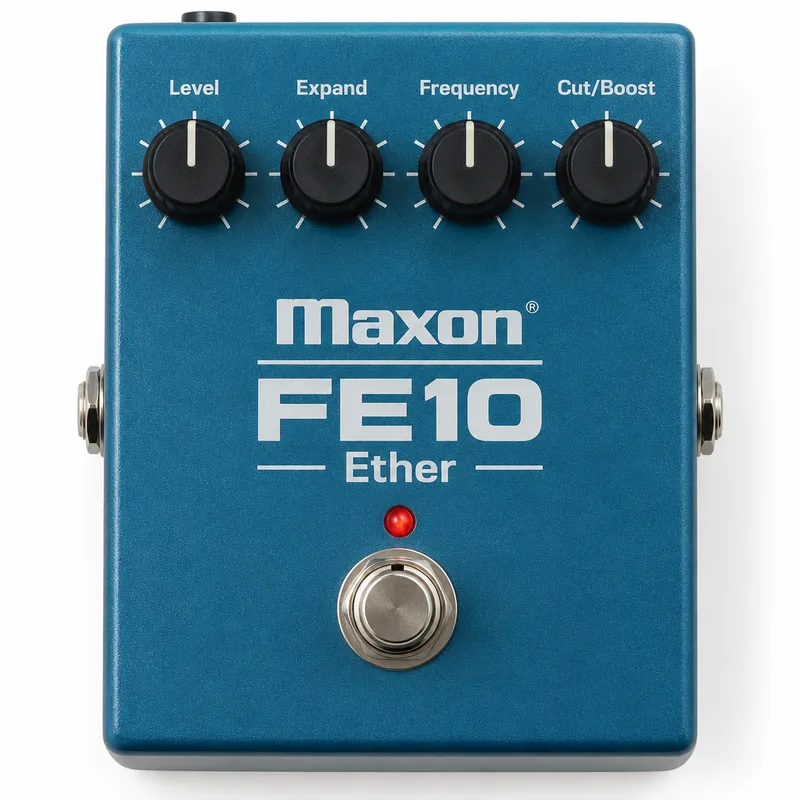
The Ether keeps the core Super Fuzz control set and replaces the Air's two-position tone switch with the parametric section24.
| Control | What it does |
|---|---|
| Level | Sets the output volume2 |
| Expand | Sets the fuzz intensity, the classic Super Fuzz control carried over from the Air24 |
| Frequency | Selects the center frequency of the parametric EQ, anywhere from 100 Hz to 5 kHz21 |
| Cut/Boost | Cuts or boosts the selected frequency2 |
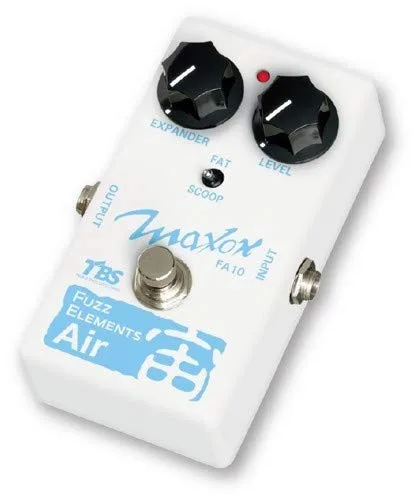
For comparison, the FA10 Air uses a dual-position Tone switch with fixed Fat and Scoop settings, giving two distinct fuzz tones4. The Ether effectively takes the Fat position and makes it a moving target: the same cut-or-boost idea, but at any frequency you choose across a four-octave-plus span.
Where the circuit comes from
The FE10 runs on a 9-Volt DC battery or an external adaptor, with mechanical true bypass switching and an effect LED indicator2. Its fuzz engine is built on square wave clipping with an upper octave harmonic1, the feature that defines its place in the Fuzz Elements line.
Within the Fuzz Elements line, the Ether stands out for its tonal range: Maxon says it can go from "sizzling, scorching highs that accentuate the upper octave harmonic to big, beefy bottom that's perfect for Bass Gu"itar1. That upper octave harmonic comes from its square wave clipping circuit1, and the beefy low end is what makes it usable on bass as well as guitar1.
Power comes from a 9-Volt DC battery or an external adaptor, and the pedal uses mechanical true bypass switching with an effect LED indicator2.
Videos
Godlyke Inc.
Godlyke Inc.
Godlyke Inc.
Questions
Is the Maxon FE10 Ether true bypass?
Yes. Maxon specifies mechanical true bypass switching for the FE10 Ether, along with an effect LED indicator. When the pedal is off, the signal passes through without buffering, which matters to players who keep several pedals on one board.
What is the Maxon FE10 Ether based on?
Its fuzz engine is based on the vintage Shin-Ei / Univox Super Fuzz, using square wave clipping with an upper octave harmonic. Maxon describes it as taking the Fat channel of the Fuzz Elements Air and adding a parametric equalizer.
What frequency range does the Ether's parametric EQ cover?
The parametric EQ sweeps from 100 Hz to 5 kHz. The Frequency control selects the center frequency and the Cut/Boost control cuts or boosts it, so you can shape anything from low end to the upper octave harmonic.
Is the Maxon FE10 Ether still available?
Both Maxon's product page and Godlyke's listing show the FE10 Ether as sold out, as does the related FA10 Air. The Fuzz Elements series was announced in 2014, so finding one now means the secondhand market.
Is the Maxon FE10 Ether good for bass?
Maxon says the Ether can produce big, beefy bottom end that is perfect for bass guitar, by boosting the low end of the parametric EQ's range. The same EQ can instead push scorching highs that accentuate the upper octave harmonic.
Sources (4)
- ETHER (FE10), Godlyke Distributing, Inc.
- Maxon Fuzz Elements Ether (FE10), Maxon (maxonfx.com)
- Maxon Fuzz Elements models, Guitar Interactive Magazine, 2014-03-28
- AIR (FA10), Godlyke Distributing, Inc.