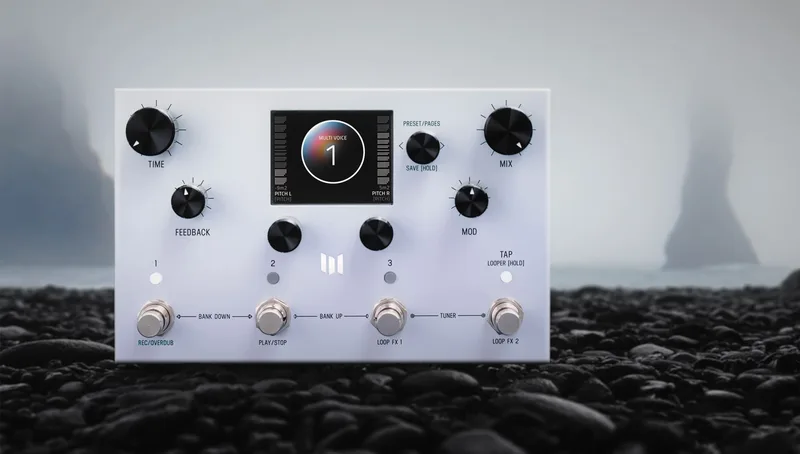


The Meris LVX Modular Delay System is a stereo delay pedal built around two independent delay lines, each offering a maximum of 2540ms of delay time1. Meris calls it a "Highly Configurable Dual Delay"2, and rather than giving the player one fixed delay circuit, it lets the player assemble a delay from a choice of structures and delay types on a color screen. It was announced on May 18, 2022, available to preorder for $599 and shipping in late summer 20223,4.
The signal path is analog, with a JFET input section, while the processing is digital: 24-bit AD/DA conversion and 32-bit floating point DSP2. The pedal is built in the U.S.5, and its enclosure is a white powder coat with a fine iridescent flake6.
What the LVX does
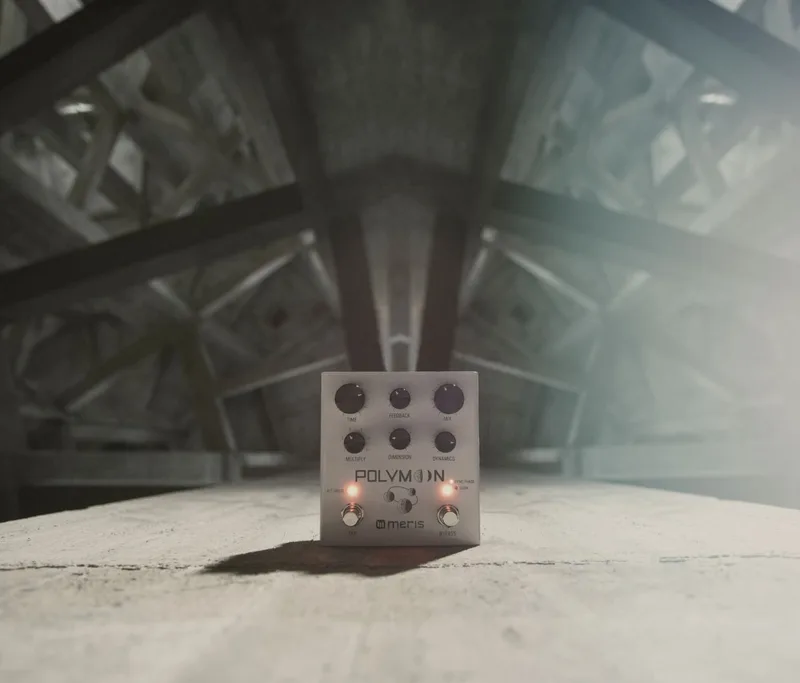
The core idea is modularity. Instead of a single delay voice, the LVX borrows processing elements from across the Meris family, including the Polymoon, Hedra, Enzo and Ottobit Jr.6. The result covers delays, modulation from tremolo to vibrato, rotary and flange, filtering, looping and stereo reverbs5.
Each of the two delay lines can run up to 2540ms1,2, and the pedal handles stereo in and out with separate jacks for each channel6. Input and output headroom is switchable between Instrument and Synthesizer/Line levels, which makes it usable with synths and line-level gear as well as guitars6.
The factory presets lean away from familiar territory. Guitar World's reviewer found they skip the usual dotted-eighth and multi-tap effects in favor of non-conventional sounds: wild rhythmic patterns, unusual sequenced pitch shifting, synth-like pads, shimmering reverb-like resonance with infinite tails, and bass-heavy descents1.
Delay structures and delay types
The LVX separates the architecture of a delay from its character. Delay types are Digital, BBD (analog bucket brigade style delay) and Magnetic, a tape delay emulation with saturation, degradation, wow and flutter1. Structures consist of Standard, MultiTap, Multi Filter, Poly (based on the Meris Polymoon), Reverse and Series1.
| Delay type | Character |
|---|---|
| Digital | Clean digital delay |
| BBD | Analog bucket brigade style delay |
| Magnetic | Tape delay with saturation, degradation, wow and flutter |
| Structure | What it is |
|---|---|
| Standard | Conventional single delay line |
| MultiTap | Multiple taps from one delay line |
| Multi Filter | Filtered delay structure |
| Poly | Based on the Meris Polymoon |
| Reverse | Reverse delay |
| Series | Two delay lines in series |
A structure and a type are chosen independently, so a player can, for example, run a MultiTap structure through the Magnetic tape character. The interface also offers a selectable text view as an alternative to the original graphic view for creating delay sounds9.
The controls and color screen
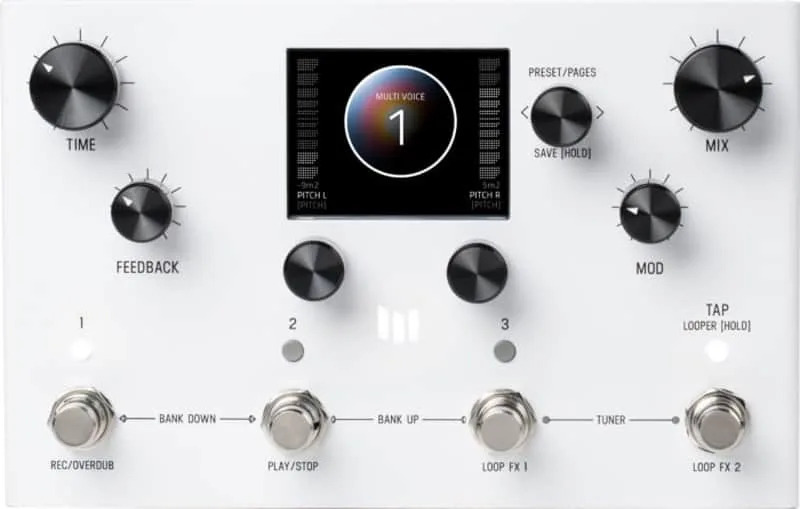
The top panel provides Time, Feedback, Modulation and Mix knobs, plus three Controller knobs with push functions for accessing additional pages and parameters, and four footswitches that handle preset and bank selection, the tuner, tap and looper functions, with pushbutton LEDs1. Gearnews describes the front panel as knobs labeled Time, Feedback, Mix and Mod, with Controller 1 and Controller 2 for moving around the color screen and changing parameters, and a Preset/Pages knob which also saves2.
Editing presets involves pushing the C3 knob to access the edit page, then scrolling through a rotating selection of categories with the C1 knob and adjusting parameters with the C2 knob1. The pedal provides 99 internal preset locations arranged in 33 banks of three presets each, including a favorite preset bank1. There is also an Instant Access Tuner with configurable Reference and Output mode6.
Players who prefer not to build delay sounds through the graphic view can switch to a selectable text view as an alternative interface for creating delay sounds9.
Power and connections
Rear jacks include mono/stereo pairs of ¼-inch inputs and outputs, a ¼-inch expression pedal/switch jack, 5-pin DIN MIDI In and Out jacks, and a USB-C port used for loading firmware updates1. Power comes from a 9V DC 300mA supply, sold separately8, with 9V DC center-negative polarity8.
The LVX has a switchable input/output headroom level, so it can be set for Instrument or Synthesizer / Line levels, which suits it to keyboards and studio gear as well as guitars6.
What reviewers said
Premier Guitar's reviewer found the LVX to be "clearly conceived to work effectively with other instruments and in other applications," appealing to game and film sound designers and synthesists as well as guitarists5. On the interface, the reviewer wrote:
"A smart, thoughtful interface streamlines access to and control of secondary and hidden controls5."
Premier Guitar also found the LVX's approachability and intuitive operation make it appealing for any artist that likes to move fast, while cautioning that players who stay in the vintage lane or maintain a focused sonic vision may find it overkill5. The same review described the look as ultra-clean, evocative of a lab instrument as much as a guitar pedal5.
Among the presets, Premier Guitar highlighted the Rumble preset as a super-dimensional slapback, the Hot Plate reverb as super organic, feeling like fireworks popping off the fretboard, Roto Pan as a swirling, slightly distorted tremolo, and 4 Read Heads as a multiple-head tape-echo simulation5. Pedal of the Day called the LVX "a real revelation" in where effects pedals are headed7.
Videos
JHS Pedals
Sweetwater
Meris
News
Questions
Does the Meris LVX have a looper?
Yes. The LVX includes a true stereo 60-second looper, and its four footswitches are used to create, start and stop loops as well as to scroll through presets. Looping is built into the same pedal as the delay engines, so no separate looper is needed on the board.
Is the Meris LVX true bypass?
The LVX offers a choice of buffered or true bypass, so a player can pick whichever suits the rest of the pedalboard. A buffered path keeps the signal consistent through long cable runs, while true bypass removes the pedal's circuit from the chain entirely when it is off.
What power supply does the Meris LVX need?
It runs on a 9V DC 300mA power supply, sold separately, with center-negative polarity. Units shipped direct from Meris as of November 10, 2022 include a hardware startup delay mod that improves compatibility with third-party power supplies, so most isolated supplies on the market work with current units.
How many presets does the LVX hold?
The LVX provides 99 internal preset locations arranged in 33 banks of three presets each, including a favorite preset bank. Presets are selected and saved with the Preset/Pages knob, and two of the four footswitches can also scroll through them.
Is there an editor for the Meris LVX?
Yes. Meris released the free prEDITOR software in February 2024, which enables computer-based preset editing and drag-and-drop preset library management. The pedal itself can also be edited from its front panel using the color screen and the three Controller knobs.
What was the LVX startup delay mod?
It is a hardware modification that improves compatibility with third-party power supplies. Any LVX shipped direct from Meris as of November 10, 2022 includes the mod, so players using common isolated power supplies do not need to worry about startup problems with current units.
Sources (9)
- Meris LVX Modular Delay System review, Guitar World, 2023-01-05
- Meris LVX: Now with official editor for simpler workflow!, gearnews.com, 2024-02-29
- Meris unveils ultra-high-end stereo modular delay pedal, the LVX, Guitar.com, 2022-05-18
- Meris changes the delay pedal game with the new LVX Modular Delay System, Guitar World, 2022-05-18
- Meris LVX Modular Delay System Review, Premier Guitar, 2022-12-14
- Meris LVX Modular Delay System, Pedal of the Day, 2022-11-11
- Meris MercuryX Modular Reverb System, Pedal of the Day, 2023-10-22
- Best delay pedals 2026: from slapback to space age, GuitarPlayer (www.guitarplayer.com), 2023-07-26
- A new level of delay pedal? The new Meris LVX Modular Delay System means serious business, MusicRadar, 2022-05-19