

The Meris Polymoon is a stereo delay pedal that Meris calls a "Super-Modulated Delay inspired by cascaded rack gear"1. Where a standard delay pedal repeats what you play and adds a little modulation on top, the Polymoon builds an entire chain of studio-style processors into one box: a pair of dynamic flangers in parallel, a multi-tap modulated delay, and a pair of barber-pole phasers, all in sequence2. The idea, as MusicRadar's Trevor Curwen explained, came from the sounds players got in the 1980s by running several rack delay units into each other, an approach associated with Allan Holdsworth and Frank Zappa2.
Guitar.com described the result plainly when the pedal appeared among its best premium pedals of 2018: a digital stompbox designed to sound like plugging into an irresponsibly long chain of studio processors3. Delicious Audio summed up what that means in practice: tidal soundscapes and super-modulated repeat trails, with instruments taking on new shapes through what it called massive algorithmic flow4.
How the Polymoon works
The Polymoon's signal path is unusual for a pedal. According to MusicRadar's review, it starts with a pair of dynamic flangers running in parallel, feeding the multi-tap modulated delay, before the signal hits a pair of barber-pole phasers2. A barber-pole phaser is one that appears to sweep endlessly upward or downward rather than cycling, and having two of them after the delay means the repeats themselves keep moving.
The delay line offers up to 1200ms of real time, selectable multiple-tap delay1. In a multi-tap delay, several points along the delay line are tapped for output at once, so instead of a single series of evenly spaced repeats you get layered, overlapping echoes. The Multiply knob sets how many delay taps are added to the output1, which is the control that most changes the character of the repeats.
Controls
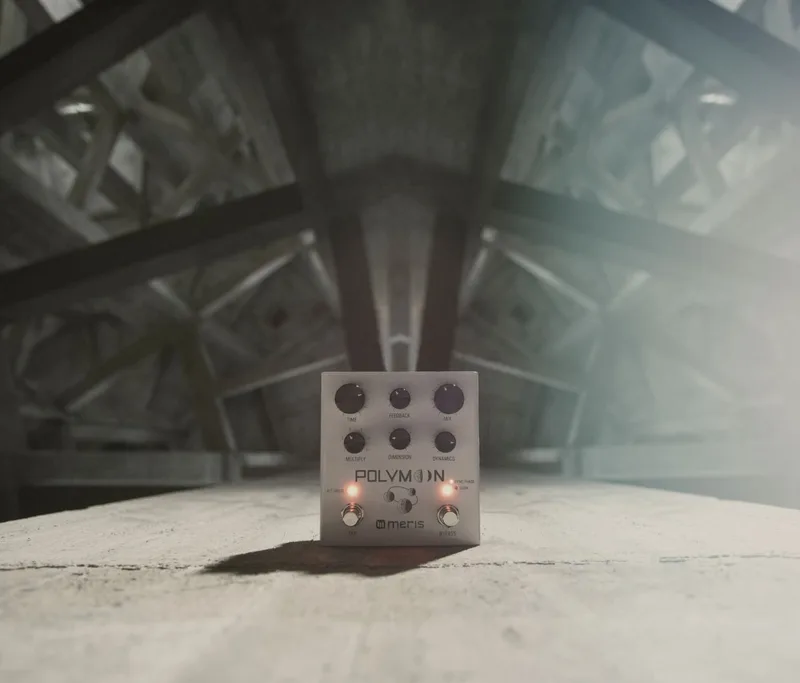
The Polymoon keeps its front panel simple, with a small knob set and two footswitches: tap-tempo and bypass6. Several knobs have alternate functions.
| Control | What it does |
|---|---|
| Time knob | Sets the time for the delay and the synchronized phaser1 |
| Multiply knob | Sets the number of delay taps added to the output1 |
| Feedback knob | Sets the feedback amount1 |
| Feedback knob (alt) | Feedback Filter: controls the filter in the feedback path. Noon is no filtering, toward minimum is darker, toward maximum is brighter1 |
| Mix knob | Adjusts the balance between dry and wet signals1 |
| Mix knob (alt) | Delay Level: sets the gain of the wet signal, from 0dB to -12dB. Set to minimum for auto-scaling1 |
Tap tempo is selectable between quarter note and dotted eighth note subdivisions1, the latter being the rhythm behind the classic dotted-eighth delay sounds many players build parts around.
Presets, MIDI and the EXP jack
The Polymoon has no preset buttons on the pedal itself, but presets are available through an external 4-Preset switch or over MIDI1. Both connect through a single multi-function EXP jack, which can host a MIDI connection, a preset switch, an expression pedal or a tap switch, with compatible hardware1.
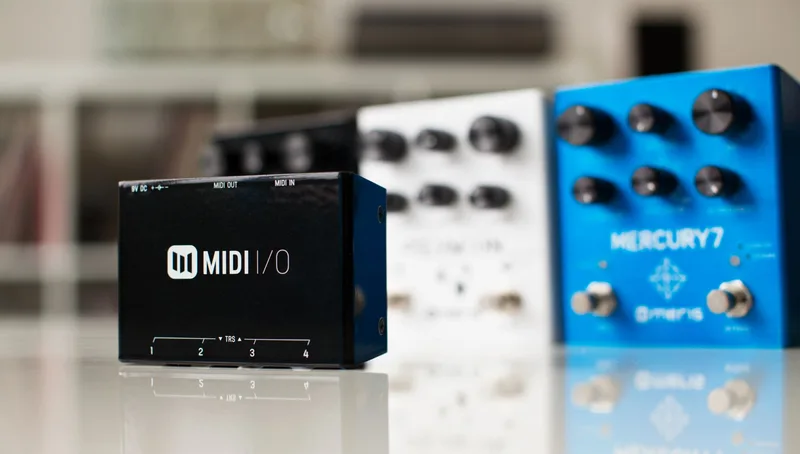
MIDI runs in and out over TRS through that EXP jack, using a compatible MIDI-to-TRS conversion box, which is not included with the pedal1. Players who want to recall sounds mid-set, or control the Polymoon from a larger MIDI pedal setup, will need that extra hardware.
The Polymoon runs on 9V mains power only, with the supply included6, and draws under 150 mA1. There is no battery option.
Where it came from
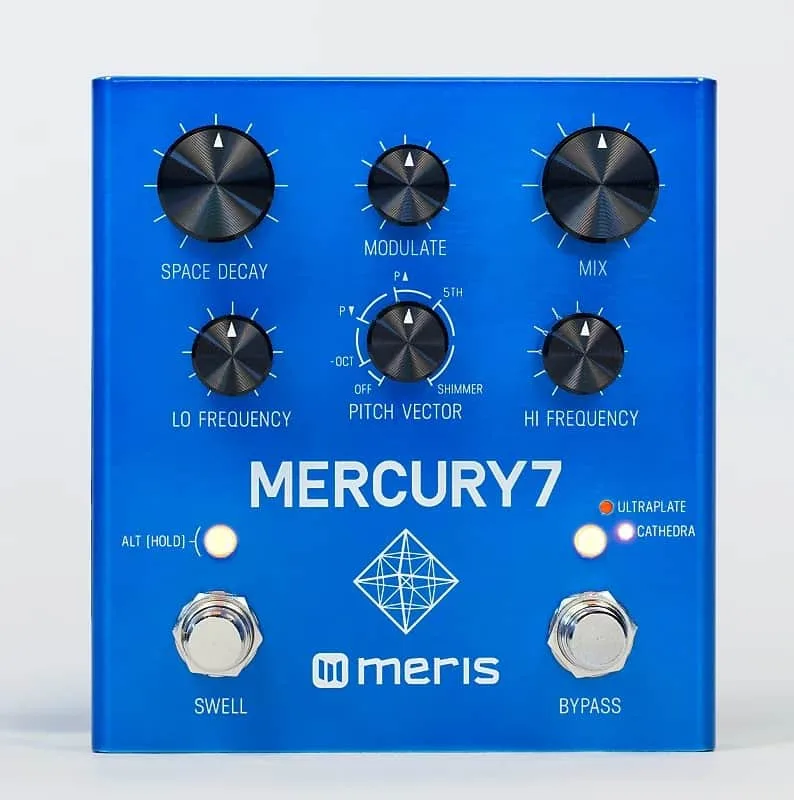
Meris built its reputation on 500 series rack modules before moving into pedals, and the Polymoon is the odd one out in that line. As MusicRadar noted, the company's other pedals, such as the Ottobit Jr and Mercury7, grew out of existing 500 series designs, while the Polymoon seems to have started life purely as a pedal, with no equivalent module2. Its inspiration, though, is entirely rack-based: the cascaded 1980s rack delays used by players like Allan Holdsworth and Frank Zappa2. Pedal of the Day's guest reviewer Dominick F. described it as an incredible delay pedal based on old rack unit modules5.
The pedal earned an AudioFanzine Best Product 2018 award, which Meris lists on its product page1, and it was featured in the That Pedal Show episode "Choosing A Digital Delay For Guitar, Fun With Boss, Meris, Strymon, Line 6, OTO, Keeley & More" in November 2023, alongside delay pedals from those other makers7.
What reviewers said
MusicRadar's Trevor Curwen was enthusiastic, calling the Polymoon his current favorite altered delay pedal2:
MusicRadar's Trevor Curwen called the Polymoon his current favorite altered delay pedal, describing it as a delightful confection of delay and modulation that never ceases to amaze, with a cornucopia of sounds to explore2.
Guitar.com's 2018 premium pedals feature placed it alongside the company's other releases that year, noting its digital design aimed at the sound of a long chain of studio processors3. Delicious Audio pitched it at players chasing ambient textures, with tidal soundscapes and super-modulated repeat trails leading to new inspiration with every note4.
Polymoon and the LVX
Videos
Meris
The Pedal Zone
AndyDemos
Questions
Does the Meris Polymoon have presets?
Yes, but not from the pedal's own knobs. Presets are available through an external 4-Preset switch or over MIDI, both connected through the pedal's multi-function EXP jack with compatible hardware, which is sold separately.
How do you use MIDI with the Polymoon?
The Polymoon has no dedicated MIDI ports. MIDI runs in and out over TRS through the EXP jack, using a compatible MIDI-to-TRS conversion box, which is not included with the pedal. The same jack can also host an expression pedal, a preset switch or a tap switch.
Is the Meris Polymoon stereo?
Yes. The Polymoon has stereo input and output, with premium analog JFET inputs feeding the digital processing. Stereo operation is a core part of its design, since its parallel flangers and dual barber-pole phasers create movement across the two channels.
What is the maximum delay time on the Polymoon?
Up to 1200ms, available with or without tap tempo. The Time knob sets the delay time and also synchronizes the phaser, and tap tempo can be set to quarter or dotted eighth note subdivisions.
Is the Polymoon discontinued?
The company has not announced a discontinuation, but new units are not currently available direct from the maker.
Sources (7)
- Polymoon, Meris, 2018
- Meris Polymoon review, MusicRadar, 2018-03-26
- Gear of the Year 2018: Best premium pedals, Guitar.com, 2018-12-12
- Meris Polymoon Modulated Delay, Delicious Audio, 2021-08-02
- Guest Review Series 4/28/18: Meris Polymoon Delay, Pedal of the Day, 2018-04-28
- Meris Polymoon Delay Review, Guitar.com, 2018-04-16
- Choosing A Digital Delay For Guitar, That Pedal Show, 2023-11-03