

The MI Audio Lo-Fi Delay is a compact delay pedal from MI Audio, a maker based in Sydney, Australia. It is built around the PT2399 chip, a digital delay device that emulates an analog or tape delay sound, with custom circuitry around it for modulation and filtering. MI Audio calls it "Warm, warbly, messy goodness. A creative tool for the adventurous."1
The pedal delivers up to approximately 600ms of delay time, with a REPEATS control that runs from short slapback all the way into self-oscillation, and a modulation section that MI Audio says can do classic modulated delay sounds "but be pushed to do so much more."2 The design has a long history at the company: MI Audio showed a prototype Lo-Fi Delay as far back as March 2012, describing careful design work around the PT chip "to give modulation like no other pedal."3
What it does: a modulated PT2399 delay
The PT2399 is a digital delay chip that has become a staple of the lo-fi delay category. GuitarPCB's documentation describes it as providing "smooth delay effects with a maximum delay time of approximately 600 milliseconds," with subtle artifacts at maximum that vary with each chip's tolerance4, which is exactly the character lo-fi builders lean into. Delicious Audio's guide to lo-fi pedals groups the MI Audio Lo-Fi Delay among lo-fi delays valued for their digital artifacts rather than clean, pristine repeats5.
MI Audio's own description of the pedal is an "analog/digital hybrid design" built around the PT2399 chip1. What separates it from a basic PT2399 build is the modulation and filtering wrapped around the chip. MI Audio says the pedal offers "modulation like no other pedal, with control over the filtering of the delay signal," and that the filtering control "really gives a new perspective with a flick of the switch"2.
The modulation is deep enough to go well beyond chorus-style delay. In square wave mode, MI Audio points to "cool octave skipping sounds"2, and the DEPTH control goes from zero at minimum, for an unmodulated delay, to what the maker calls "super warble at maximum"2.
The controls
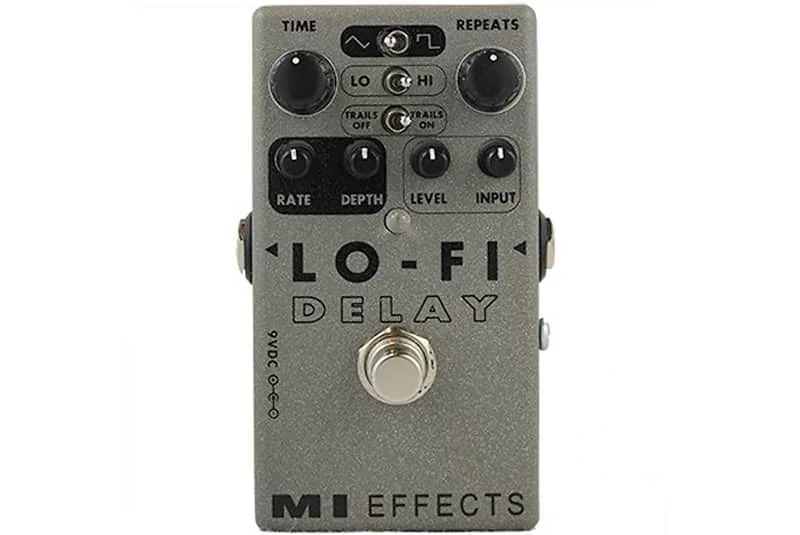
The production pedal carries knobs for input level, delay time, repeats and modulation depth, plus switches for the LFO waveform, filter character and trails behavior2.
| Control | What it does |
|---|---|
| INPUT | Sets the gain of the signal hitting the circuit. Adjust for the best signal-to-noise ratio, or push it to deliberately overdrive the delay line for a dirty echo while the dry signal stays clean12 |
| TIME | Delay time, up to a maximum of approximately 600ms12 |
| REPEATS | Goes from short slapback echoes to self-oscillation2 |
| DEPTH | Modulation depth, from zero (unmodulated delay) to "super warble" at maximum2 |
| SQUARE/TRIANGLE WAVE switch | Selects the LFO waveform modulating the delay signal. Triangle at low rate and depth gives classic chorus sounds; square wave gives choppy, tremolo-like sounds and even pseudo pitch-shifting, including octave skipping2 |
| Hi/Lo switch | Two filter cutoff settings: a "natural" analog sound or a darker, warmer echo tone1 |
| TRAILS ON/OFF switch | Lets repeats continue or cut off when the pedal is switched off. With trails on, you can play an atmospheric sound or oscillation, switch off, and play over the top, which MI Audio says acts almost like a short looper2 |
The INPUT control is worth a note for anyone who has used other PT2399 delays: because it drives the delay line itself, it doubles as a character control, letting you keep echoes clean or push them into overdrive without affecting the dry path12.
Power and connections
The pedal runs on a 9V battery or a 9VDC power supply, through a 2.1mm jack with negative center, and draws 30mA1. Input impedance is 500kΩ1.
For output, there is a stereo output jack that gives access to the delay signal alone via the ring, using a stereo splitter, so the wet signal can be routed elsewhere for further processing1.
The bypass is buffered, not true bypass1. Players who want the repeats to keep ringing after switching off can use the TRAILS switch rather than relying on a bypass mode.
How it compares with other lo-fi delays
The PT2399 lo-fi field is crowded, and the MI Audio stands out mainly for its modulation depth and the wet-only output213.
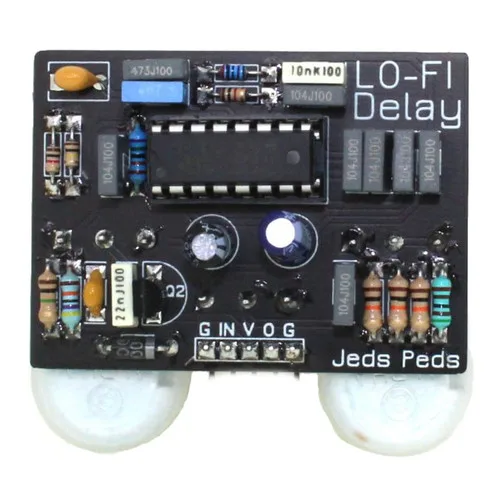
- The Jeds Peds Lo-Fi Delay is another PT2399 build, using the chip's two on-board amps as input and output mixers.
- The Hochstrasser Electronics Sundial, reviewed by Pedal of the Day, is a PT2399-based digital delay whose feedback control routes the delay back into itself for lush echoes, with self-oscillation past about 2:00 on the dial6.
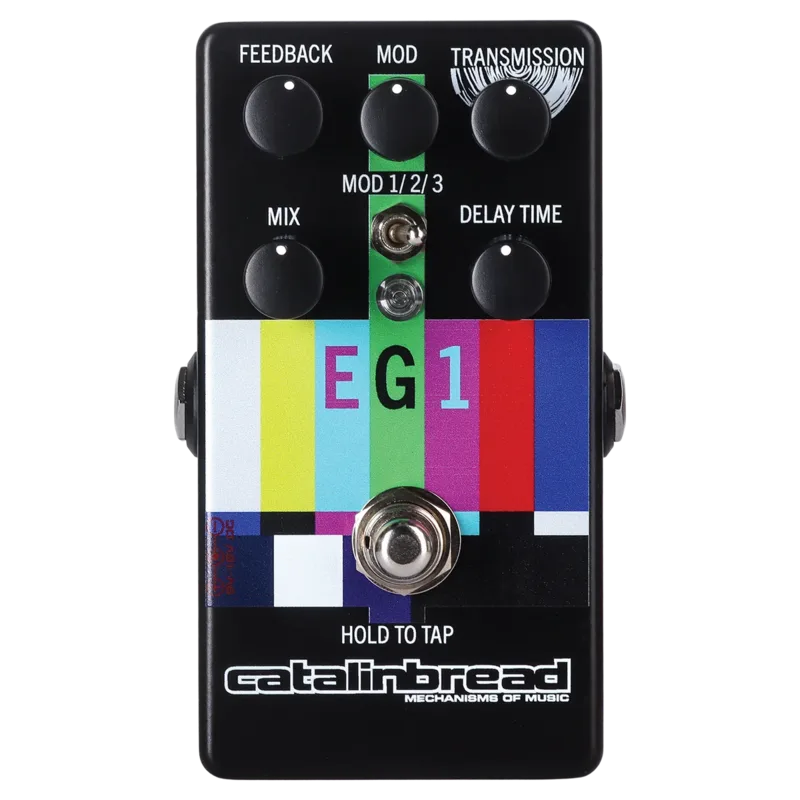
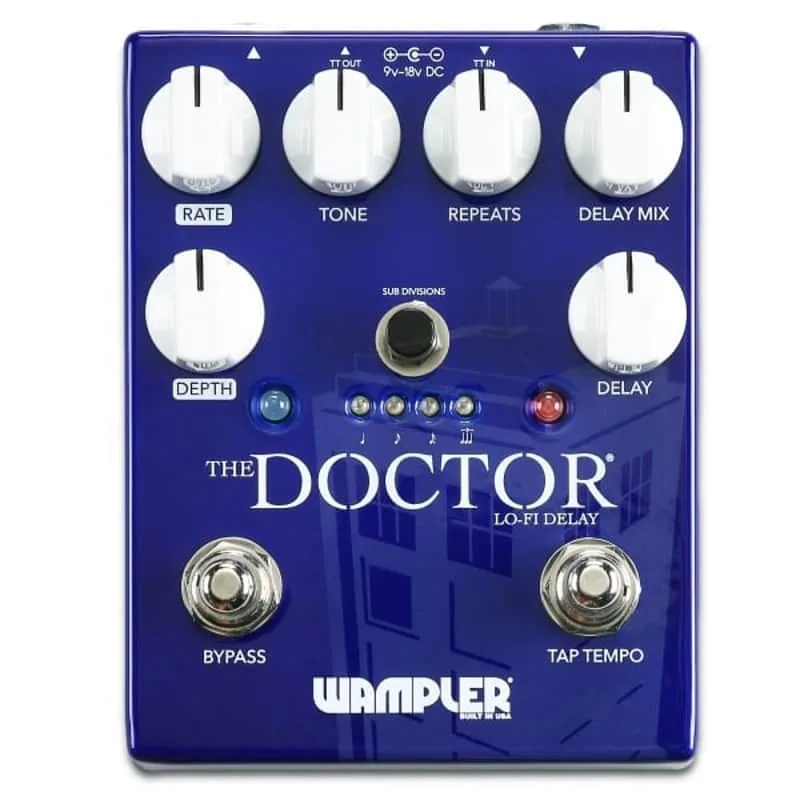
- The Catalinbread EG1 Lo-Fi Delay and Wampler The Doctor Lo-Fi Delay take the lo-fi delay idea in other directions, with the Wampler adding self-oscillating capabilities combined with modulation.
Against these, the MI Audio's distinguishing features are the waveform switch on the modulation, the filter switch for shaping the echo's tone, the INPUT control that can overdrive the delay line, and the ring output for the wet signal alone12.
Where it came from
The Lo-Fi Delay has been in MI Audio's lineup in evolving forms for well over a decade. The March 2012 prototype page describes the same core idea: a PT2399 chip with careful custom circuitry around it for modulation, including the octave skipping sounds in square wave mode that carried through to the production pedal3. The R&D Lab page on MI Audio's site shows a later development version, described as an "as-of-yet unnamed" MI Effects Lo-Fi Delay, with the REPEATS, TIME, INPUT and DEPTH controls, the square/triangle wave switch, the trails switch, and a LO/HI-PASS mode switch that MI Audio said would probably become a three position filter switch in production2. The production pedal as sold carries the two position Hi/Lo filter switch1.
Videos
MI Audio
Brett Kingman
animaguitara
Questions
Is the MI Audio Lo-Fi Delay analog or digital?
It is a hybrid. The delay line is the PT2399 chip, a digital delay device that emulates an analog or tape delay sound, with custom analog circuitry around it for the modulation and filtering. MI Audio describes it as an analog/digital hybrid design.
Is the MI Audio Lo-Fi Delay true bypass?
No. MI Audio lists the bypass as buffered bypass. When the pedal is switched off, a buffer keeps the signal path active rather than a hard true-bypass switch.
What is the maximum delay time on the MI Audio Lo-Fi Delay?
Approximately 600 milliseconds. That figure matches the practical ceiling of the PT2399 chip the pedal is built around, which is rated for smooth delay up to roughly 600ms before artifacts appear.
Can the MI Audio Lo-Fi Delay run on a battery?
Yes. MI Audio specifies power as a 9V battery or a 9VDC power supply, through a 2.1mm jack with negative centre. Current draw is 30mA, so a standard 9V supply is more than enough.
Does the MI Audio Lo-Fi Delay self-oscillate?
Yes. The REPEATS control goes from short slapback echoes all the way to self-oscillation, where the delay feeds back on itself and generates its own tones.
Sources (6)
- Store | MI Audio, MI Audio, 2020-04-11
- LoFi Delay, MI Audio
- NEW PROTOTYPE LO-FI DELAY, MI Audio (miaudio.com), 2012-03-16
- NostalgiTone-Space-Modulator, GuitarPCB, 2024-09
- The Best LoFi Guitar Pedals In 2024: Analog & Digital Artifact Simulators, Delicious Audio, 2024-07-22
- Hochstrasser Electronics Sundial Lo-Fi Digital Delay, Pedal of the Day, 2020-12-21