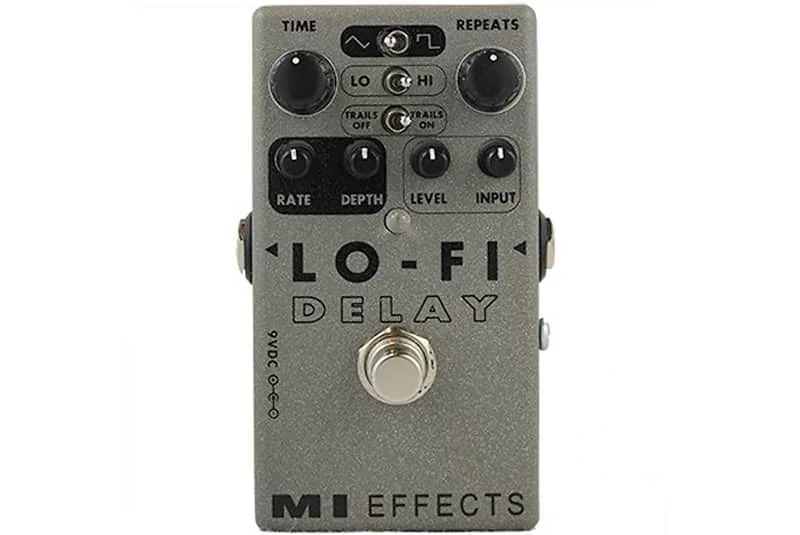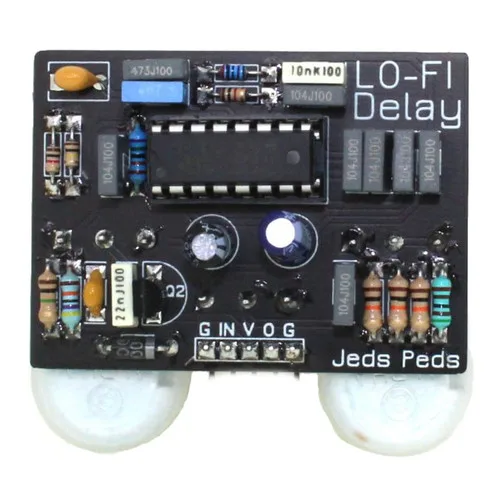

The Jeds Peds Lo-Fi Delay is a DIY delay pedal kit, one of Jeds Peds' most popular kits since they began selling it in 20141. It is not a finished pedal in its base form: you buy it as a kit at whatever level suits your bench, from a bare PCB up to a pre-built unit, and you build the rest yourself. The circuit is built around the PT2399 delay chip, and Jeds Peds says the result is some really "haunting" and musical repeats at long delay times1.
What the Lo-Fi Delay does
As a delay, the pedal produces repeats of what you play, and the "lo-fi" character comes from how the PT2399 chip behaves when it is pushed. Jeds Peds describes the repeats at long delay times as really "haunting" and musical1:
"This leads to some really "haunting" and musical repeats at long delay times."
The kit itself is designed to make the build practical. The PCB has spots for right angled mounted pots, so the controls sit directly on the board rather than flying off on wires, and Jeds Peds supplies the correct-value pots free when they are in stock, otherwise wired pots are supplied1. Drilling, where the kit level includes it, covers all the holes for a complete pedal1.
The kit is offered at several levels, so you can match what you buy to what you already have in your parts drawer1:
| Kit level | What you get |
|---|---|
| PCB Only | Just the plain PCB |
| PCB & Components | PCB plus the board components |
| PCB & Components and off board parts | Adds the off board parts |
| Full Kit | Everything to build the pedal |
| Full Kit & Drilling | Full kit with the enclosure drilled |
| JP Pro level kit | Jeds Peds' pro level option |
| Pre Built Kit | Built for you, £38.001 |
The pre-built version carries a 12 month repair warranty, but Jeds Peds accepts no returns on pre builds1.
How the PT2399 circuit is used
The PT2399 is the chip at the heart of this pedal and of many other lo-fi delay designs. It is a digital delay chip that emulates an analog or tape delay sound, and MI Audio, whose own MI Audio Lo-Fi Delay is built on the same chip, notes that a lot of manufacturers have used it for exactly that reason2. Aion FX describes it as technically digital but warmer and analog-voiced, with characteristics similar to a tape delay unit, and notes that its overall complexity is much lower and its parts cost far cheaper than a BBD-based delay3.
Jeds Peds' take on the chip is not a stock circuit. The design uses the two on-board amps of the PT2399 as input and output mixers, and the feedback and filtering are combined in a way Jeds Peds calls unique, which produces a slightly different set of controls than the typical PT2399 delay1.
A few things about the chip are worth knowing as a player:
- It is designed to produce echoes in the range of 40ms to 340ms4.
- EarthQuaker Devices notes that when used for delay it offers a shorter total delay time than the FV-1, and tends to start getting dirty when pushed beyond around 450 ms5. That dirt is a large part of what players call the lo-fi character.
- It works with analog circuitry around it, which is where makers like Jeds Peds put their own design choices5.
- According to Josh Scott of JHS Pedals, quoted by Guitar World, the chip was originally intended to add slapback delays to karaoke machines6.
That last point explains a lot about the chip's personality: it was never designed as a premium studio delay, and when a circuit pushes it past its comfortable range, the repeats degrade in a way many players find musical rather than merely broken546.
Is it a good first build?
Jeds Peds calls it a straightforward build with no specialist skill required, but also describes it as an ambitious beginner project, mostly suited to those who have built a couple of pedals before1. In practice that means it is a reasonable second or third build rather than a first one: the PT2399 circuit is simpler than a BBD-based delay3, but a delay has more going on than a basic boost or fuzz, with the feedback and filtering combined in the board's design1.
If you are new to building, the kit levels let you start small: a PCB and components, with the enclosure, drilling and off board parts handled at whatever level you choose1. You will need three knobs, and Jeds Peds suggests medium sized ones1.
Videos
Jeds Peds
Questions
Is the Jeds Peds Lo-Fi Delay a kit or a finished pedal?
It is a DIY guitar effects pedal kit, sold by Jeds Peds since 2014. It comes in several levels, from a PCB only up to a full kit with drilling, and there is also a pre-built version. The pre-built kit is priced at £38.00 and carries a 12 month repair warranty, with no returns accepted on pre builds.
What chip does the Jeds Peds Lo-Fi Delay use?
It is built around the PT2399, a digital delay chip that emulates an analog or tape delay sound. Jeds Peds' circuit uses the chip's two on-board amps as input and output mixers, and combines the feedback and filtering in a way that gives a slightly different set of controls than a typical PT2399 delay.
Is the Jeds Peds Lo-Fi Delay good for a first build?
Jeds Peds calls it a straightforward build with no specialist skill required, but describes it as an ambitious beginner project, mostly suited to builders who have already built a couple of pedals. If you have some soldering experience behind you, it is within reach.
How many knobs does the Jeds Peds Lo-Fi Delay need?
It needs three knobs, and Jeds Peds suggests medium sized ones. The PCB design has spots for right angled mounted pots, and correct-value pots are supplied free when in stock, otherwise wired pots are supplied.
Does the Jeds Peds Lo-Fi Delay kit include an enclosure?
The kit is supplied with a JP1590BI enclosure, and the drilling option includes all the holes for a complete pedal. You will still need to supply your own knobs, three of them, unless your kit level includes off board parts.
Sources (6)
- Lo-Fi Delay, Jeds Peds
- LoFi Delay, MI Audio
- Vector Ambient Delay / MP Deep Blue Delay, Aion FX, 2019-03-03
- Elettrorama MFOS Echo Rockit effect synthesizer ready to roll, gearnews.com, 2018-06-14
- Reverbology, EarthQuaker Devices, 2021-11-09
- “I've never heard it sound this good, ever”: Meet the ultra-precise, digital-meets-analog Delay pedal that has Josh Scott raving, Guitar World, 2023-10-12