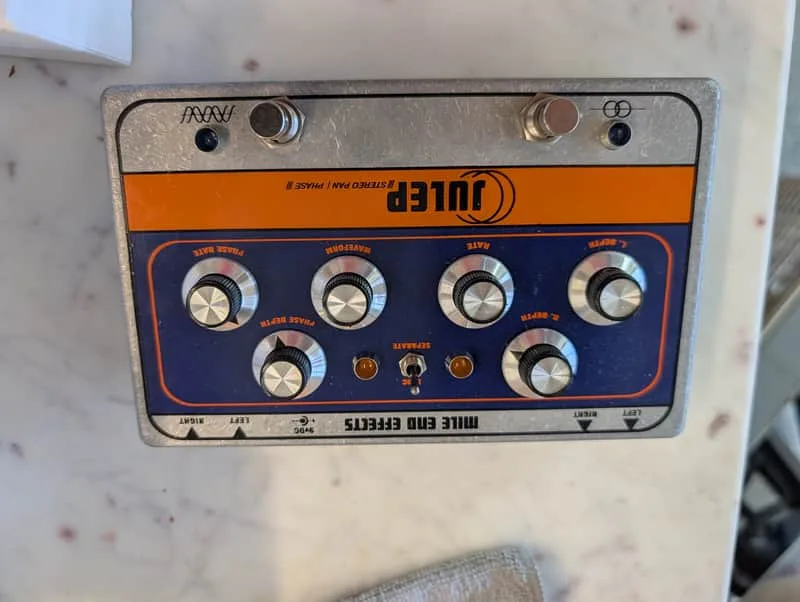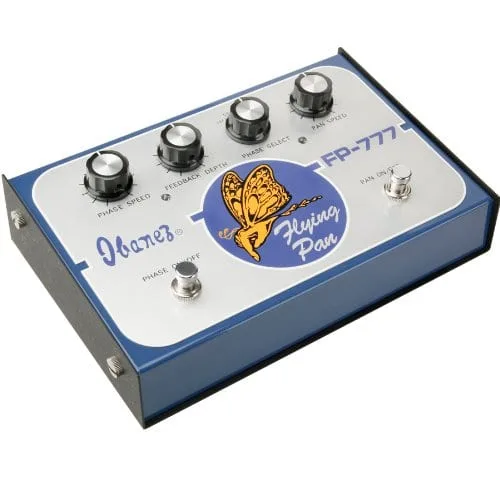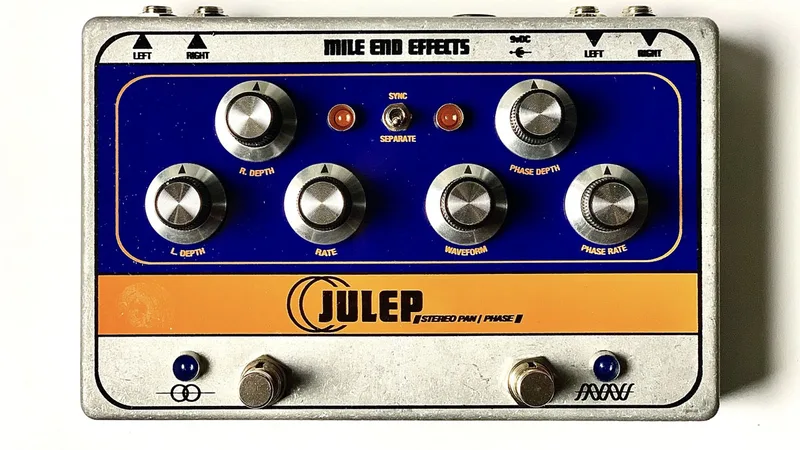


The Mile End Effects Julep is an optical stereo panning/tremolo and phasing effect pedal that packs two modulation effects into one box. By concept it is a semblance of the infamous Ibanez FP-777 Flying Pan, the 1970s stereo panner/phaser, but functionally and electronically it is an expansion of that circuit rather than a recreation of it1. The two effects run in parallel, each with its own footswitch and controls, so you can use the panner and the phaser together or independently1.
The Julep is the latest creation of Justin Cober, the one-man stompbox maker behind Mile End Effects, whose pedals have been reported to sell out within days of release1. It is handmade in Canada2 and takes its name from a Montreal landmark, the Gibeau Orange Julep, "more recognizably 'The big orange on Decarie Blvd.'"3
A stereo panner and phaser in one pedal
The Julep combines a stereo tremolo/panner and a phaser in a single enclosure, and the two sides are independent. Delicious Audio describes the range as running "from syrupy, frothy vibe effects to dizzying, choppy stutters," with a subtle, vintage-voiced phaser that at certain depth settings reaches rotary simulation and uni-vibe territory1. Pedal of the Day's reviewer summed up the appeal for modulation-focused players:
"If you're a modulation nut, you're going to absolutely fall in love with the Julep Stereo Pan / Phase pedal"4
The connection to the Ibanez FP-777 Flying Pan is conceptual rather than a straight clone. The Julep keeps the idea of a stereo panner and phaser sharing a box, but expands it functionally and electronically1. Gearnews framed the announcement as a pedal delivering "the famous 70s Flying Pan tone"1.
The controls
Each side of the pedal has its own control set, and the two effects run in parallel with separate footswitches1.
| Control | What it does |
|---|---|
| Rate | Sets the panning/tremolo speed4 |
| Depth (left and right) | Individual knobs control the depth of the left and right sides of the tremolo4 |
| Waveform | Moves from triangle to square, exploring everything in between4 |
| Phase Depth | Controls the depth of the phaser4 |
| Phase Rate | Controls the speed of the phaser4 |
| Sync/Separate switch | Synchronizes the panning/tremolo between the stereo outputs, or separates the outputs by 180 degrees4 |
| PAN ENGAGE footswitch | Turns on the panning/tremolo1 |
One detail worth knowing: the Waveform knob, although it sits on the phaser's side of the pedal, is actually applied to the tremolo, shaping its stereo LFO wave between triangle, square pulses and everything in between1. The phaser is switched on through its own dedicated footswitch1.
Stereo outputs and mono use
The stereo outputs can be sent to two different effects chains for panning possibilities, run to two separate amplifiers, or the pedal can be used in mono14. The Sync/Separate switch determines how the two outputs relate: synchronized panning/tremolo on both sides, or the outputs separated by 180 degrees so they move in opposition4.
In a mono rig, nothing is lost functionally. MusicRadar notes that "when operated in mono, the panning effect is simply a tremolo effect"2. The amplitude movement that pans signal between two outputs becomes a conventional tremolo on a single output, so the pedal works as a tremolo and phaser for players running one amp.
Availability and price
The Julep was announced in December 2021 with pre-orders open at $279 CAD (approximately £169) and shipping expected around 1 March 202225. As of mid-2022 it was still available for pre-order through the maker's website4, though Delicious Audio cautioned that the builder's pedals are hard to find and tend to sell out quickly1.
The Julep requires 100 mA at 9V DC through a standard 2.1mm center negative connector1, so plan on a pedalboard power supply rather than a battery.
Videos
Pedal of the Day
The Erratic Pedal Adventures
Basement Lyle
News
Questions
Is the Mile End Effects Julep true bypass?
Yes, the Julep is true bypass. It runs on a 9V DC power supply with a 2.1mm center negative connector and draws 100 mA, so it needs a proper power supply rather than a battery.
What does the Julep do in mono?
When operated in mono, the panning effect is simply a tremolo effect. The stereo panning that moves signal between two outputs becomes amplitude modulation on a single output, so the pedal works as a tremolo and phaser in a standard mono rig.
Who designed the Mile End Effects Julep?
The Julep is the latest creation of Justin Cober, the one-man stompbox maker behind Mile End Effects, a Montreal builder whose pedals have been reported to sell out within days of release.
Which pedal is the Julep based on?
By concept it is a semblance of the infamous Ibanez FP-777 Flying Pan, the 1970s stereo panner and phaser. Functionally and electronically the Julep is an expansion of that design rather than a straight copy.
Where is the Julep made?
The Julep is handmade in Canada by Mile End Effects, the one-man Montreal operation run by Justin Cober. The pedal is named after a Montreal landmark, the Gibeau Orange Julep, known locally as the big orange on Decarie Boulevard.
Sources (5)
- Mile End Effects Julep Stereo Tremolo/Phaser, Delicious Audio, 2022-06-13
- Mile End Effects unveils the Julep, a stereo panning/tremolo and phaser pedal that remixes the Ibanez FP-777 Flying Pan, MusicRadar, 2021-12-21
- Mile End Effects Launches the JULEP, Premier Guitar, 2021-12-14
- Mile End Effects Julep Stereo Pan / Phase, Pedal of the Day (pedal-of-the-day.com), 2022-06-13
- This new stereo tremolo and phaser pedal delivers the famous 70's Flying Pan tone, gearnews.com, 2021-12-21