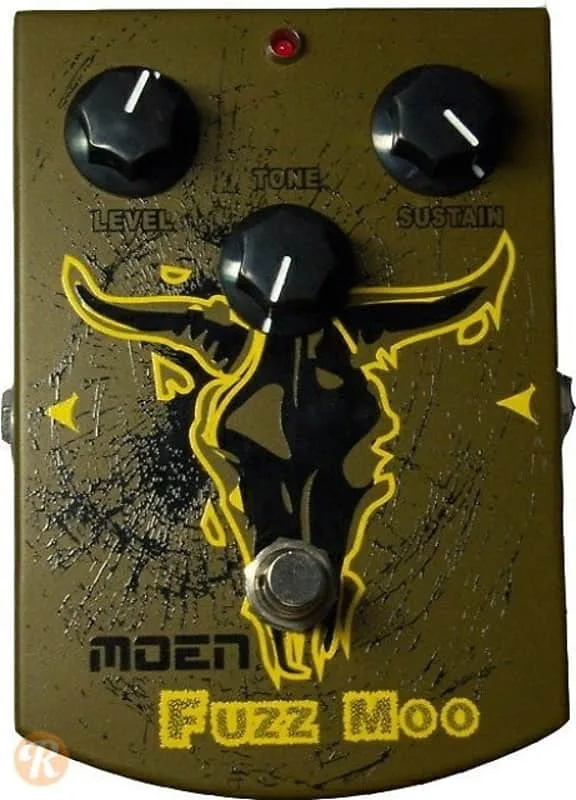


The Moen Fuzz Moo is an analog fuzz pedal made in China by Moen, built on Big Muff-family circuitry. Moen markets it as an "Analog Fuzz Box Analog Sustained Fuzzy Distortion," and states that like any other MOEN effects pedal, the Fuzz Moo is designed with analog circuitry to ensure full processing and reproduction1. What sets it apart from the many Big Muff-style pedals is its tone stack: a 100K resistor there means it is not as scooped as some Muffs, sitting quite flat with a slightly boosted low end1.
Where it sits in the fuzz family
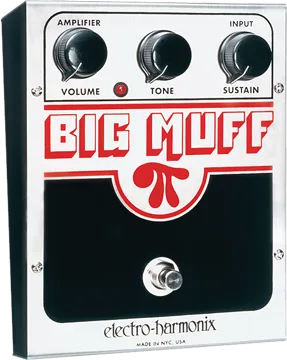
The Electro-Harmonix Big Muff Pi is the circuit the Fuzz Moo descends from. It is recognizable for its thick and rich sound with scooped mids, and for better sustain than its contemporaries2. Delicious Audio's buying guide puts Big Muffs in the high gain fuzz camp: "They offer a huge tone but famously lack in mids, which makes them less than ideal for solos"3. That mid scoop is exactly what the Fuzz Moo's tone stack softens, which is the practical difference a player hears between the two.
The Big Muff has been cloned widely over the years, by minor and major manufacturers including Jen, Sola Sound/Colorsound, and Ibanez4. The Fuzz Moo is part of that family, though not a direct copy of a particular version.
Is it a Big Muff clone?
Not exactly. When IvIark of the Guitar FX Layouts blog traced the circuit from his own pedal in November 2014, he concluded: "It isn't. It's just a variation on the commonly swapped components like coupling caps and collector resistors." He believed the pedal to be a clone of the now defunct Righteous Tones Sonic Mayhem1.
What reviewers found
IvIark's verdict on the traced circuit was strongly positive. On the sound: "I have been playing with this one and it's pretty meaty with alot of headroom available. Kinda like an very early 70's Fuzz," flexible in achieving different levels of raunch, with a lot of gain1.
"When A/B'd in a studio against the Muff and some other well-known Fuzz boxes.... the Moo stomped all over them!! Very musical and workable fuzz tones."
He also connected the flat tone stack to how well he got on with the pedal, and called it "a great sounding and cheap Big Muff made in China by Moen," and "definitely a recommended build"1.
Millennium bypass and the circuit
The Fuzz Moo uses millennium bypass for its switching. In the traced layout, a J201 FET near the output socket is part of that bypass arrangement and, according to the analysis, does not affect the pedal's tone1.
For anyone building the circuit from the published stripboard layout, the component suggestions are:
- Transistors: any NPN silicon transistor, with the BC550C, 2N5088 and MPSA18 given as examples1
- Clipping diodes: germanium like the 1N34A, schottky like the BAT43 or BAT85, and even LEDs "may work well in there"1
The traced schematic and stripboard layout were published by Guitar FX Layouts on 8 November 2014, traced from the author's own pedal1.
Videos
intheblues
SWAMP Industries
Budget Pedal Demos
Questions
What is the Moen Fuzz Moo based on?
The Fuzz Moo is a Big Muff-family fuzz, but IvIark of Guitar FX Layouts, who traced the schematic from his own pedal, did not find it to be a straight copy of any single Big Muff version. He described it as a variation on commonly swapped components like coupling caps and collector resistors, and believed it to be a clone of the now defunct Righteous Tones Sonic Mayhem.
Is the Moen Fuzz Moo a Big Muff clone?
It belongs to the Big Muff family of circuits, and Guitar FX Layouts called it a great sounding and cheap Big Muff made in China by Moen. But when the circuit was traced, the author concluded it is not a direct clone of a particular Big Muff version, just a variation on commonly swapped components, and likely a clone of the Righteous Tones Sonic Mayhem.
What is millennium bypass?
Millennium bypass is the switching arrangement used in the Fuzz Moo. In the traced circuit, a J201 FET near the output socket forms part of the millennium bypass, and according to the Guitar FX Layouts analysis it does not affect the pedal's tone. It is an electronic alternative to a conventional mechanical true bypass switch.
What transistors are suggested for building the Fuzz Moo?
For anyone building the circuit from the published layout, the suggestion is any NPN silicon transistor, with the BC550C, 2N5088 and MPSA18 given as examples. For the clipping section, germanium diodes like the 1N34A, schottky diodes like the BAT43 or BAT85, and even LEDs are suggested as alternatives to try.
Is the Moen Fuzz Moo analog?
Yes. The pedal is marketed as an analog fuzz box, described as an Analog Sustained Fuzzy Distortion, and Moen states that like any other MOEN effects pedal the Fuzz Moo is designed with analog circuitry to ensure full processing and reproduction.
Can I use germanium diodes in the Fuzz Moo?
Yes, as an alternative in the clipping section. The Guitar FX Layouts write-up of the traced circuit suggests trying germanium diodes like the 1N34A, schottky diodes like the BAT43 or BAT85, and even LEDs, all of which may work well in that position of the circuit.
Sources (4)
- Guitar FX Layouts: Moen Fuzz Moo, Guitar FX Layouts (tagboardeffects.blogspot.com), 2014-11-08
- The history of the big muff over time, anasounds.com, 2022-06-08
- The 3 Best Fuzz Pedals Per Type, In 2023, Delicious Audio, 2022-09-15
- The Big Muff History, www.kitrae.net, 2017-01