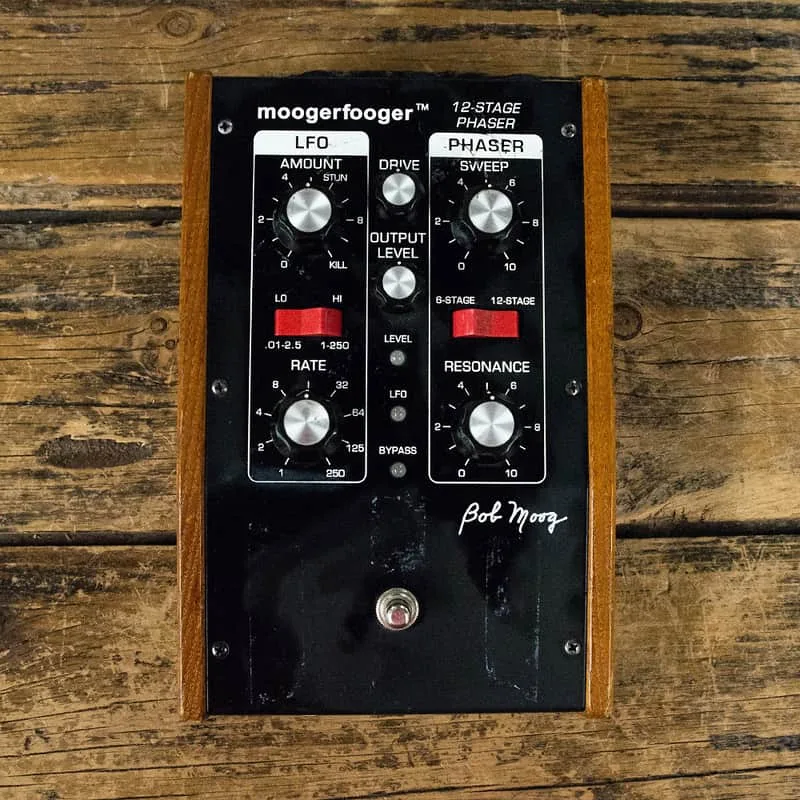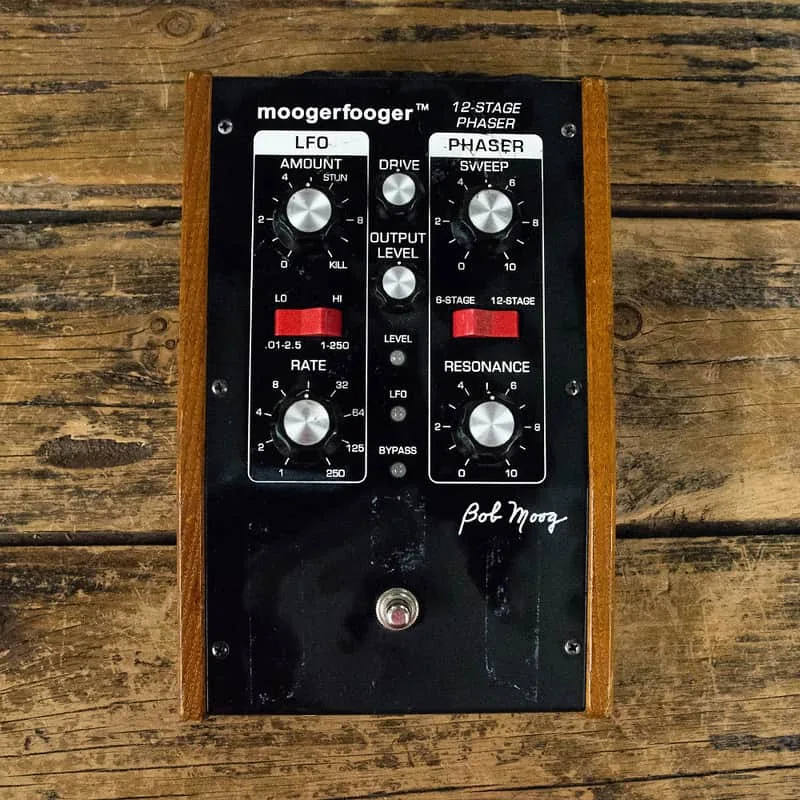


The Moog Moogerfooger MF-103 12-Stage Phaser is an analog phaser pedal designed by Bob Moog himself, produced by Moog from 19991. It combines a 6-stage/12-stage phaser with resonance and a wide-range LFO in one voltage-controlled analog unit, and Moog describes it as a direct descendant of its modular synthesizers, designed to work with any sound source12. Vintage Synth Explorer characterizes the sound as "dynamic sweeping effects that add motion and life to whatever you apply it to"1.
The enclosure follows the Moogerfooger look: a rugged black chassis with Minimoog-style knobs and switches and wooden side panels1.
What the MF-103 does
The MF-103 is built from what RockBoard's PedalPedia, carrying Moog's product description, calls "two complete modular functions: a 12 stage phaser with resonance that allows for perfect tonal" control, plus a wide-range LFO2. A front-panel switch selects between 6-stage and 12-stage phasing, choosing between the internal circuits used to control the phase-shifting31.
The practical difference between the two modes is in the frequency response: the 6-stage mode has three dips, while the 12-stage mode has six dips, for a deeper, more complex sweep1. Pedal of the Day's reviewer, Mike B, found the result lush and analog, with "gorgeous swirls and pulses" and controls he called "a tweaker's dream"4.
The controls
Four main knobs control LFO Rate and Amount and Phaser Sweep and Resonance, with two smaller knobs for input and output levels1. Pedal of the Day's detailed walkthrough of the panel3:
| Control | What it does |
|---|---|
| RATE | Varies the LFO's frequency over a 250:1 range3 |
| SWEEP | Moves the phaser frequency response over a six-octave range3 |
| DRIVE | Adjusts the gain of the audio input to the phaser3 |
| OUTPUT LEVEL | Balances the phaser signal with the bypassed signal3 |
| LO-HI rocker switch | Chooses between the low LFO range (0.01 Hz to 2.5 Hz) and the high LFO range (1.0 Hz to 250 Hz)3 |
| Stage switch | Selects 6- or 12-stage phasing3 |
The input stage is worth noting for guitarists: the input can be overdriven, and the Drive knob "adds some gain into the phaser's output, giving it a bit of bite and edge," in the reviewer's words13. That puts a touch of overdrive character inside the phaser itself.
The panel also carries three LEDs and a footswitch3:
- LEVEL: a three-color LED used to set the DRIVE control3
- LFO: an LED that indicates the LFO rate3
- BYPASS: a two-color LED that shows whether the phaser is active or bypassed3
- ON/BYPASS: a rugged, smooth-acting stomp switch3
Inputs, outputs and CV control
The MF-103 has a mono input but stereo outputs, so you can run it into two amps or a stereo return1. Where most modern pedals offer MIDI, this one goes the modular route: all of its parameters can be controlled by CV/Gate rather than MIDI1. The control destinations are LFO rate, LFO amount, LFO waveform, Phaser resonance and Phaser sweep1.
RockBoard's PedalPedia notes that the MF-103 contains multiple CV and expression pedal inputs and outputs, which allows each parameter to be manipulated and connected with other Moogerfooger analog effects2. Pedal of the Day's reviewer highlighted "the ability to control the vast majority of these parameters with Expression pedals"3; his second review unit arrived complete with an expression pedal3. If you are building a board around foot control, see expression pedals.
History and versions
Moog produced the MF-103 from 1999, designed by Bob Moog1. Guitar World likewise dates the pedal's arrival to 19995. It sits in the Moogerfooger line of voltage-controlled analog effects inspired by original Moog synth modules, as Guitar.com reported when Moog sunset the Moogerfooger range6.
"All three are voltage-controlled analog effects inspired by original Moog synth modules."
Videos
Sweetwater
jfusion10
Pedal of the Day
Questions
Is the Moog MF-103 stereo?
It has a mono input but stereo outputs, so a single source can be spread across two amps or a stereo effects loop. Vintage Synth Explorer lists the unit this way, and the two outputs are part of what makes its sweeping effects feel wide and moving.
Does the MF-103 have MIDI?
No. All of its parameters are controlled by CV/Gate rather than MIDI, which reflects its modular-synthesizer heritage. You connect control voltages or expression pedals to its CV jacks instead of sending it program changes.
What is the difference between 6-stage and 12-stage phasing?
A switch on the pedal selects between the two. The 6-stage mode produces three dips in the frequency response, while the 12-stage mode produces six dips, giving a deeper, more pronounced sweep. Both modes come from the same analog circuit.
Can you use an expression pedal with the Moogerfooger MF-103?
Yes. The MF-103 has multiple CV and expression pedal inputs and outputs, letting you control the vast majority of its parameters by foot or from other gear. Pedal of the Day's reviewer used one with his second review unit.
Can the MF-103 be used on guitar?
Yes. Moog designed it to work with any sound source, and Pedal of the Day reviewed it as a guitar effect pedal, describing lush analog sweeps. Its input stage can even be overdriven for extra bite.
Sources (6)
- Moog MF-103 12-Stage Phaser, Vintage Synth Explorer, 2026
- MF-103 12-Stage Phaser product page, RockBoard PedalPedia
- Moog Moogerfooger MF-103 12-Stage Phaser, Pedal of the Day, 2015-12-15
- Moog Moogerfooger MF-103 12-Stage Phaser, Pedal of the Day, 2015-03-23
- Behringer's new ring modulator will literally fill the gap left by Moog's Moogerfooger, Guitar World, 2023-02-22
- Moog sunsets Moogerfooger effects, Guitar.com, 2018-08-28