

The Moog Moogerfooger MF-108M Cluster Flux is an analog effects pedal that produces flanging, chorus and vibrato, built around high-voltage Panasonic bucket-brigade delay (BBD) chips. Announced by Moog Music in June 2011 as the newest addition to the Moogerfooger line of analog effects, it reached Moog dealers worldwide in Q3 20111. Premier Guitar's reviewer described it as a relatively more conventional multi-effects unit compared with other Moogerfoogers, but one that offers Flange, Chorus and Vibrato effects with the ability to tweak them wildly2.
What it does to your sound
At the core of the circuit are a set of high-voltage Panasonic bucket-brigade devices, the same kind of delay chip that classic chorus and flanger pedals were built on2. MusicRadar's review describes the pedal as mashing up delay-based effects with multi-form LFO modulations to produce complex yet playable chorus, flange and vibrato sounds3. The reviewer heard a rich, jet-like flanger sound recalling Bowie's Station to Station or the Beatles' Blue Jay Way, and a lush chorus free of the tinny digital vibe of inexpensive '80s analog emulators3.
Premier Guitar's reviewer summed it up this way:
"the Moog was as rich-sounding as the classy exterior suggests, kicking out oscillations in deep waves with controllable, bubbly chaos"
Controls and connections
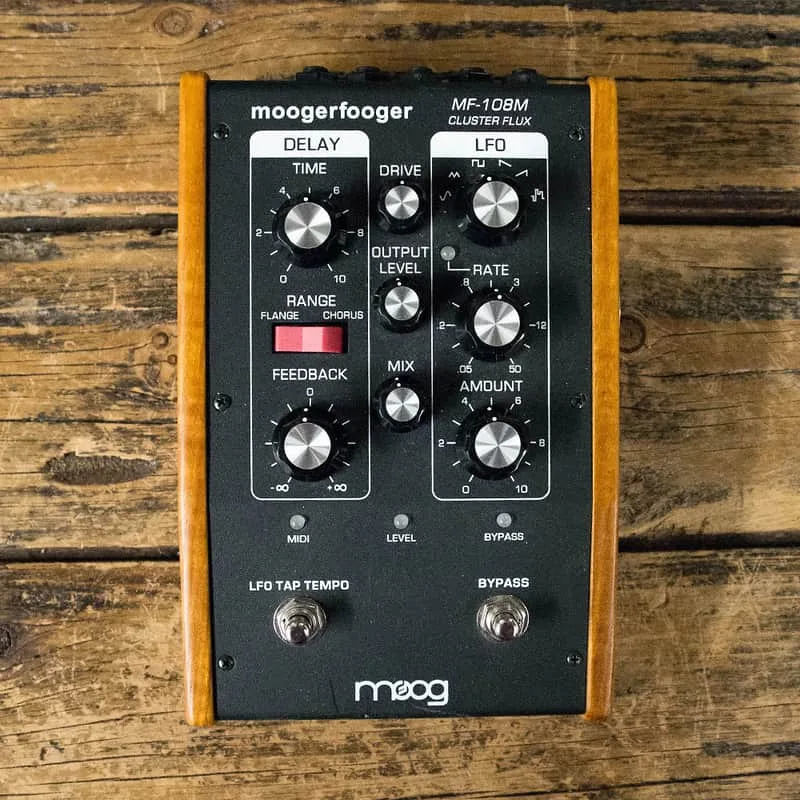
The face of the pedal is laid out in three sections. The left-hand Delay section controls the delay Time and Feedback with its Time knob2. In the center, three mini-pots cover input Drive, Output Level and Mix, and a red rocker switch moves between chorus and flange3. Two more pots adjust the LFO oscillator's Rate and Amount, and beneath them the LFO Tap Tempo and Bypass switches complete the control panel3.
| Control | Function |
|---|---|
| Time | Sets the delay time in the Delay section2 |
| Feedback | Sets feedback in the Delay section2 |
| Drive | Mini-pot covering the input stage3 |
| Output Level | Mini-pot covering output level3 |
| Mix | Mini-pot covering the wet/dry blend3 |
| LFO Rate / Amount | Adjust the oscillator's Rate and Amount3 |
| Chorus/Flange switch | Red rocker switch to move between chorus and flange3 |
| LFO Tap Tempo / Bypass | Footswitches on the face of the pedal3 |
Round the back, the rear panel carries a good number of 1/4-inch jack points: CV inputs for Feedback, Time, LFO Rate, Mix and LFO Amount sit alongside Left and Right outputs, a MIDI jack, and a Feedback Insert that uses a standard 1/4-inch TRS patch cable3. The LFO Rate, LFO Amount, Feedback, Time and Mix parameters can also be controlled separately through expression pedals plugged into the crown of the unit2, which makes the pedal a natural fit alongside other expression pedals on a board.
The MIDI input allows for MIDI-control interfacing, useful for computer sequencing or syncing with a drum machine2. Moog's press release lists what MIDI IN can reach: Delay Time, Range, Feedback, Output Level, LFO Waveform, LFO Rate, LFO Amount and Mix1. Molten Voltage reported in 2013 that the Cluster Flux is among the devices capable of synchronization to MIDI Clock4, so it can lock its modulation to a sequencer or drum machine's tempo.
Build and availability
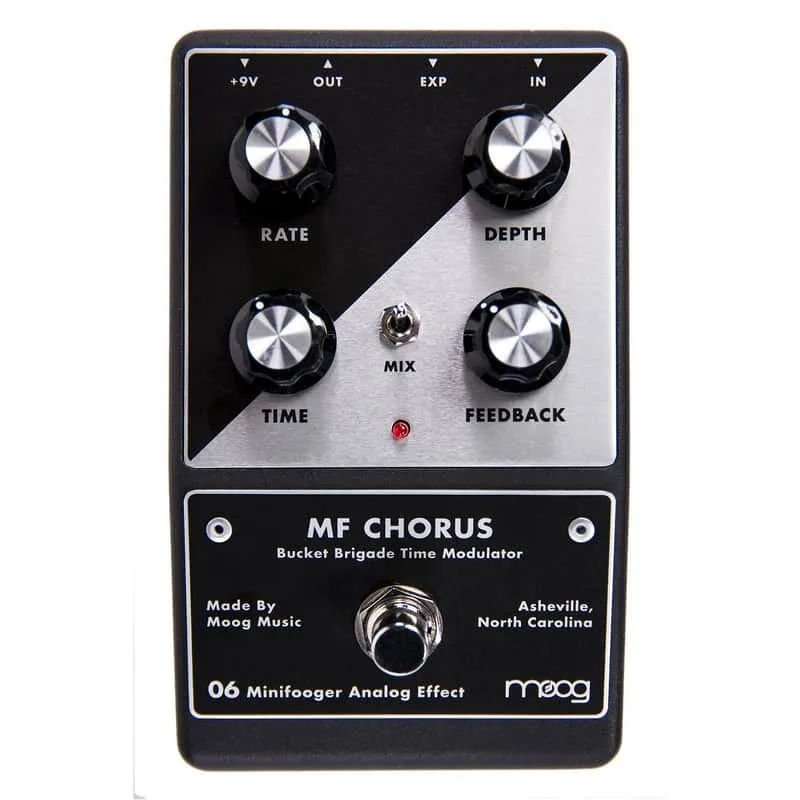
The Moogerfoogers are big and heavy pedals, with hardwood sides made of walnut, and Premier Guitar's reviewer called the Cluster Flux a beautiful piece of US-made, analog craft2. MusicRadar noted that Moog planned on keeping the Cluster Flux in production as long as their supply of BBD chips held out, since the pedal is built from the remaining supply of high-voltage Panasonic BBD chips still out there3. Players looking for a more compact take on the same bucket-brigade sound may also come across the later Moog MF Chorus from the Minifooger range, and Moog's related Moog Cluster Flux and Moog MF-108M Cluster Flux pages cover the same pedal family. For context on the effect types themselves, see Chorus Pedals, Flanger Pedals and Vibrato Pedals.
Videos
Nicholas Greenwood
soundpurestudios
mootbooxle
Questions
Does the Moog Cluster Flux sync to MIDI clock?
Yes. The pedal has a MIDI input, and Molten Voltage reported in 2013 that the Cluster Flux is capable of synchronization to MIDI Clock. Premier Guitar's review notes the MIDI input is useful for computer sequencing or syncing with a drum machine, and Moog's press release states that MIDI IN allows control of Delay Time, Range, Feedback, Output Level, LFO Waveform, LFO Rate, LFO Amount and Mix.
Can you control the Cluster Flux with an expression pedal?
Yes. Premier Guitar's review says the LFO Rate, LFO Amount, Feedback, Time and Mix parameters can each be controlled separately through expression pedals plugged into the crown of the unit. The rear panel also carries CV inputs for the same five parameters, so players with CV gear can drive them that way instead.
Is the Moog Cluster Flux made in the USA?
Yes. Premier Guitar's reviewer called it a beautiful piece of US-made, analog craft. The pedal is part of Moog's Moogerfooger line of analog effects, announced in June 2011 and built around high-voltage Panasonic bucket-brigade delay chips.
What is the Cluster Flux's Drive knob for?
Drive is a mini-pot in the centre section of the panel that covers the input stage, setting how hard the signal pushes into the effect. It sits alongside Output Level and Mix, which together make up the pedal's three centre controls, according to MusicRadar's review.
Does the Cluster Flux have stereo outputs?
Yes. The rear panel carries Left and Right outputs on 1/4-inch jacks, alongside CV inputs for Feedback, Time, LFO Rate, Mix and LFO Amount, a MIDI jack, and a Feedback Insert point that uses a standard 1/4-inch TRS patch cable.
Sources (4)
- Moog Announces MF-108M Cluster Flux, Premier Guitar, 2011-06-26
- Moog Moogerfooger MF-108M Cluster Flux Pedal Review, Premier Guitar, 2011-11-15
- Moog MF-108M Cluster Flux review, MusicRadar, 2011-10-31
- MIDI PedalBoard Devices: MIDI PedalBoards are finally a reality, Molten Voltage (blog.moltenvoltage.com), 2013-05-07