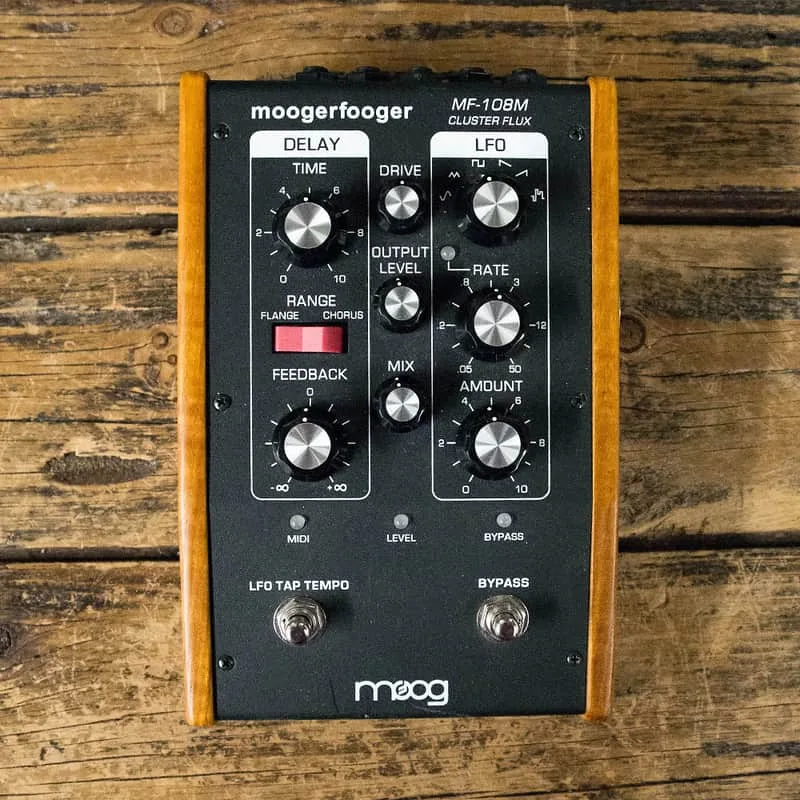


The Moog MF-108M Cluster Flux is an analog chorus, flanger and vibrato pedal from Moog Music, announced in June 2011 as the newest addition to the Moogerfooger line of analog effects1. It combines a delay line with multi-form LFO modulation to produce complex but playable chorus, vibrato and flanging effects, and Moog positioned it as capable of a much wider range of modulated delay effects beyond those three classics12.
The circuit is a modulated BBD (bucket brigade delay) line built from the remaining supply of high-voltage Panasonic BBD chips, with an all-analog audio signal path12. That chip supply is also the pedal's lifespan: Moog said they plan to keep the Cluster Flux in production only as long as their supply of BBD chips holds out3.
What it does to your sound
The Cluster Flux mashes up delay-based effects with multi-form LFO modulations3. At its most conventional it produces classic flanging, chorusing and vibrato; pushed further, the six LFO waveforms and the feedback controls open up modulated delay effects that go well past those categories12.
MusicRadar's reviewers described the results in reference points a player will recognize: a rich, jet-like flanger sound recalling Bowie's "Station to Station" or the Beatles' "Blue Jay Way," and a lush chorus free of the tinny digital vibe of inexpensive 1980s analog emulators3.
"Much of the value of the Cluster Flux lies in the six waveform options."
Premier Guitar's reviewer found those waveform options key to experimentation and unusual applications, and described the unit as offering Flange, Chorus and Vibrato effects "with the ability to tweak them wildly"2.
The controls
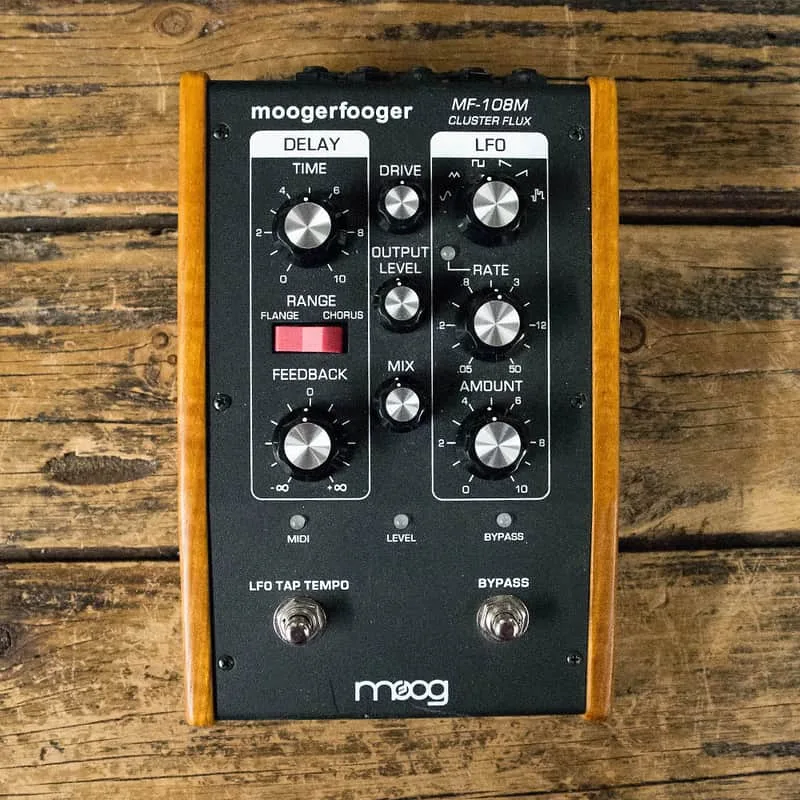
The front panel is organized in columns. The first houses the delay section, with continuous Time and Feedback pots, and two more pots adjust the oscillator's Rate and Amount3. A rotary switch selects the LFO waveform: Sine, Triangle, Square, Sawtooth, Ramp and Random Stepped3. A red rocker switch moves between chorus and flange voicing3.
Three mini-pots in the center section cover input (Drive), output (Output Level) and Mix functions3. Premier Guitar also notes a Flange/Chorus voicing switch alongside the Drive, Output Level and Mix knobs2. At the bottom of the panel, LFO Tap Tempo and Bypass footswitches complete the controls3.
| Control | What it does |
|---|---|
| Time | Sets the delay line time (continuous)3 |
| Feedback | Sets delay line feedback (continuous)3 |
| LFO Rate | Adjusts the oscillator's speed3 |
| LFO Amount | Adjusts the oscillator's depth3 |
| Waveform rotary switch | Selects Sine, Triangle, Square, Sawtooth, Ramp or Random Stepped3 |
| Chorus/Flange rocker switch | Moves between chorus and flange voicing3 |
| Drive mini-pot | Input level3 |
| Output Level mini-pot | Output level3 |
| Mix mini-pot | Dry/effect balance3 |
| LFO Tap Tempo footswitch | Taps in the LFO rate3 |
| Bypass footswitch | Engages and bypasses the effect3 |
Power, CV, MIDI and stereo outputs
The MF-108M relies solely on its standard +9V, 300 mA wall wart to power up and down3. That current draw rules out battery operation and is worth noting if you run a daisy chain: 300 mA is far beyond a typical analog stompbox.
The Cluster Flux runs only on its +9V, 300 mA wall wart3. There is no battery option, and the draw is high enough that a small daisy-chain supply may not cope.
Around the back, 1/4-inch jack points carry CV inputs for Feedback, Time, LFO Rate, Mix and LFO Amount, sitting alongside Left and Right outputs, a MIDI jack, and a Feedback Insert via a standard 1/4-inch TRS patch cable3. The CV inputs let you drive the pedal's parameters from expression pedals, other Moogerfoogers or modular gear, and the Feedback Insert lets you place another effect inside the feedback loop.
The second output is configurable via DIP switches for different types of stereo outputs1. MIDI IN allows control of Delay Time, Range, Feedback, Output Level, LFO Waveform, LFO Rate, LFO Amount and Mix1. Premier Guitar's reviewer found the MIDI input useful for computer sequencing or syncing with a drum machine2, and the pedal is capable of synchronization to MIDI Clock5.
Where it came from and what reviewers said
Moog announced the MF-108M on 16 June 2011, with availability at Moog dealers worldwide in Q3 2011 for a sell price of $599.0014. MusicRadar reported the same launch with an MSRP of $599.00 USD.
MusicRadar's review called the 4 lbs (1.8 kg) build rugged, with a solid organic-meets-industrial housing and sturdy knobs and switches, suitable on the floor or racked up3. Their overall verdict:
"Another superb addition to the MoogerFooger line that should prove highly desirable"
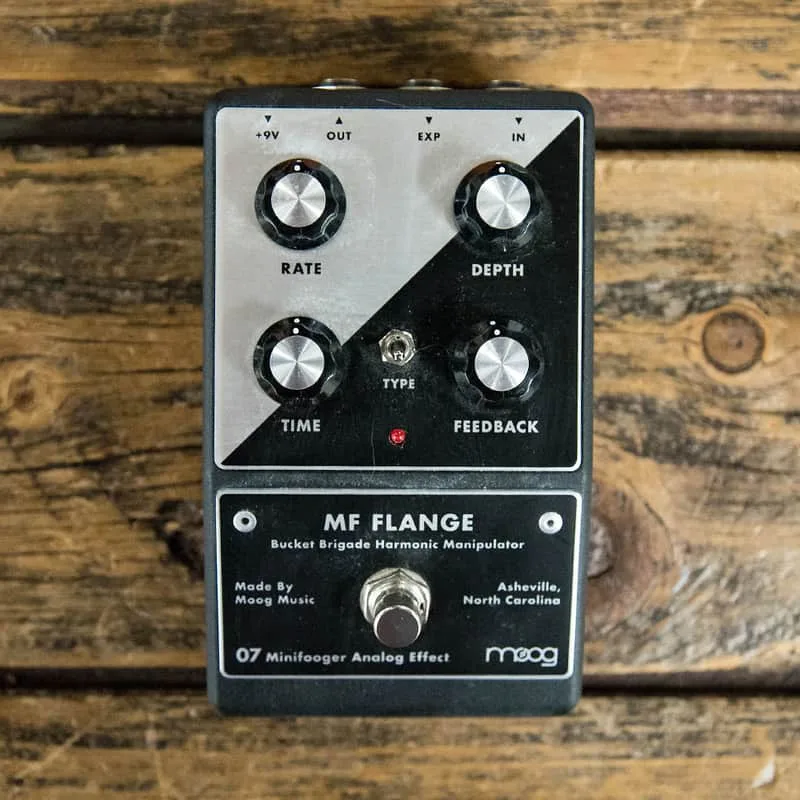
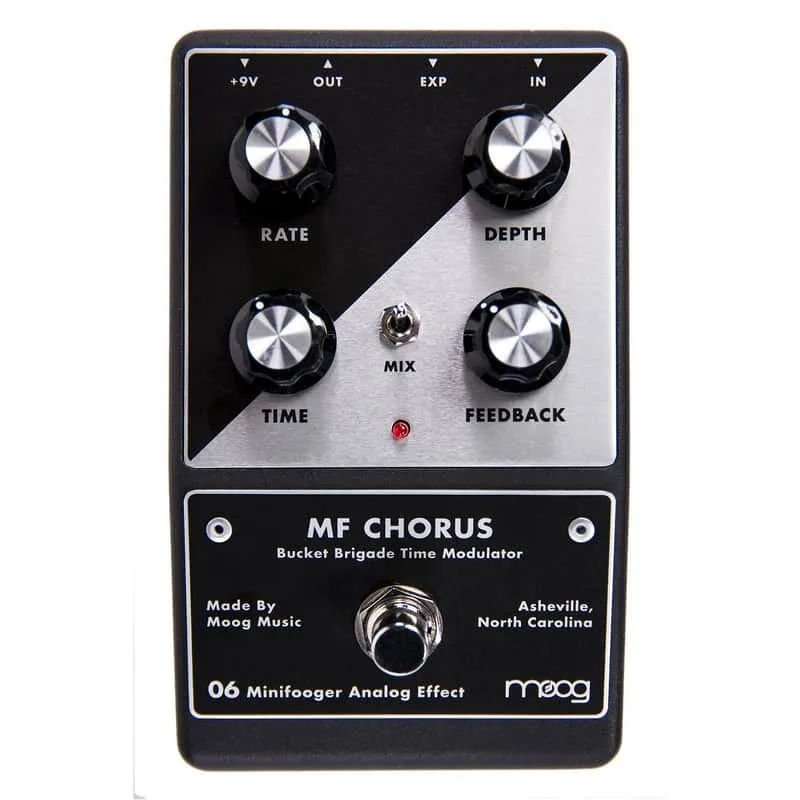
Premier Guitar listed the street price as $550 and described it as a relatively more conventional multi-effects unit within the Moogerfooger range2. Moog later brought BBD-based chorus and flange sounds to a smaller format in the Minifooger line, including the Moog MF Chorus2.
Videos
Nicholas Greenwood
soundpurestudios
mootbooxle
Questions
Is the Moog Cluster Flux analog?
Yes. The MF-108M Cluster Flux is part of Moog's Moogerfooger line of analog effects and uses an all-analog audio signal path. Its circuit is a modulated BBD (bucket brigade delay) line built from remaining supplies of high-voltage Panasonic BBD chips, which is also why Moog could only promise to keep it in production while those chips last.
Can the Cluster Flux sync to MIDI clock?
Yes. The pedal has a MIDI input that allows MIDI-control interfacing, which reviewers found useful for computer sequencing or syncing with a drum machine, and it is capable of synchronization to MIDI Clock. MIDI IN can control Delay Time, Range, Feedback, Output Level, LFO Waveform, LFO Rate, LFO Amount and Mix.
Does the Cluster Flux have stereo outputs?
Yes. The rear panel carries Left and Right 1/4-inch outputs, and the second output is configurable via DIP switches for different types of stereo outputs. There is also a Feedback Insert on a standard 1/4-inch TRS patch cable for inserting other effects into the feedback loop.
How much does the Moog Cluster Flux weigh?
MusicRadar's review describes the MF-108M as a 4 lbs (1.8 kg) build, calling it rugged and suitable for use on the floor or racked up. It is a substantial unit compared with a compact stompbox, with a solid housing and sturdy knobs and switches.
Sources (5)
- Moog Announces MF-108M Cluster Flux, Premier Guitar, 2011-06-26
- Moog Moogerfooger MF-108M Cluster Flux Pedal Review, Premier Guitar, 2011-11-15
- Moog MF-108M Cluster Flux review, MusicRadar, 2011-10-31
- Moog launches MF-108M Cluster Flux, MusicRadar, 2011-06-16
- MIDI PedalBoard Devices: MIDI PedalBoards are finally a reality, Molten Voltage (blog.moltenvoltage.com), 2013-05-07