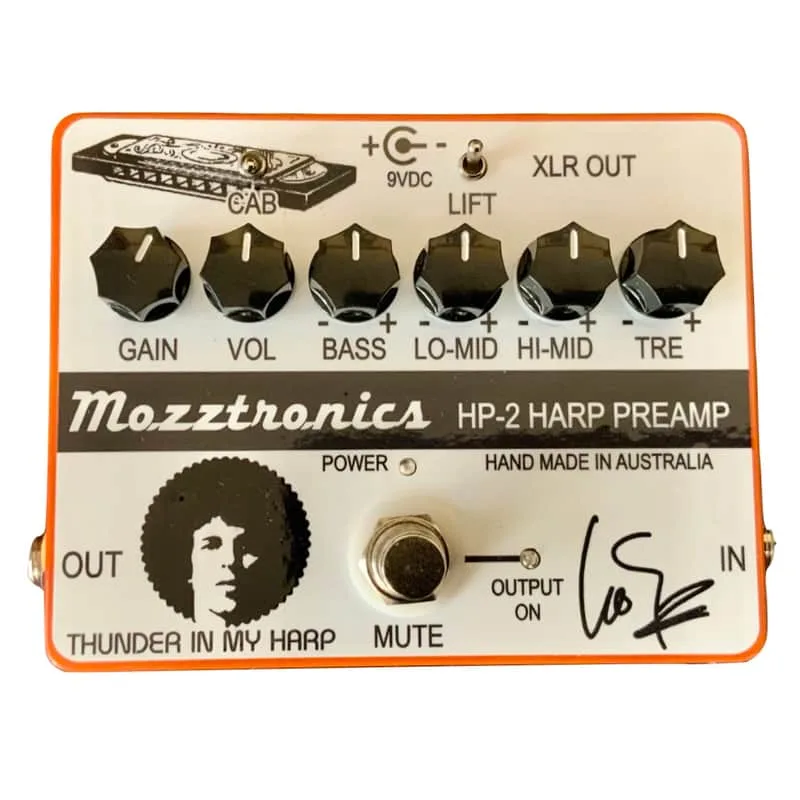


The Mozztronics HP-2 Leo Sayer Signature Harp Preamp is a specialist preamp pedal designed for harmonica and mic use. Mozztronics lists it as a preamp overdrive, meaning it does two jobs at once: it gives a harp or mic signal the gain, tone shaping and speaker-style filtering it usually lacks, and it can push the signal into overdrive on the way. The pedal was created in conjunction with Leo Sayer, the singer and harmonica player whose name it carries1.
At its core, the HP-2 uses three stages of JFET circuitry operating in pure Class A. Mozztronics describes this as a way to emulate the sound and feel of a low-wattage valve amp, including speaker response. For a harmonica player, that matters because the amp and speaker are a large part of the traditional amplified harp sound, and a pedal that models that response can stand in for a valve amp when one is not practical to carry or mic up1.
The controls
The HP-2 keeps its control set focused on what a harp player needs on stage: gain, master volume, a full four-band EQ, and a switch for the speaker simulation1.
| Control | What it does |
|---|---|
| GAIN | Sets the amount of preamp drive1 |
| VOLUME | Sets the overall output level1 |
| Bass, Lo-Mid, Hi-Mid, Treble | A 4-band Baxandall EQ for shaping the tone across the whole range1 |
| CABSIM | Engages or bypasses the speaker simulation1 |
| LIFT | Ground-lift switch for the XLR output1 |
The Baxandall EQ is worth a word for players used to the single tone knob on many harp pedals. Because it splits the range into Bass, Lo-Mid, Hi-Mid and Treble bands, it covers the frequencies that matter most for a mic'd harmonica: the low-end thump, the midrange where the harp sits in a mix, and the top end where a cupped mic gets harsh. The CABSIM switch lets the player decide whether the speaker simulation is part of the sound, which is useful when the pedal feeds a real guitar amp on one output and a PA on the other1.
Inputs, outputs and power
The input is a 1/4-inch socket for mic or harp, so a player plugs the mic directly into the pedal rather than into a PA channel first1. On the output side there are two connections: a 1/4-inch amp-out for feeding a guitar or harp amp, plus a fully balanced XLR designed for PA or mixer use. That XLR output is what makes the HP-2 a practical front-of-house tool as well as an amp preamp, since a balanced line can run to the mixing desk without a separate direct box1.
The LIFT switch belongs to that XLR output and is a ground-lift: it disconnects the ground path on the balanced line, the standard fix for the hum and buzz that ground loops cause when a pedal and a PA are plugged into different points of the power system1.
The HP-2 runs on 9V DC, center negative, the common pedalboard supply format. It has no battery option mentioned by the maker, so plan a power supply output for it alongside the rest of the board1.
Where it sits
As a preamp with an overdrive character and a built-in speaker simulation switch, the HP-2 is aimed squarely at amplified harmonica rather than guitar. Its analog JFET circuitry and Class A design put it in the camp of pedals that chase a valve-amp feel with transistors, and its XLR output and mic-ready input set it apart from general-purpose overdrive or EQ pedals that would need extra hardware to do the same job1.
Videos
Alexey Kormin
Marko Balland
Pete Towers
Questions
Can the Mozztronics HP-2 be used with a vocal mic?
Yes. The maker describes the HP-2 as a preamp pedal designed for harmonica and mic use, and its input is a 1/4-inch socket for mic or harp. Plug a mic straight in, shape the tone with the four-band EQ, and send the signal to an amp or, via the balanced XLR output, to a PA or mixer.
Is the HP-2 Harp Preamp analog or digital?
The HP-2 is an analog pedal. Mozztronics describes it as using three stages of JFET circuitry operating in pure Class A to emulate the sound and feel of a low-wattage valve amp, including speaker response.
Does the HP-2 have an XLR output?
Yes. Alongside a 1/4-inch amp output, the HP-2 carries a fully balanced XLR output designed for PA or mixer use, with a LIFT ground-lift switch for the XLR line.
What does the LIFT switch do on the HP-2?
LIFT is a ground-lift switch for the XLR output. Lifting the ground on a balanced line is a standard way to deal with hum and ground loops when connecting the pedal to a PA or mixer.
What power supply does the HP-2 need?
The HP-2 runs on 9V DC, center negative, the same supply format as most standard pedalboard power supplies.
Who helped design the Mozztronics HP-2?
Mozztronics created the HP-2 Leo Sayer Signature Harp Preamp in conjunction with Leo Sayer, and the pedal carries his name.
Sources (1)
- HP-2 HARP PREAMP by Mozztronics, RockBoard (rockboard.de PedalPedia), 2026